Body-weight supported treadmill or total body recumbent stepper for mobility-adapted cardiopulmonary exercise testing in multiple sclerosis patients with varying disability
Saman Hadjizadeh Anvar, Liam P. Kelly, Caitlin Newell, Lynsey Alcock, Hamidreza Barzegarpoor, Michelle Ploughman

TL;DR
This study compares two exercise devices for testing heart and lung function in people with multiple sclerosis, finding that one device works better for those with mobility issues.
Contribution
The study identifies the total body recumbent stepper as a more effective tool for maximal cardiopulmonary exercise testing in MS patients with mobility disability.
Findings
MS patients achieved similar VO2max values on both devices, but controls performed better on the treadmill.
MS patients more consistently met maximal CPET criteria using the total body recumbent stepper.
The treadmill disadvantaged MS patients, especially those with mobility disability, compared to the stepper.
Abstract
Accurate exercise prescription in persons with multiple sclerosis (MS) depends on cardiopulmonary exercise testing (CPET). Obtaining an accurate VO2max can be challenging when patients experience lower limb impairment and fatigue that can change over time. We sought the optimal adapted device to achieve a maximal CPET among persons with MS. In a randomized crossover trial with within-subject, repeated measures design, clinic-referred persons with MS (n = 10) with three-month stability, no exercise obstruction, ability to walk with or without assistance, and sex- and age-matched (±3 years) Controls (n = 7) were recruited by convenience sampling. Participants performed CPET on body weight-supported treadmill (BWST) and total body recumbent stepper (TBRS). We collected standard aerobic metrics, including V˙O2max, % normative values for V˙O2max (%V˙O2max), heart rate maximum (HRmax),…
Genes, proteins, chemicals, diseases, species, mutations and cell lines named across the full text — each resolved to its canonical identifier and authoritative record.
Click any figure to enlarge with its caption.
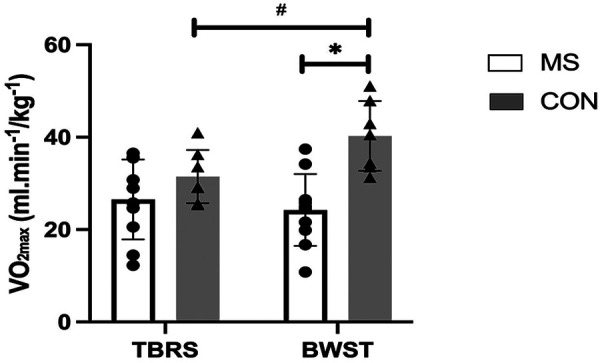 Figure 1
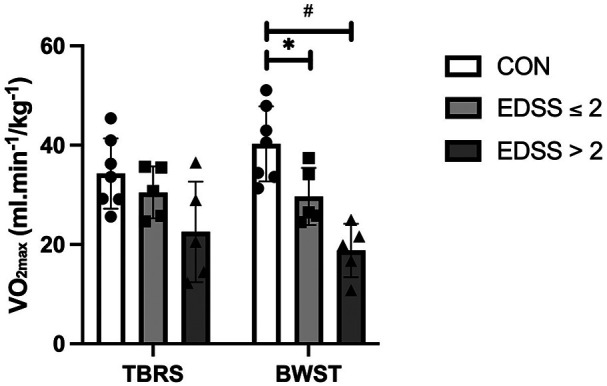 Figure 2
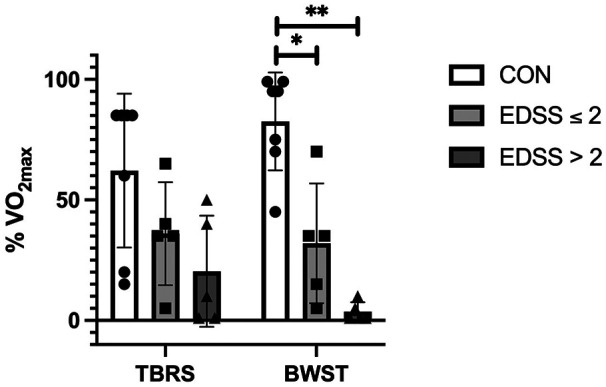 Figure 3
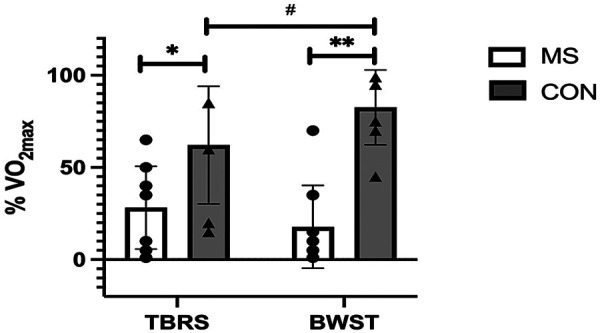 Figure 4
Peer Reviews
No public reviews on file for this paper yet. If you reviewed it on a platform where reviews are public (OpenReview, ICLR, NeurIPS, ICML), you can paste yours below so the community can read it here.
Videos
No videos yet. Explain this paper in a talk, walkthrough, or lecture? Add one.
Taxonomy
TopicsMultiple Sclerosis Research Studies · Balance, Gait, and Falls Prevention · Long-Term Effects of COVID-19