Immersive Technologies for Cognitive Rehabilitation in Dementia and Mild Cognitive Impairment: Systematic Review
Jaromir Konecny, Giuseppe Lanza, Serafino Buono, Raffaele Ferri, Antonina Luca, Radek Martinek, Sabrina Musso, Aurora Palmigiano, Barbora Prauzkova, Angelica Quercia, Francesco Rundo, Ramachandran Avala Subramanian, Alessandro Serretti, Michal Prauzek

TL;DR
Immersive technologies like VR and AR show promise for cognitive rehabilitation in dementia and mild cognitive impairment, but challenges remain in implementation and standardization.
Contribution
This systematic review provides a comprehensive synthesis of immersive technologies' usability, effects, and challenges in cognitive rehabilitation for MCI and dementia.
Findings
VR interventions showed consistent benefits for memory, attention, and executive functioning.
AR supports real-world task guidance and daily functioning, while CAVE systems aid spatial navigation and clinical supervision.
Key barriers include cybersickness, interface complexity, and practical constraints like cost and staffing.
Abstract
Cognitive decline across the mild cognitive impairment (MCI)–dementia continuum is a major driver of loss of independence and growing health- and social-care burden. Immersive technologies, such as virtual reality (VR), augmented reality (AR), and Cave Automatic Virtual Environment (CAVE) systems, are increasingly explored as tools to enhance engagement, personalization, and ecological validity in cognitive rehabilitation. This systematic review synthesizes current evidence on the usability, therapeutic effects, and implementation challenges of immersive technologies for cognitive rehabilitation in MCI and dementia. A systematic search of Scopus and Web of Science was conducted for peer-reviewed journal articles published between 2021 and 2026. Eligible studies investigated VR, AR, or CAVE interventions targeting cognitive rehabilitation outcomes in MCI and/or dementia and reported…
Genes, proteins, chemicals, diseases, species, mutations and cell lines named across the full text — each resolved to its canonical identifier and authoritative record.
Click any figure to enlarge with its caption.
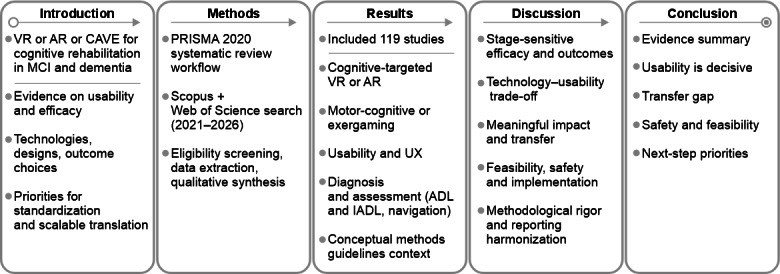 Figure 1
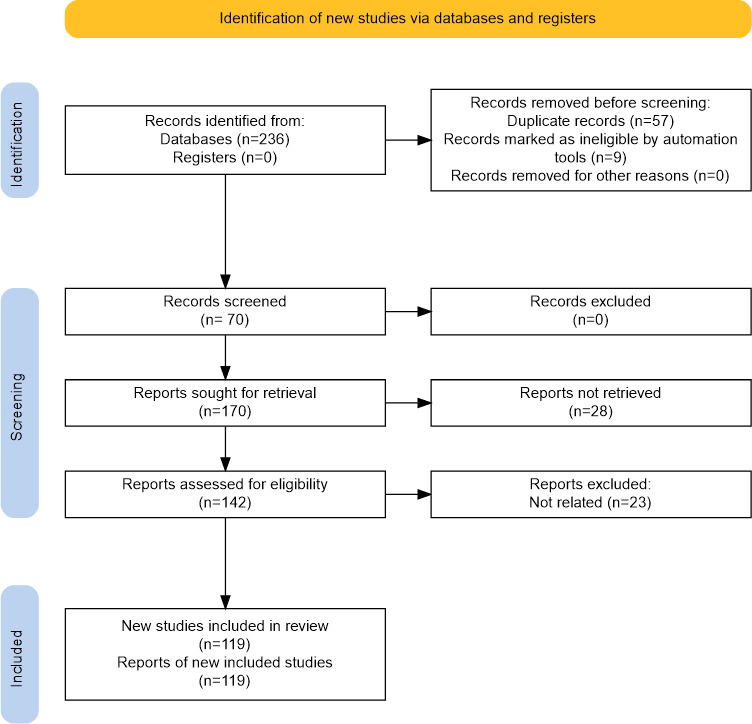 Figure 2
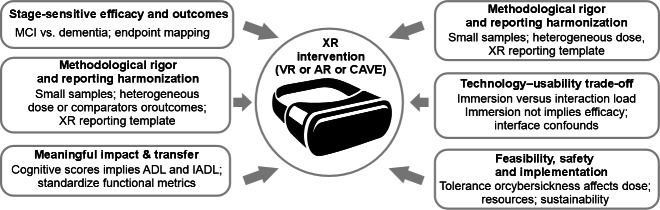 Figure 3
Peer Reviews
No public reviews on file for this paper yet. If you reviewed it on a platform where reviews are public (OpenReview, ICLR, NeurIPS, ICML), you can paste yours below so the community can read it here.
Videos
No videos yet. Explain this paper in a talk, walkthrough, or lecture? Add one.
Taxonomy
TopicsStroke Rehabilitation and Recovery · Virtual Reality Applications and Impacts · Dementia and Cognitive Impairment Research