Amyloid spatial extent with florbetapir-PET for early detection of preclinical Alzheimer’s disease
Emma G. Thibault, Grace Del Carmen Montenegro, J․Alex Becker, Julie C․ Price, Brian C. Healy, Bernard J. Hanseeuw, Rachel F. Buckley, Heidi I.L. Jacobs, Michael J. Properzi, Reisa A. Sperling, Keith A. Johnson, Michelle E. Farrell

TL;DR
This study shows that measuring the spatial extent of amyloid-beta with florbetapir-PET improves early detection of Alzheimer's disease before traditional methods detect it.
Contribution
The study introduces a new spatial extent metric (EXT) that enhances early amyloid detection and predicts tau and cognitive changes in preclinical Alzheimer's.
Findings
EXT reclassified 21.4% of participants from amyloid-negative to amyloid-positive.
EXT predicted amyloid progression with 83% sensitivity and 94% specificity over 5.5 years.
EXT outperformed SUVR in predicting early tau accumulation and cognitive decline.
Abstract
•Florbetapir spatial extent replicates PiB findings in preclinical AD.•Spatial extent detects early amyloid-β spread below SUVR thresholds.•EXT predicts early medial temporal tau accumulation and plasma pTau217 levels.•Spatial extent improves early detection and could improve trial enrichment in AD. Florbetapir spatial extent replicates PiB findings in preclinical AD. Spatial extent detects early amyloid-β spread below SUVR thresholds. EXT predicts early medial temporal tau accumulation and plasma pTau217 levels. Spatial extent improves early detection and could improve trial enrichment in AD. Prevention of Alzheimer’s disease (AD) requires biomarkers sensitive to the earliest amyloid-β (Aβ) deposits. To characterize performance of a recently-developed Aβ-PET spatial extent metric (EXT) for early Aβ detection using 18[F]-florbetapir (FBP)-PET, evaluating its sensitivity,…
Genes, proteins, chemicals, diseases, species, mutations and cell lines named across the full text — each resolved to its canonical identifier and authoritative record.
Click any figure to enlarge with its caption.
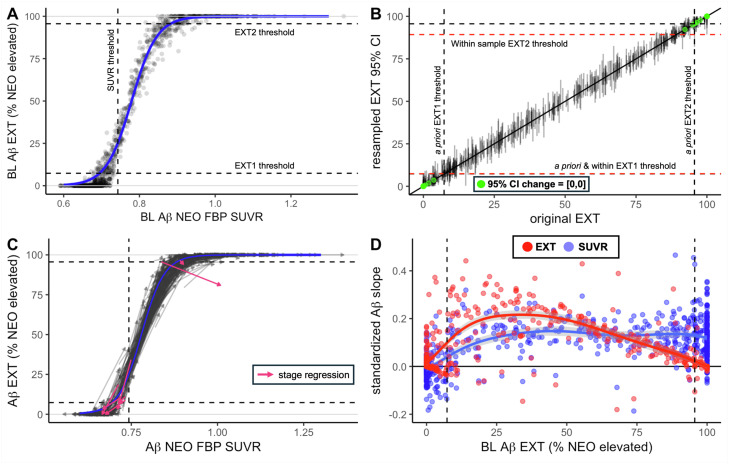 Figure 1
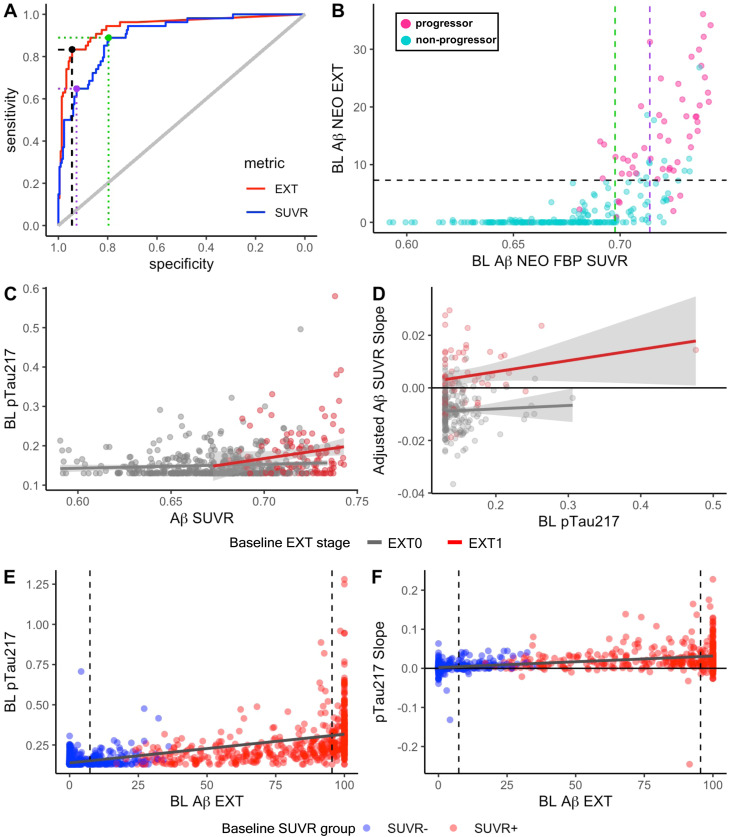 Figure 2
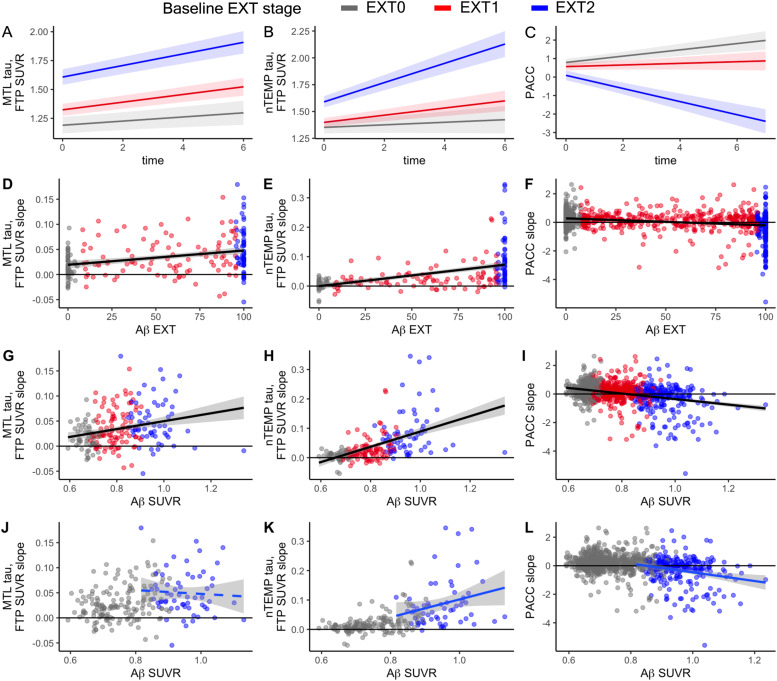 Figure 3
Peer Reviews
No public reviews on file for this paper yet. If you reviewed it on a platform where reviews are public (OpenReview, ICLR, NeurIPS, ICML), you can paste yours below so the community can read it here.
Videos
No videos yet. Explain this paper in a talk, walkthrough, or lecture? Add one.
Taxonomy
TopicsAlzheimer's disease research and treatments · Dementia and Cognitive Impairment Research · S100 Proteins and Annexins