Percutaneous Transcatheter Closure of Multiple Ostium Secundum Atrial Septal Defects: A Case Report
Daniel Goshen, Jamil Aboulhosn

TL;DR
A 61-year-old woman with two heart defects had them successfully closed using a minimally invasive procedure with two devices, avoiding surgery.
Contribution
This case demonstrates the feasibility of using multiple transcatheter devices to close multiple atrial septal defects.
Findings
Two 17 mm and 14 mm ASDs were successfully closed using 11 mm and 18 mm Amplatzer septal occluders.
Transesophageal echocardiography confirmed no residual shunt after device deployment.
The staged deployment of devices avoided entanglement and minimized embolization risk.
Abstract
Ostium secundum atrial septal defects (ASDs) are a common congenital heart defect that are often asymptomatic until adulthood. Percutaneous transcatheter device closure is now a widely accepted form of treatment as an alternative to surgical repair. A 61-year-old woman presented with two secundum ASDs measuring 17 mm (superior) and 14 mm (inferior) with evidence of significant left-to-right shunting along with right ventricular and right atrial enlargement. Under the guidance of transesophageal echocardiography (TEE), the inferior defect was closed first with an 11 mm Amplatzer septal occluder (ASO) (Abbott Medical Inc., IL, USA), and the superior defect was closed next with an 18 mm ASO. The devices were interdigitated and deployed in a staged fashion to avoid entanglement. Immediate TEE and color Doppler confirmed that both devices were well seated across all rims with no residual…
Genes, proteins, chemicals, diseases, species, mutations and cell lines named across the full text — each resolved to its canonical identifier and authoritative record.
Click any figure to enlarge with its caption.
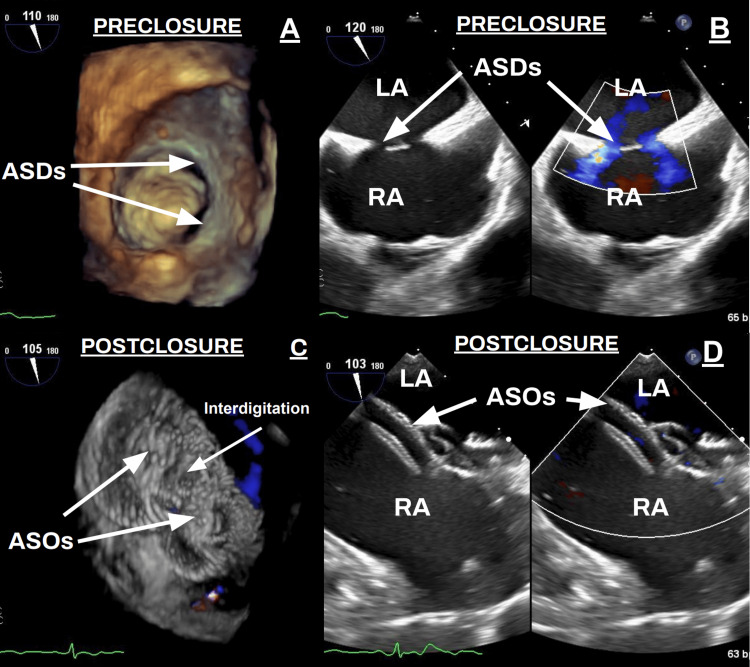 Figure 1
Peer Reviews
No public reviews on file for this paper yet. If you reviewed it on a platform where reviews are public (OpenReview, ICLR, NeurIPS, ICML), you can paste yours below so the community can read it here.
Videos
No videos yet. Explain this paper in a talk, walkthrough, or lecture? Add one.
Taxonomy
TopicsCardiovascular and Diving-Related Complications · Congenital Heart Disease Studies · Cardiac and Coronary Surgery Techniques