Exploring patient interpretation of an orthosis adherence checklist: A cognitive interview study
Marjan Saeedi, Joy Christine MacDermid, Louis Ferreira, Sahar Johari, Mike Szekeres

TL;DR
This study explores how patients interpret an orthosis adherence checklist to improve its use in measuring adherence to upper extremity orthoses.
Contribution
The study identifies patient interpretations and areas for improvement in a clinician-developed orthosis adherence checklist.
Findings
Most checklist items were seen as meaningful and easy to answer by participants.
Terms like 'customizability' and 'aesthetics' were confusing or overly technical for some patients.
Participants suggested adding a 'Not applicable' response option for irrelevant items like 'affordability'.
Abstract
Upper extremity orthoses are commonly used in rehabilitation to reduce pain, improve alignment, and support return to daily activities. These benefits depend on regular and correct use, yet adherence is influenced by personal, environmental, and device-related factors. Although a checklist of adherence-related items has been developed based on clinician expertise, it has never been evaluated by patients. Understanding how patients interpret these items is essential before the checklist can inform development of a patient-reported outcome measure (PROM) to support adherence. The aim of this study was to explore how people with lived experience of upper extremity pain and disability using upper extremity orthoses understand and respond to the items in an adherence checklist, and to identify areas requiring improvement. Cognitive interviews were conducted with adults who had used an upper…
Genes, proteins, chemicals, diseases, species, mutations and cell lines named across the full text — each resolved to its canonical identifier and authoritative record.
Click any figure to enlarge with its caption.
 Figure 1
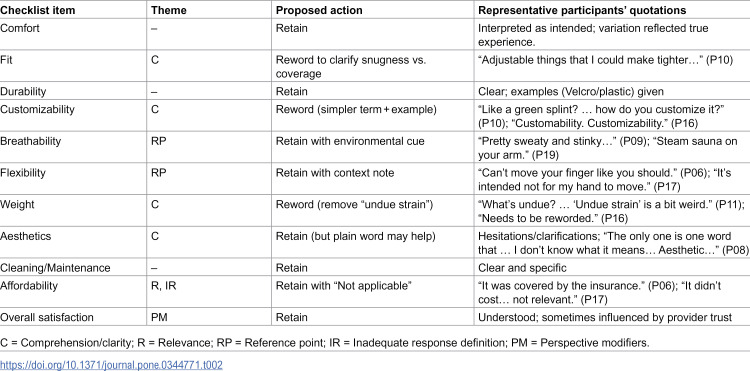 Figure 2
Peer Reviews
No public reviews on file for this paper yet. If you reviewed it on a platform where reviews are public (OpenReview, ICLR, NeurIPS, ICML), you can paste yours below so the community can read it here.
Videos
No videos yet. Explain this paper in a talk, walkthrough, or lecture? Add one.
Taxonomy
TopicsProsthetics and Rehabilitation Robotics · Muscle activation and electromyography studies · Cerebral Palsy and Movement Disorders