Thaliacean tunicates, vertebrate sisters regained lifelong mobility
Yasunori Sasakura

TL;DR
This study investigates how Thaliacean tunicates, close relatives of vertebrates, evolved to regain mobility after their ancestors became stationary.
Contribution
The study reveals new insights into the embryogenesis of Thaliacean tunicates and their evolutionary transition to mobility.
Findings
Thaliacean tunicates have a unique embryogenesis process distinct from other tunicates.
They regained mobility from a sessile ancestor, offering new perspectives on tunicate evolution.
Abstract
Tunicates are the closest living relatives of vertebrates, but many details of their evolutionary history remain unclear. A study published in PLOS Biology explores the unique embryogenesis of Thaliacea, the tunicates that regained mobility from their sessile ancestor. Tunicates are the closest living relatives of vertebrates, but many details of their evolutionary history remain unclear. This study explores the unique embryogenesis of Thaliacea, the tunicates that regained mobility from their sessile ancestor.
Genes, proteins, chemicals, diseases, species, mutations and cell lines named across the full text — each resolved to its canonical identifier and authoritative record.
Click any figure to enlarge with its caption.
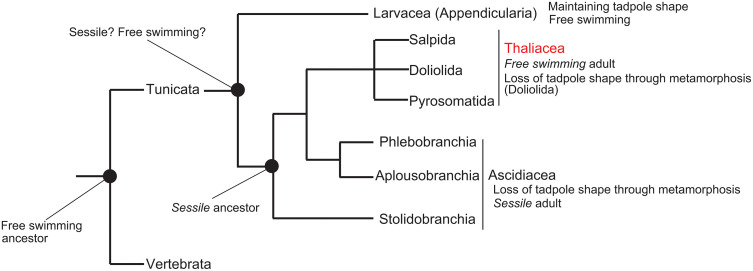 Figure 1
Peer Reviews
No public reviews on file for this paper yet. If you reviewed it on a platform where reviews are public (OpenReview, ICLR, NeurIPS, ICML), you can paste yours below so the community can read it here.
Videos
No videos yet. Explain this paper in a talk, walkthrough, or lecture? Add one.
Taxonomy
TopicsMarine Ecology and Invasive Species · Protist diversity and phylogeny · Planarian Biology and Electrostimulation