When revealed after the fact, selfish intentions undermine prosocial actions in 5-year-olds
Kayley Dotson, Michael Tomasello, Asami Shinohara, Asami Shinohara, Asami Shinohara, Asami Shinohara

TL;DR
Five-year-olds are less likely to reciprocate kindness if they later learn the person had selfish motives.
Contribution
Shows that revealed selfish intentions after a prosocial act reduce children's willingness to reciprocate.
Findings
Children shared less when a puppet's selfish intention was revealed after a prosocial act.
Children did not explicitly rate the puppet differently based on the revealed intention.
Hidden selfish motives negatively affect future prosocial behavior in young children.
Abstract
Early in ontogeny, children show a preference for prosocial others and for those with helpful intentions. Here, we investigate how children reason about prosocial actions when a selfish intention is revealed only after a prosocial behavior has benefitted them. 5-year-old children (N = 48) played a game with a puppet who acted prosocially by letting the child take a turn in a game. After the game, the puppet revealed either a selfish intention of getting a cookie for letting the child play (Undermining condition) or a prosocial intention of wanting the child to have fun (Prosocial condition). When given a chance to reciprocate a prosocial act, children shared less when the puppet had an Undermining versus a Prosocial intention. Children did not show any condition differences in their explicit social evaluations of the puppet, however. Our results indicate that an agent’s initially hidden…
Genes, proteins, chemicals, diseases, species, mutations and cell lines named across the full text — each resolved to its canonical identifier and authoritative record.
Click any figure to enlarge with its caption.
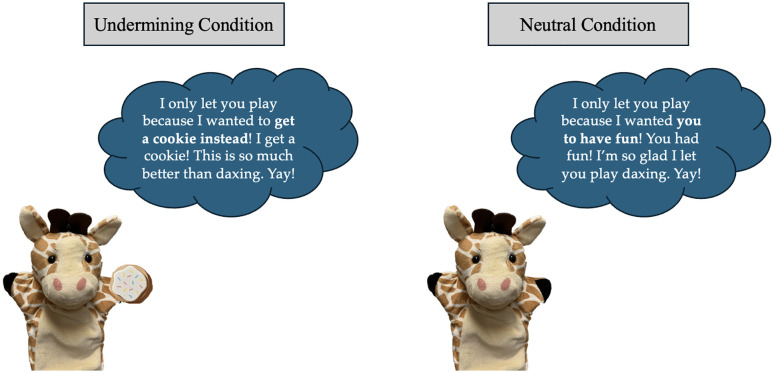 Figure 1
 Figure 2
 Figure 3
Peer Reviews
No public reviews on file for this paper yet. If you reviewed it on a platform where reviews are public (OpenReview, ICLR, NeurIPS, ICML), you can paste yours below so the community can read it here.
Videos
No videos yet. Explain this paper in a talk, walkthrough, or lecture? Add one.
Taxonomy
TopicsChild and Animal Learning Development · Action Observation and Synchronization · Embodied and Extended Cognition