Association between vaginal washing and group B Streptococcus colonization from periconception through the first trimester of pregnancy in a cohort of Kenyan women
Clayton S. Jisuvei, John Kinuthia, Barbra A. Richardson, Sujatha Srinivasan, Erica M. Lokken, Kishor Mandaliya, Walter Jaoko, Matthew Munch, Tina L. Fiedler, David N. Fredricks, Raymond Scott McClelland

TL;DR
Vaginal washing with soap and water is linked to a five-fold increase in group B streptococcus (GBS) colonization in Kenyan women during early pregnancy.
Contribution
This study identifies a strong association between vaginal washing with soap and increased GBS colonization during pregnancy.
Findings
GBS prevalence was nearly five times higher during vaginal washing with soap and water compared to no washing.
Vaginal washing with water alone was not associated with increased GBS colonization.
GBS prevalence decreased from periconception to late first trimester, regardless of washing practices.
Abstract
Vaginal washing has been associated with adverse reproductive health outcomes including pelvic inflammatory disease, reduced fecundability, and HIV acquisition. This analysis tested the hypothesis that vaginal washing is associated with increased risk of group B streptococcus (GBS) colonization. Women planning pregnancies contributed monthly visits during which vaginal fluid specimens were collected and urine pregnancy testing was performed. In women who became pregnant, additional samples were collected at 9–12 weeks gestation. Broad-range 16S rRNA gene PCR with next generation sequencing (NGS) was performed to identify vaginal bacterial species. Generalized estimating equations with a log link, Poisson family, independent correlation structure and robust errors were used to generate prevalence ratios comparing the prevalence of GBS detection at vaginal washing visits versus…
Genes, proteins, chemicals, diseases, species, mutations and cell lines named across the full text — each resolved to its canonical identifier and authoritative record.
Click any figure to enlarge with its caption.
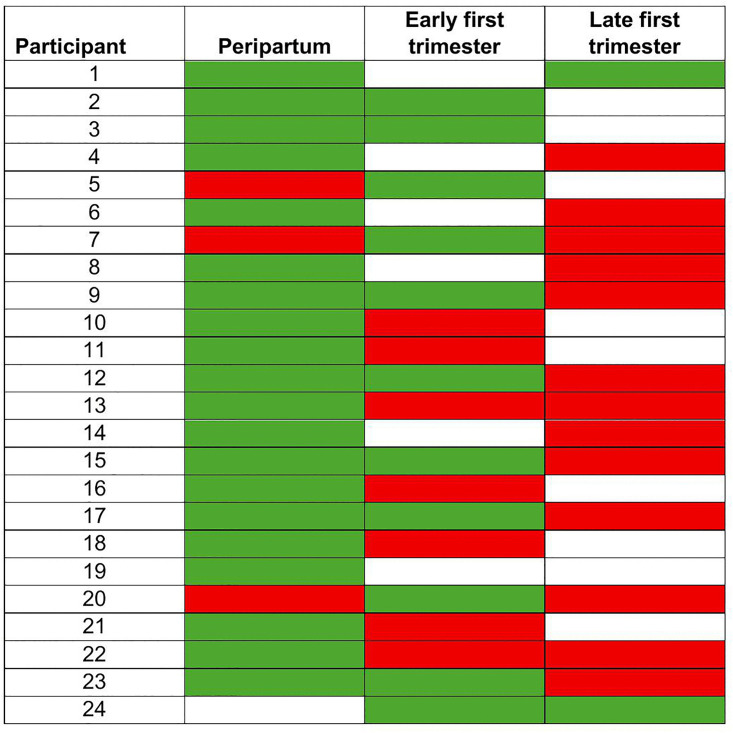 Figure 1
 Figure 2
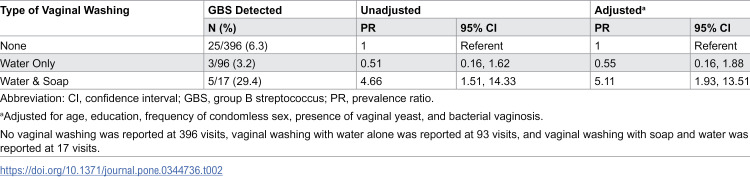 Figure 3
Peer Reviews
No public reviews on file for this paper yet. If you reviewed it on a platform where reviews are public (OpenReview, ICLR, NeurIPS, ICML), you can paste yours below so the community can read it here.
Videos
No videos yet. Explain this paper in a talk, walkthrough, or lecture? Add one.
Taxonomy
TopicsNeonatal and Maternal Infections · Reproductive tract infections research · Preterm Birth and Chorioamnionitis