Factors Associated With Loss to Follow-Up Among People Living With HIV in a National Tertiary Care Hospital: Protocol and Baseline Analysis of a Prospective Cohort Study
Luis Eduardo Del Moral Trinidad, Jaime Federico Andrade Villanueva, Luis Alberto Ruíz Mora, Carlos Valentino García y Nuño, Maria Fernanda Perez Quintero, Brian Eduardo Apodaca Escalante, Jocelyn Graciela Torres Arias, Juan Pablo Martínez Herrera, Melva Guadalupe Herrera Godina

TL;DR
This study aims to identify factors that lead to loss of follow-up among HIV patients in Mexico to improve retention in care.
Contribution
The study provides a protocol and baseline analysis for a prospective cohort study in the Mexican context.
Findings
Baseline data show high socioeconomic vulnerability and late HIV presentation among participants.
Notable levels of perceived stigma and reduced quality of life were observed in the cohort.
The study will use longitudinal follow-up to inform targeted interventions for improving care engagement.
Abstract
Advances in antiretroviral therapy (ART) have significantly improved the life expectancy of people living with HIV. However, maintaining retention in care—defined as ongoing engagement with medical services from diagnosis through regular follow-up—is essential for optimal clinical outcomes. Loss to follow-up (LTFU), commonly defined as the absence of ART prescription refills or medical visits for more than 90 days, has been associated with increased mortality, treatment failure, and continued community transmission. Although multiple individual and structural factors have been linked to LTFU, evidence from the Mexican context remains limited. This protocol describes a prospective cohort study designed to identify factors associated with LTFU among recently diagnosed people living with HIV in Mexico. We conducted a prospective cohort study at a national tertiary care hospital in…
Genes, proteins, chemicals, diseases, species, mutations and cell lines named across the full text — each resolved to its canonical identifier and authoritative record.
Click any figure to enlarge with its caption.
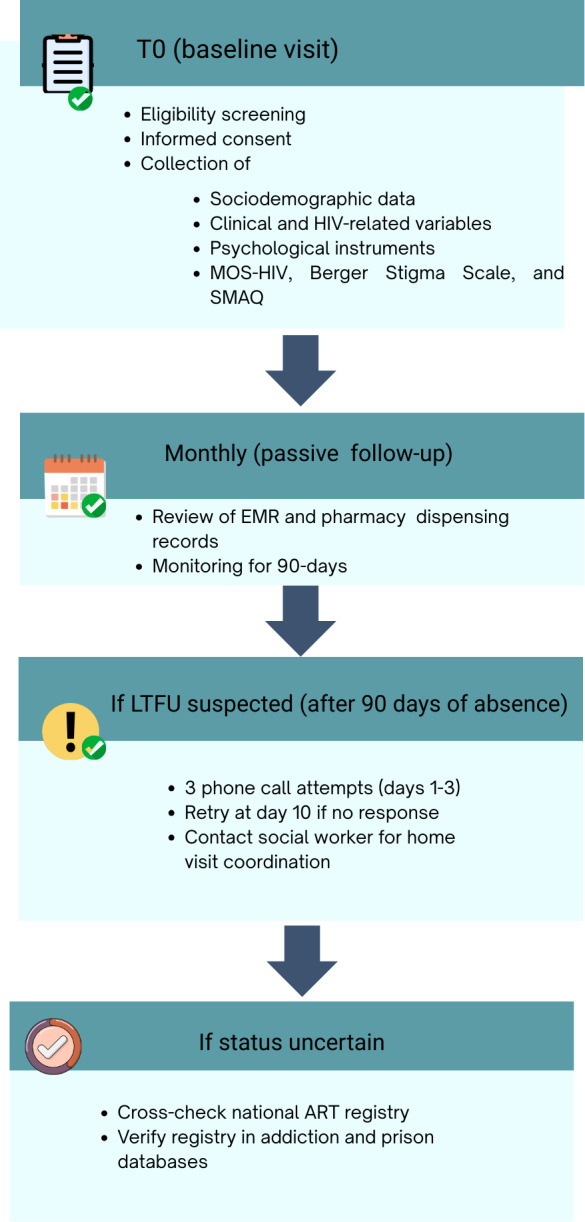 Figure 1
Peer Reviews
No public reviews on file for this paper yet. If you reviewed it on a platform where reviews are public (OpenReview, ICLR, NeurIPS, ICML), you can paste yours below so the community can read it here.
Videos
No videos yet. Explain this paper in a talk, walkthrough, or lecture? Add one.
Taxonomy
TopicsHIV/AIDS Research and Interventions · HIV-related health complications and treatments · Pneumocystis jirovecii pneumonia detection and treatment