Induced pathogenicity toward open-ocean diatoms by a filterable bacterium Ekhidna algicida sp. nov
Shiri Graff van Creveld, Sacha N Coesel, Ellen Lavoie, Vaughn Iverson, Rhonda Morales, Megan J Schatz, Alexandra E Jones-Kellett, Jesse McNichol, Rebecca S Key, Jed Fuhrman, Bryndan P Durham, E Virginia Armbrust

TL;DR
A new filterable bacterium, Ekhidna algicida, was found to kill open-ocean diatoms, potentially affecting marine ecosystems and nutrient cycles.
Contribution
Discovery of a novel filterable marine bacterium that exhibits induced pathogenicity toward diatoms.
Findings
Ekhidna algicida strain To15 kills various diatoms through exudates produced during co-culture.
The genome of E. algicida encodes a type IX secretion system and candidate proteases, suggesting protein-mediated pathogenicity.
Twenty additional algicidal Ekhidna strains were isolated, all passing through 0.2 μm filters.
Abstract
Phytoplankton are the base of marine food webs. They form intricate interactions with heterotrophic bacteria ranging from mutualistic to pathogenic that together impact oceanic carbon and nutrient cycling. Our understanding of these interactions in marine environments remains primarily limited to laboratory-based studies of model organisms. Here, we report the discovery and characterization of Ekhidna algicida sp. nov. strain To15, isolated from the oligotrophic Pacific Ocean (16°N, 140°W) based on its algicidal effect on the pelagic diatom Thalassiosira oceanica. Subsequent co-culture experiments demonstrate that E. algicida is lethal within days to a diverse array of diatoms, including diatoms isolated from similar locations, with the effect mediated by bacterial exudates produced during co-culture with susceptible diatoms. Exudates of E. algicida monoculture are not algicidal,…
Genes, proteins, chemicals, diseases, species, mutations and cell lines named across the full text — each resolved to its canonical identifier and authoritative record.
Click any figure to enlarge with its caption.
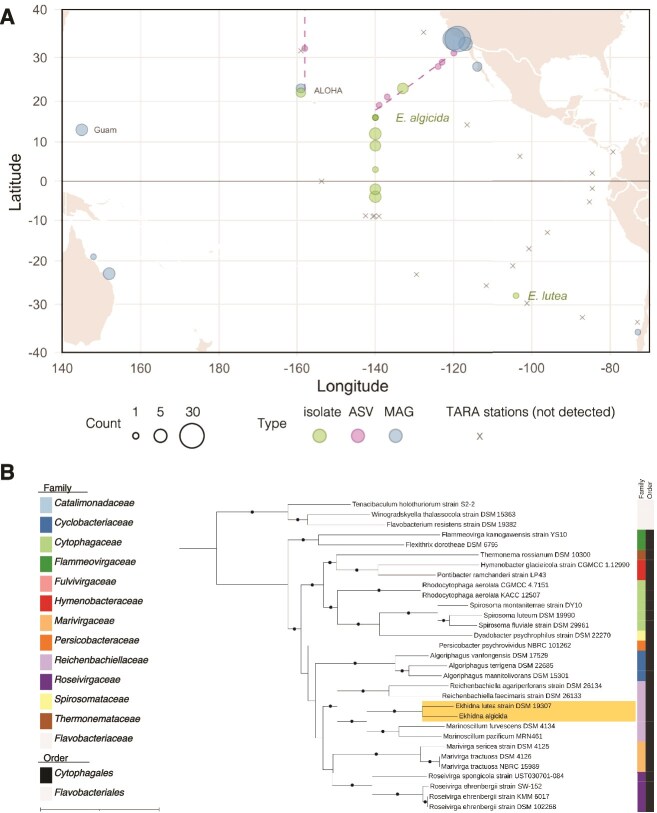 Figure 1
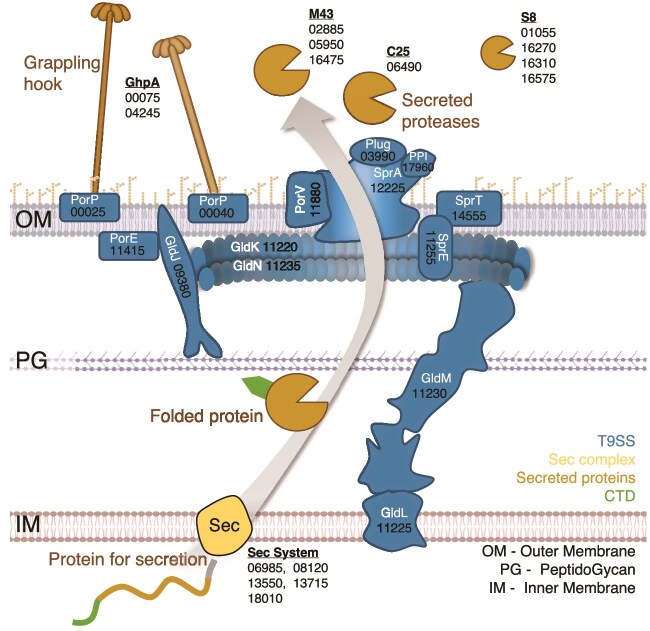 Figure 2
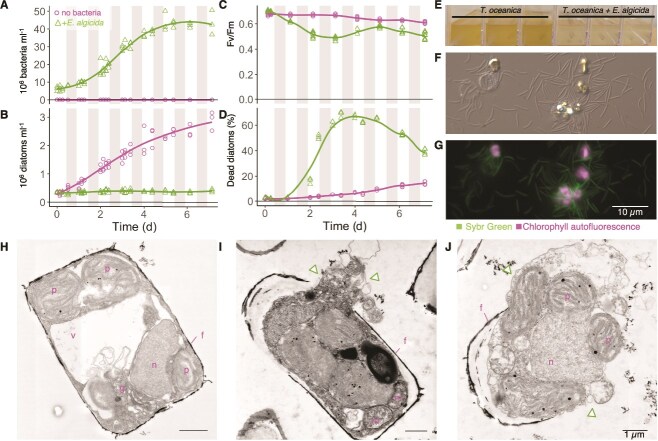 Figure 3
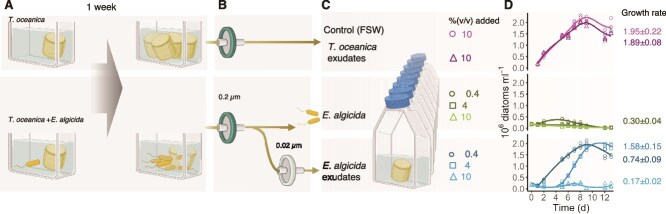 Figure 4
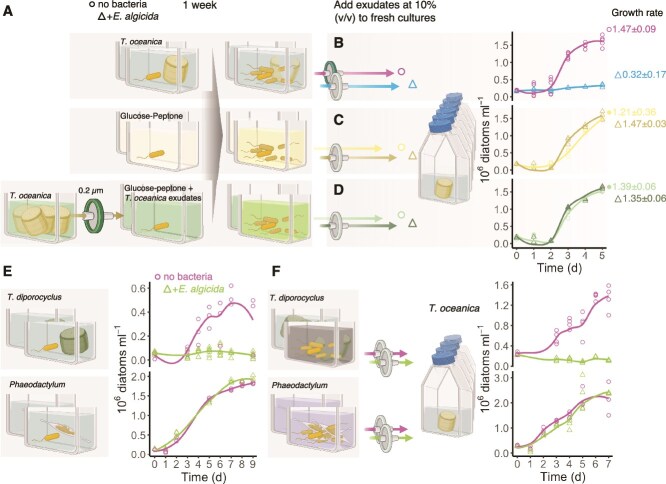 Figure 5
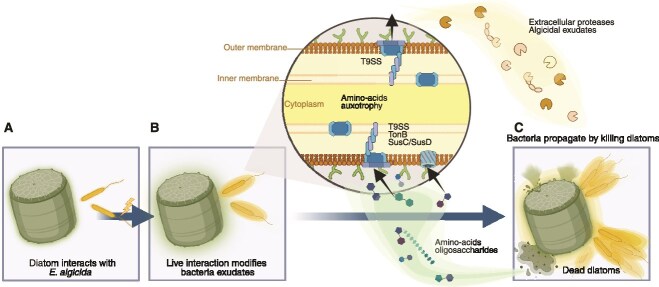 Figure 6
Peer Reviews
No public reviews on file for this paper yet. If you reviewed it on a platform where reviews are public (OpenReview, ICLR, NeurIPS, ICML), you can paste yours below so the community can read it here.
Videos
No videos yet. Explain this paper in a talk, walkthrough, or lecture? Add one.
Taxonomy
TopicsMicrobial Community Ecology and Physiology · Genomics and Phylogenetic Studies · Diatoms and Algae Research