Thigh gaps and filtered snaps: a qualitative study exploring opportunities to mitigate social media harm through content moderation for people with eating disorders
Pranita Shrestha, Jue Xie, Pari Delir Haghighi, Michelle L. Byrne, Scott Griffiths, Roisin McNaney

TL;DR
This study explores how harmful social media content affects people with eating disorders and suggests ways to moderate content to reduce harm.
Contribution
The paper introduces an eight-category framework for identifying harmful social media content related to body image and eating disorders.
Findings
Participants identified a spectrum of harmful and ambiguous content on social media.
Algorithms contribute to an 'echo chamber' that amplifies harmful content for people with eating disorders.
Shared responsibility among users, creators, platforms, and policymakers is needed to mitigate social media harm.
Abstract
The ubiquity of social media has increased exposure to idealised beauty standards, often unrealistic and harmful. Repeated exposure has been linked to body dissatisfaction, harmful behaviours, and potentially the development of eating disorders (ED). Given the volume of content produced daily, effective harm mitigation strategies (automated or user-driven) are essential, requiring an informed understanding of the contexts and nuances surrounding harmful content. The study has two key aims: (1) to understand the perspectives of experts by profession and people with lived experience of ED, on what makes social media content harmful in the context of body image and ED, including why and how this harm occurs; and (2) to explore how technology might help mitigate these effects. We engaged n = 30 participants, including 12 interviews with experts by profession (n = 2 ED support service…
Genes, proteins, chemicals, diseases, species, mutations and cell lines named across the full text — each resolved to its canonical identifier and authoritative record.
Click any figure to enlarge with its caption.
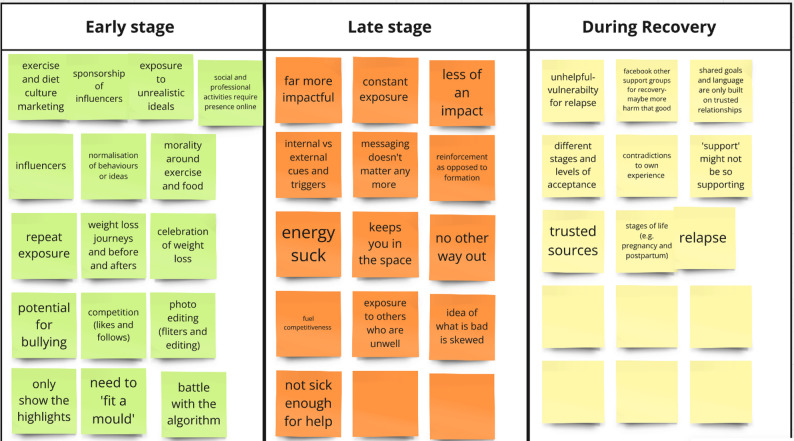 Figure 1
Peer Reviews
No public reviews on file for this paper yet. If you reviewed it on a platform where reviews are public (OpenReview, ICLR, NeurIPS, ICML), you can paste yours below so the community can read it here.
Videos
No videos yet. Explain this paper in a talk, walkthrough, or lecture? Add one.
Taxonomy
TopicsEating Disorders and Behaviors · Body Image and Dysmorphia Studies · Mental Health via Writing