3D Printing: The Key to Success in an Otherwise Impossible Percutaneous Coronary Intervention
Tim Noterdaeme, Olivier Gach, Lucien Finianos, Pieter‐Jan Palmers, Giuseppe Colletti, Claudiu Ungureanu

TL;DR
3D-printed models tailored to patients can help plan complex heart procedures when traditional methods aren't effective.
Contribution
The paper highlights how 3D printing can improve percutaneous coronary interventions in challenging cases.
Findings
3D-printed models can enhance planning for complex PCI cases.
Adoption is limited by cost, availability, and time.
Infrastructure and dedicated programs could increase clinical use.
Abstract
Patient‐specific 3D‐printed models could enhance PCI planning, improving feasibility and efficacy in cases where conventional methods fail or coronary anatomy is atypical. Despite their potential, adoption is limited by system availability, equipment costs, and time expenditure. Appropriate infrastructure and dedicated programs could expand and broaden their clinical application.
Genes, proteins, chemicals, diseases, species, mutations and cell lines named across the full text — each resolved to its canonical identifier and authoritative record.
Click any figure to enlarge with its caption.
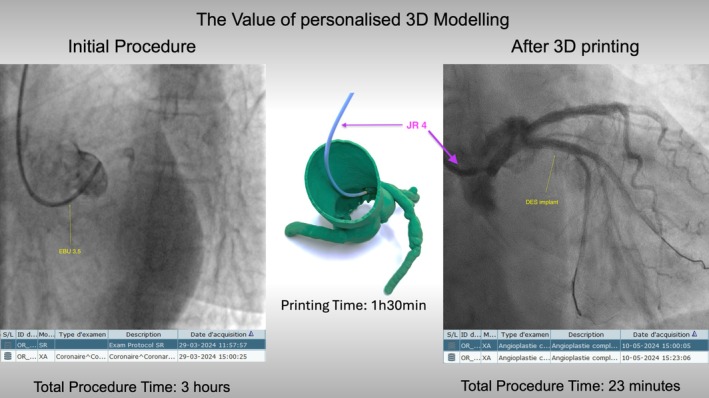 Figure 1
Peer Reviews
No public reviews on file for this paper yet. If you reviewed it on a platform where reviews are public (OpenReview, ICLR, NeurIPS, ICML), you can paste yours below so the community can read it here.
Videos
No videos yet. Explain this paper in a talk, walkthrough, or lecture? Add one.
Taxonomy
TopicsAnatomy and Medical Technology · Coronary Interventions and Diagnostics · Cardiac and Coronary Surgery Techniques