Pseudoexfoliation material deposits in a 43-year-old patient with an implantable collamer lens
Nikolaos Dervenis, Panagiotis Dervenis

Abstract
Genes, proteins, chemicals, diseases, species, mutations and cell lines named across the full text — each resolved to its canonical identifier and authoritative record.
Click any figure to enlarge with its caption.
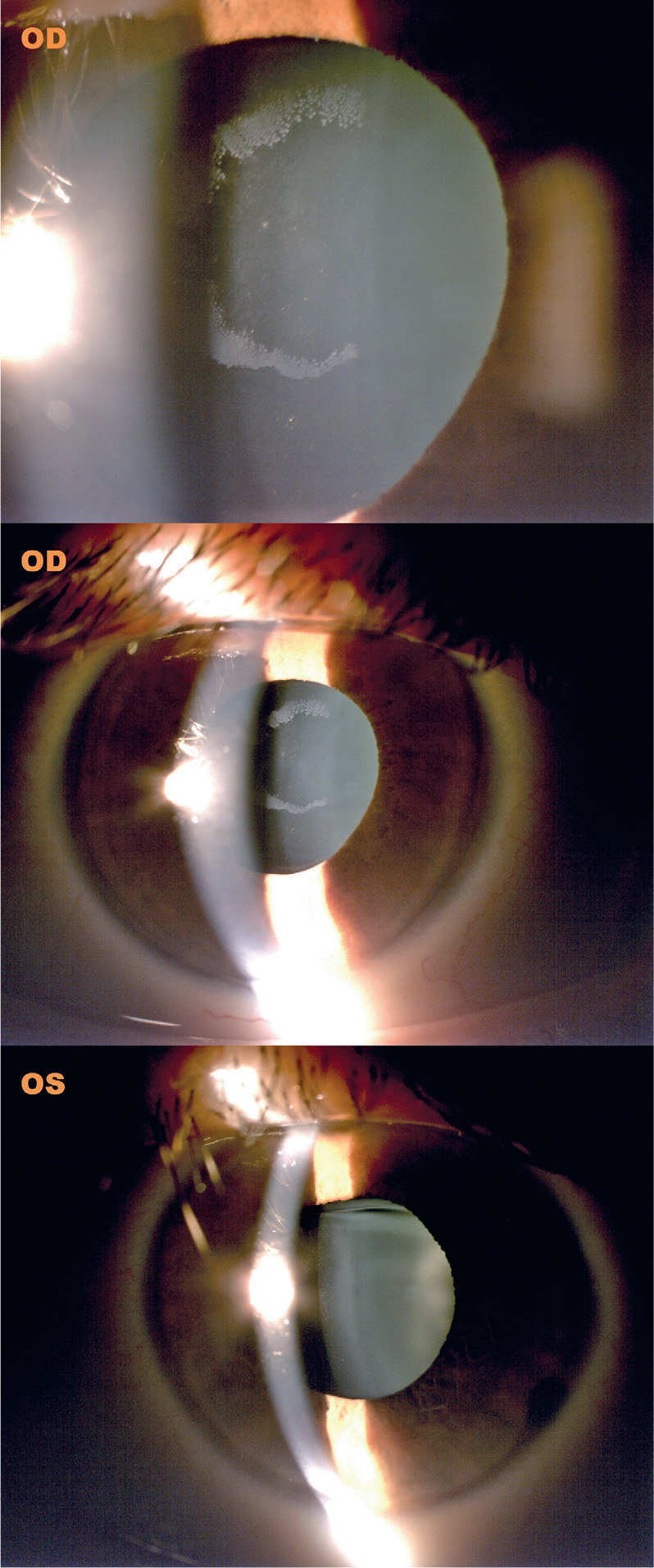 Figure 1
Peer Reviews
No public reviews on file for this paper yet. If you reviewed it on a platform where reviews are public (OpenReview, ICLR, NeurIPS, ICML), you can paste yours below so the community can read it here.
Videos
No videos yet. Explain this paper in a talk, walkthrough, or lecture? Add one.
Taxonomy
TopicsIntraocular Surgery and Lenses · Corneal surgery and disorders · Ocular and Laser Science Research
We present a case of pseudoexfoliation material deposits on the implantable collamer lens (ICL) of the right eye in a 43-year-old male patient. The patient had undergone ICL implantation 14 yr prior and presented for a routine follow-up. The implanted ICL was a non-central hole type.
On examination, the patient’s best-corrected visual acuity was 20/20 in both eyes. However, intraocular pressure (IOP) was elevated in the right eye at 26 mmHg, accompanied by increased trabecular meshwork pigmentation. In contrast, the IOP in the left eye was 14 mmHg.
This case represents only the second reported instance of early-onset pseudoexfoliation development associated with an ICL implant, highlighting the need for long-term monitoring in such patients^(1)^.
The reference list from the paper itself. Each links out to its DOI / PubMed record.
- 1Singh S Sachdev MS Taneja S. Unilateral pseudoexfoliation deposits on an implantable collamer lens with uretts-zavalia syndrome in fellow eye Indian J Ophthalmol - Case Reports 202332611