Iridodialysis
Gilberto Krasilchik, Nicole Bulgarão Maricondi Almeida, Newton Kara-Junior

Abstract
Genes, proteins, chemicals, diseases, species, mutations and cell lines named across the full text — each resolved to its canonical identifier and authoritative record.
Click any figure to enlarge with its caption.
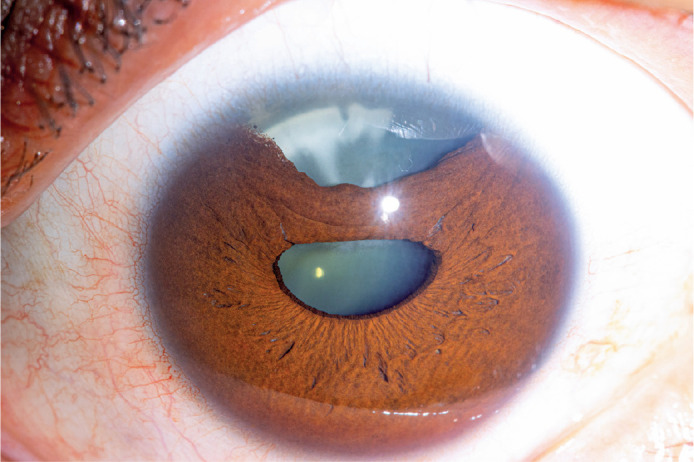 Figure 1
Peer Reviews
No public reviews on file for this paper yet. If you reviewed it on a platform where reviews are public (OpenReview, ICLR, NeurIPS, ICML), you can paste yours below so the community can read it here.
Videos
No videos yet. Explain this paper in a talk, walkthrough, or lecture? Add one.
Taxonomy
TopicsMetabolism and Genetic Disorders · Pediatric Urology and Nephrology Studies · Veterinary Medicine and Surgery
Iridodialysis refers to the separation of the iris from its attachment to the ciliary body. This condition commonly arises due to trauma or complications during intraocular surgery, given the inherently weak structure of the iris root^(^1^)^. The iris plays a crucial role in controlling pupil diameter^(^1^)^. Consequently, iris defects can lead not only to cosmetic deformations, such as polycoria and ectopic pupil, but also to significant functional impairments. These include monocular diplopia, photophobia^(^2^)^, reduced visual quality, severe glare, and decreased contrast sensitivity^(^1^)^.
The reference list from the paper itself. Each links out to its DOI / PubMed record.
- 1Ferro Desideri L Arun K Doherty G Bernardi E Anguita R. Iris reconstruction: A surgeon’s guide J Clin Med 202413927063873123510.3390/jcm 13092706 PMC 11084487 · doi ↗ · pubmed ↗
- 2Wan W Shi L Li C. Comparing safety and efficiency of two closed--chamber techniques for iridodialysis repair - a retrospective clinical study BMC Ophthalmol 20181813113052656910.1186/s 12886-018-0984-y PMC 6286550 · doi ↗ · pubmed ↗