Corneal dermoid
Amanda Ginelli, Nicole Bulgarão Maricondi de Almeida, Newton Kara-Júnior

Abstract
Genes, proteins, chemicals, diseases, species, mutations and cell lines named across the full text — each resolved to its canonical identifier and authoritative record.
Click any figure to enlarge with its caption.
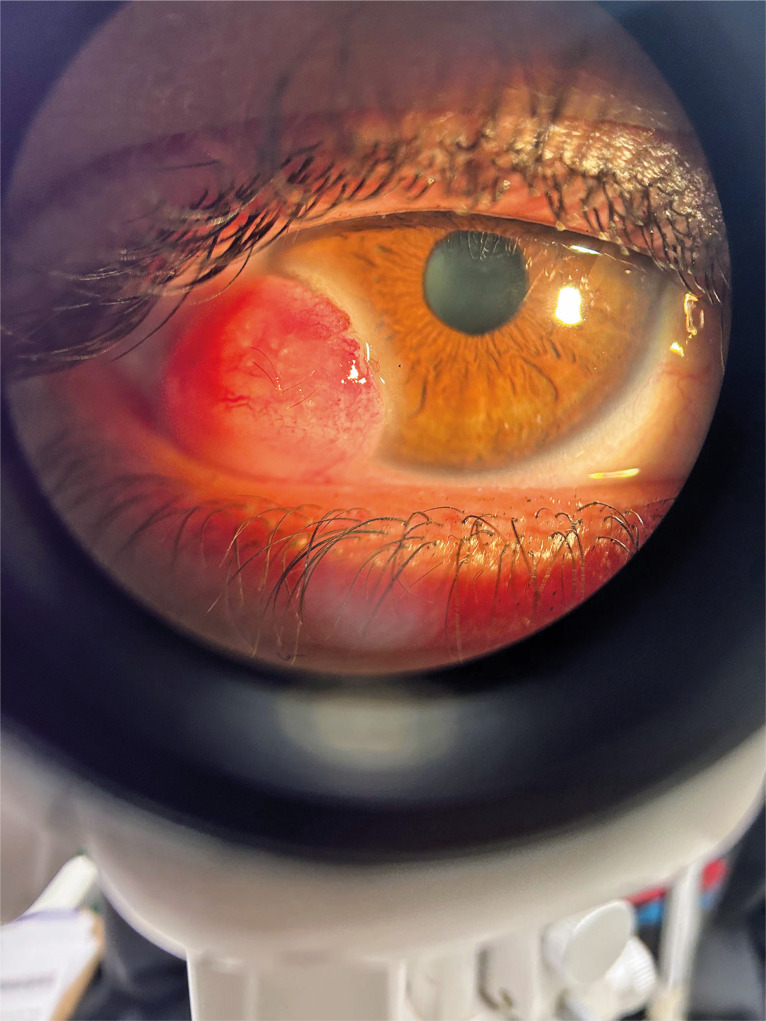 Figure 1
Peer Reviews
No public reviews on file for this paper yet. If you reviewed it on a platform where reviews are public (OpenReview, ICLR, NeurIPS, ICML), you can paste yours below so the community can read it here.
Videos
No videos yet. Explain this paper in a talk, walkthrough, or lecture? Add one.
Taxonomy
TopicsAcne and Rosacea Treatments and Effects
Corneal dermoid (Figure) is a congenital benign tumor and ocular malformation^(1)^ generally classified into three grades of severity^(2)^, with the most common site being the right eye’s temporal limbus^(1)^. Corneal dermoid can result in visual impairment, restricted eye movement, and facial asymmetry^(1)^. Pathological features include squamous epithelium coverage, hair follicles, sebaceous glands, and adipose and fibrous tissue^(1)^. Surgery is effective^(1)^, although complications include persistent epithelial defects and peripheral corneal vas-cularization and opacity^(2)^.
Figure 1
The reference list from the paper itself. Each links out to its DOI / PubMed record.
- 1Xuan S Pei X Li Z. A Retrospective analysis of corneal dermoid Cureus 2024167 e 648403915629110.7759/cureus.64840 PMC 11330282 · doi ↗ · pubmed ↗
- 2Wan Q Tang J Han Y Ye H. Surgical treatment of corneal dermoid by using intrastromal lenticule obtained from small-incision lenticule extraction Int Ophthalmol 202040143493173599210.1007/s 10792-019-01201-w · doi ↗ · pubmed ↗