Intraocular lens opacification
Pedro Henrique Oliveira Ribeiro, Nicole Bulgarão Maricondi de Almeida, Newton Kara-Júnior

Abstract
Genes, proteins, chemicals, diseases, species, mutations and cell lines named across the full text — each resolved to its canonical identifier and authoritative record.
Click any figure to enlarge with its caption.
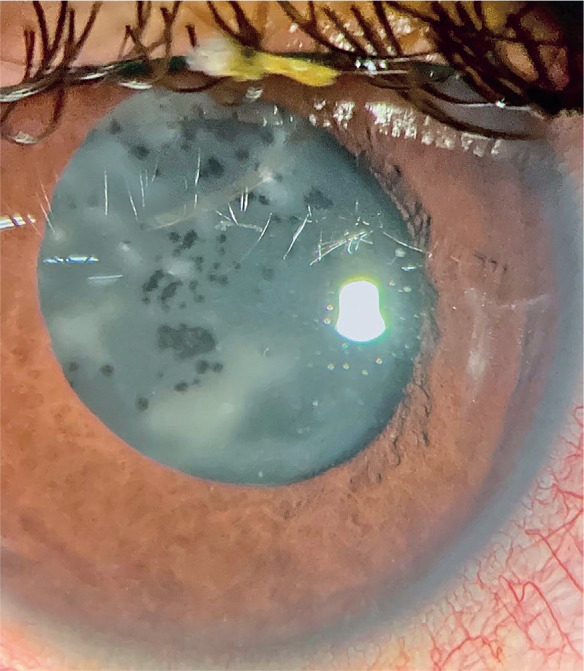 Figure 1
Peer Reviews
No public reviews on file for this paper yet. If you reviewed it on a platform where reviews are public (OpenReview, ICLR, NeurIPS, ICML), you can paste yours below so the community can read it here.
Videos
No videos yet. Explain this paper in a talk, walkthrough, or lecture? Add one.
Taxonomy
TopicsIntraocular Surgery and Lenses · Ocular Disorders and Treatments · Ocular Surface and Contact Lens
Although intraocular lens opacification is uncommon, multiple different patterns of opacities have been des-cribed according to the intraocular lens material. A well-known complication of silicone lenses is the adherence of silicone droplets on the lens surface after silicone oil injection at the time of retinal surgery. These droplets are nearly impossible to displace (Figure 1). Furthermore, these droplets hamper the patient’s vision as well as the physician’s view of the posterior pole. Thus, the compromised intraocular lens will require an exchange^(1)^.
The reference list from the paper itself. Each links out to its DOI / PubMed record.