Design principles for enantiospecific para- and ortho-[3,3] rearrangements of chiral aryl–allyl ethers
Johanna Breinsperger, Maximilian Kaiser, Peter Gärtner

TL;DR
This paper explains how to control the direction of chemical rearrangements to produce specific chiral products with high purity.
Contribution
The study establishes design principles for enantiospecific para- and ortho-Claisen rearrangements of chiral aryl–allyl ethers.
Findings
Both para- and ortho-alkylation proceed enantiospecifically with near-perfect chirality transfer.
Steric and electronic influences were identified as key factors directing the [3,3]-rearrangements.
Abstract
We report a systematic study that elucidates the regio-determining features of the stereoretentive para-Claisen–Cope and ortho-Claisen rearrangements of enantioenriched aryl–allyl ethers under mild catalytic conditions. The role of the aromatic substitution pattern as well as the nature of the rearranging ether moiety were thoroughly investigated, revealing that both para- and ortho-alkylation proceeded enantiospecifically with near-perfect chirality transfer. These findings resulted in rational design principles for accessing synthetically versatile, enantioenriched phenols and gave insights into how steric and electronic influences direct the [3,3]-rearrangements. Regioselective allyl–aryl rearrangements directed by substituents yield chiral ortho- and para-alkylated products in high enantiomeric purity.
Genes, proteins, chemicals, diseases, species, mutations and cell lines named across the full text — each resolved to its canonical identifier and authoritative record.
Click any figure to enlarge with its caption.
 Scheme 1
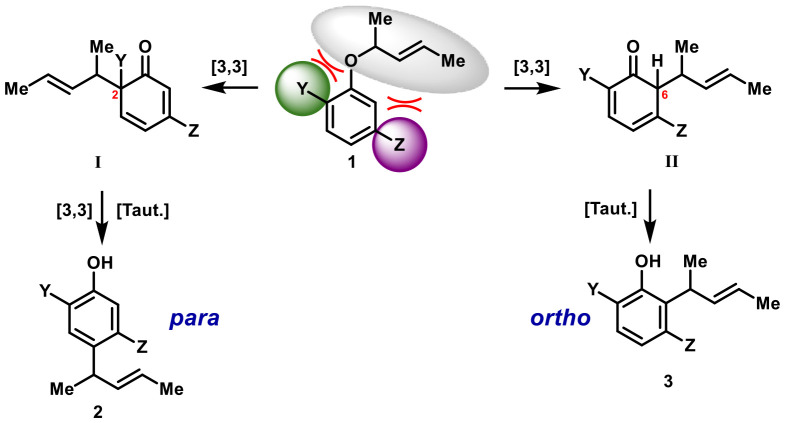 Fig. 1
 Scheme 2
 Scheme 3
|
| ||||
|---|---|---|---|---|
| Entry | Solvent (1 M) | Temp. [°C] | 2f : 3f |
|
| 1 | PhMe | 40 | 1.7 : 1 | 87 (>99) |
| 2 | EtOAc | 40 | — | — |
| 3 | THF | 40 | — | — |
| 4 | CHCl3 | 40 | — | — |
| 5 | Hexane | 40 | 1.2 : 1 | 87 (>99) |
| 6 | HFIP | 40 | 1 : 0 | 16 (>18) |
| 7 | Hexane | 60 | 1.2 : 1 | 87 (>99) |
| 8 | Heptane | 60 | 1.1 : 1 | 87 (>99) |
| 9 | PhMe | 60 |
| 87 (>99) |
| 10 | 1,2-DCE | 60 | 2 : 1 | 80 (>92) |
| 11 | 1,2-DCB | 60 | 2.3 : 1 | 77 (>89) |
| 12 | PhMe | 80 | 1.6 : 1 | 87 (>99) |
| 13 | PhMe | 100 | 1.5 : 1 | 87 (>99) |
- —Austrian Science Fund10.13039/501100002428
Peer Reviews
No public reviews on file for this paper yet. If you reviewed it on a platform where reviews are public (OpenReview, ICLR, NeurIPS, ICML), you can paste yours below so the community can read it here.
Videos
No videos yet. Explain this paper in a talk, walkthrough, or lecture? Add one.
Taxonomy
TopicsAxial and Atropisomeric Chirality Synthesis · Asymmetric Synthesis and Catalysis · Catalytic Cross-Coupling Reactions
Introduction
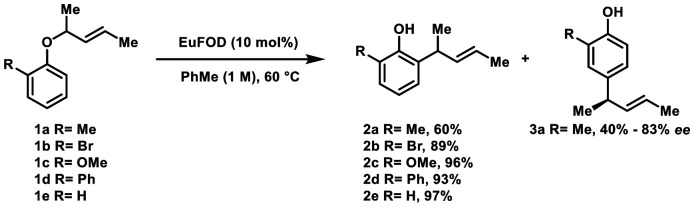
We recently reported a stereoretentive para-Claisen–Cope rearrangement of enantioenriched 2,6-disubstituted aryl–allyl ethers into para-alkylated phenols with virtually perfect chirality transfer.^1^ The process proceeded under mild, air- and moisture-tolerant EuFOD-catalysis and provided access to products in excellent yields and enantiomeric excess (up to >98% ee). Mechanistic investigations revealed a consecutive [3,3]-sigmatropic rearrangement sequence resulting in overall retention of configuration. Nevertheless, substrates lacking the 2,6-di-substitution pattern suffered from poor selectivity, resulting in seemingly unpredictable product distributions that depended heavily on the specific reaction conditions. Further, reported examples are largely limited to simple, achiral allyl^2–5^ or prenyl^6–12^ ether chains. In our recent study, we found that o-cresol derived ether 1a (R = Me, 83% ee) rearranged into the expected ortho-alkylated product 2a in 60% yield (ee n.d.) and was accompanied by para-rearranged 3a in 40% yield, with excellent chirality transfer (83% ee). Interestingly, compounds 1b–1e only delivered ortho-rearrangement 2b–2e with merely trace amounts of para-alkylation (Scheme 1). These findings prompted a more comprehensive study to elucidate how electronic and steric effects of the aromatic substituents as well as the nature of the migrating ether chain influence the regioselectivity of this transformation. Despite growing interest and recent advances, the factors governing the para-to-ortho selectivity in aryl–allyl ether rearrangements are not well understood and require further investigation.^13–15^
Rearrangement of mono-ortho substituted ethers.
In this work, our objective is the identification of the regio-determining features directing the (tandem-) [3,3]-sigmatropic rearrangement along the para-selective pathway. Therefore, our attention shifted to 2,5-disubstituted derivatives to gain a deeper mechanistic understanding of substituent interplay and its impact on the reaction outcome with the goal in mind to maximize para-selectivity. The products obtained via this method, represent versatile building blocks with multiple functional handles (Ar-OH, Y, Z and olefine-moiety, Fig. 1) otherwise difficult to access in high enantiomeric purity.^16–18^ In general, we assume that the nature of the substituents Y (C-2) and Z (C-5) in substrate 1 has the strongest influence on the regioselectivity primarily by destabilizing one of the competing reaction pathways either through steric interaction or electronic repulsion.^19^
Mechanistic pathways leading to para- and ortho-alkylation.
Consequently, two plausible intermediates must be considered: I, arising from an initial [3,3] sigmatropic rearrangement onto C-2 forming a quaternary center. Subsequent second rearrangement then leads to the formation of para-product 2 after tautomerization. In analogy, alkylation of the unsubstituted ortho-position at C-6 gives rise to intermediate II, which then tautomerizes to the ortho-product 3.^20–22^ As depicted in Scheme 1, the exclusive formation of ortho-compound 2e strongly suggests that a rearrangement into para-position via an unsubstituted ortho-position can be ruled out as a viable reaction pathway under the applied reaction conditions. The central question now revolves around which factors dictate the preference for rearrangement onto the sterically encumbered C-2 position, rather than the comparatively “free” C-6 position. It remains unclear which properties of the adjacent C-5 substituent suppress the seemingly more accessible ortho-pathway, and which features of the C-2 substituent might actively promote or prevent migration onto C-2.
Results and discussion
Compound 1f was selected as a model substrate, and the influence of solvent and temperature on product distribution as well as enantioselectivity was systematically evaluated. Applying conditions already established within our group, we subjected 1f to EuFOD-catalysis in toluene (1 M) at 40 °C to deliver 2f and 3f in a ratio of 1.7 : 1 favoring the desired para-alkylation (entry 1, Table 1). We were delighted to find that both regioisomers were obtained with perfect chirality transfer. Conducting the transformation in polar solvents such as EtOAc (entry 2), THF (entry 3), or CHCl_3_ (entry 4), did not lead to any product formation. When performed in hexane (entry 5), the products 2f and 3f were again obtained with excellent ee's though with diminished para-selectivity. Interestingly, employing HFIP as the solvent resulted in exclusive formation of the para-product 2f (entry 6). However, major loss of stereochemical information was detected, suggesting that the highly polar medium may promote a competing ionic pathway for the transformation. Next, we investigated the temperature-effect on the para-to-ortho ratio.
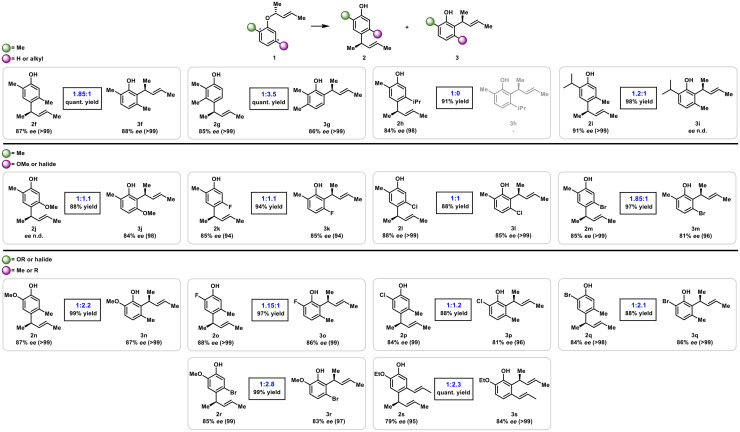
At 60 °C, reactions in hexane (entry 7) and heptane (entry 8) gave comparable ratios of 2f : 3f while the proportion of para-product 2f increased to 1.85 : 1 in toluene (entry 9) with perfect chirality transfer. Switching to 1,2-DCE (entry 10) and 1,2-DCB (entry 11) favored the formation of 2f to an even greater extent but came with loss of some stereoinformation. Therefore, we proceeded with toluene as the solvent of choice and further investigated the role of reaction temperature. Going up to 80 °C (entry 12) or 100 °C (entry 13) progressively decreased the amount of para-product. Though the excellent transfer of stereochemistry stayed intact, the yield dropped slightly at higher temperatures (see entry 13). As 60 °C appeared to be the sweet spot for efficient para-alkylation, we then turned the attention towards the scope of the rearrangement to elucidate the influence of the substitution pattern on the para-to-ortho product distribution. The discussed rearrangements proceeded with high yields and excellent chirality transfer throughout, giving rise to para- and ortho-alkylated products with high enantioselectivities. As already depicted above (Table 1) the 2,5-dimethyl substitution pattern favors para-rearrangement over ortho-alkylation, furnishing a ratio of 2f : 3f of 1.85 : 1 in quantitative yield (Scheme 2). Seemingly, a C-5 substituent can significantly block the C-6 position, forcing the rearrangement to largely proceed via a type-I intermediate, giving rise to the para-rearrangement as major product.
Scope and ratios of para- and ortho-alkylation.
In contrast, the 2,3-dimethyl substitution pattern favored ortho-rearranged 2g (1 : 3.5, quant. yield), over para-alkylation 3g indicating that a meta-substituent (at C-3 or C-5) can effectively prevent the formation of intermediates I/II, respectively, thereby influencing product distribution. Consistent with this interpretation, the sterically demanding 5-iPr enforced exclusive para-rearrangement (2h, 91% yield), whereas the corresponding ortho-product 3h was not detected.
This observation is consistent with literature precedents showing that a bulky meta-substituent exerts a shielding effect, impeding or at least strongly disfavouring rearrangement into the adjacent position on the aromatic ring.^23–25^ Inversion of this substitution pattern (2-iPr/5-Me) furnished 2i : 3i in a ratio of 1.2 : 1, reflecting increased steric congestion at C-2 compared to (2-Me/5-Me). At first, this result was surprising, as the 2-isopropyl substituent was expected to fully block the ortho-position, as seen for the 5-isopropyl derivative 2h. However, our recent work showed that 2,6-diisopropyl ethers readily undergo para-rearrangement, demonstrating that allyl groups can migrate to positions bearing a bulky isopropyl substituent.^1^
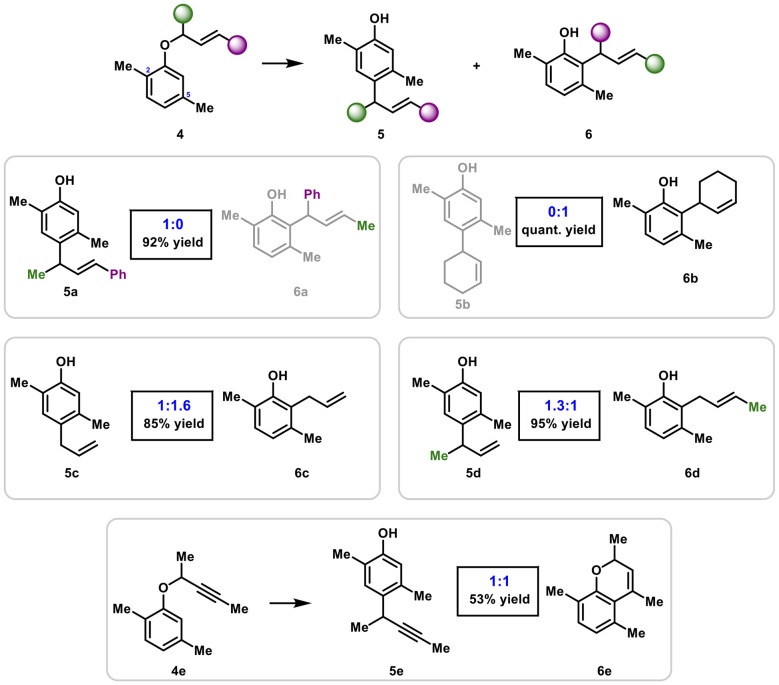
Next, we investigated various other C-5 substituents and their effects on product distribution while leaving the C-2 Me group unchanged. Introduction of 5-OMe led to the formation of 2j : 3j in excellent yield with slight preference for ortho-rearrangement (1 : 1.1). Since size difference between “OMe” and “Me” cannot explain this observation, it is assumed that the strong +M effect of the MeO-substituent favors a type-II intermediate, consequently favoring an ortho-rearrangement pathway. Incorporation of halides at C-5 furnished comparable ratios for 5-F (1 : 1.1 2k : 3k) and 5-Cl (1 : 1 2l : 3l), both in excellent combined yields. Introduction of a bromine into the 5-position again favors the para-pathway, affording a product distribution of 2m : 3m in a 1.85 : 1 ratio. This observation is likely a consequence of the greater steric bulk of Br relative to F and Cl, leading to effective shielding of the C-6 position. With these initial trends defined we broadened our focus from 2-alkyl substituents to explore diverse 2,5-substitution patterns. Introducing a strong electron donating OMe group into C-2 while having a C-5 Me group in place gave rise to ortho-alkylation as the major product (2n : 3n 1 : 2.2) in near quantitative yield. This result demonstrates the significance of electronic effects as the preference for ortho-selectivity cannot be reasoned by steric arguments alone when compared to 2f : 3f or 2i : 3i, respectively. Next, rearrangements of = halide, = Me substrates were investigated (see Fig. 1 for green and violet balls). For these substrates, we assumed that the product distribution might be determined by a combination of electronic and steric effects to a varying degree, depending on the halogen atom attached. We commenced with halide exhibiting the strongest +M-effect and the rearrangement of 2-F aryl-allyl ether furnished products 2o : 3o in a ratio of 1.15 : 1. In contrast to the strong electron donor 2-OMe (2n : 3n), para-alkylation was favored over ortho-rearrangement. Introduction of 2-Cl again prepared slightly more of the ortho-product (1 : 1.2 2p : 3p), whereas the more sterically demanding 2-Br significantly favored ortho-alkylation (1 : 2.1 2q : 3q). The substitution pattern of 2-OMe 5-Br gave rise to a 1 : 2.8 ratio of 2r : 3r favoring ortho-rearrangement. Similarly, 2-OEt 5-isoallyl furnished 2s : 3s in a ratio of 1 : 2.3. These results might be reasoned by electronic repulsion of the 2-alkoxy oxygen and the rearranging olefine moiety. In summary, product distribution can be rationalized primarily by steric effects for alkyl substituents, whereas electronic contributions might be an additional factor for halogen substituents. For OR-substituents, we suggest that, beyond steric demand and electronic repulsion, an additional factor contributes to the relatively high ortho-selectivity. We assume that the intermediate that consists of a conjugated enol ether moiety is favored, hence preferentially formed. Specifically, 2-OR groups are proposed to react preferentially via a type-II intermediate, which retains a conjugated enol ether motif. By contrast, a type-I pathway would disrupt this conjugation. This rationale accounts for the enhanced ortho-selectivity observed with 2-OR substituents and for the diminished para selectivity for 5-OR substrates relative to 2f/3f (2-Me, 5-Me), despite the potentially stronger steric and electronic influence onto a free ortho-position exerted by a 5-OR group. With the aromatic substitution pattern thoroughly investigated, we turned the focus towards the ether moiety. In case of = Me, = Ph, the rearrangement delivered para-alkylated product 5a exclusively in 92% yield (Scheme 3). We reason that a type-II intermediate was unfavored due to steric interaction of the phenyl group of the migrating ether chain and the C-5 methyl group.
Influence of the ether moiety on para-to-ortho product distribution.
Further, we were delighted to find that cyclic ethers were also very well tolerated, though in this case, the reaction was completely ortho-selective forming compound 6b as sole product in quantitative yield. Here, we assume that the steric congestion at C-2 would be too severe, hence the rearrangement selectively takes place at C-6. Simple allyl-ethers gave rise to a 1 : 1.6 5c : 6c product mixture favoring ortho-alkylation. This observation fits well with previous observations as steric interactions between C-5 methyl and a “slim” ether moiety is most likely favored over quaternarization at C-2. In case of = Me, = H, the para-rearrangement pathway is slightly favored over ortho and compounds 5d and 6d are obtained in excellent combined yield in a 1.3 : 1 ratio. Finally, rearrangement of an alkyne ether (at 110 °C) gave rise to a 1 : 1 mixture of para-alkylated alkyne 5e and cyclic product 6e in moderate yield. The latter product is most likely formed via an intramolecular electrophilic hydroarylation.^26^ Lastly, strong electron-withdrawing substituents at the aromatic core represent a significant challenge and the desired rearrangements proved unfeasible (see SI for details).
Conclusion
In this comparative study of enantioenriched 2,5-substituted aryl–allyl ethers, we were able to elucidate how different types of substituents dictate the reaction pathway between ortho- and para-rearrangement. Through systematic variation of the substituent pattern, it was possible to shed light onto the steric and electronic factors governing regioselectivity. Furthermore, we could demonstrate that the rearrangement into the ortho- and the para-position, respectively, proceed enantiospecifically and both regioisomers were obtained in high enantioselectivites with virtually perfect transfer of chirality. Insights from these model systems help clarify the interplay of substituent effects and reaction outcome, thereby enhancing the predictability and synthetic utility of this stereoretentive transformation.
Author contributions
All authors have approved the final version of the manuscript. Formal analysis, writing – original draft: Johanna Breinsperger; methodology, investigation, data curation, writing – review & editing: Johanna Breinsperger, Maximilian Kaiser; conceptualization, project administration: Maximilian Kaiser; supervision and funding acquisition: Peter Gärtner.
Conflicts of interest
There are no conflicts to declare.
Supplementary Material
QO-013-D6QO00040A-s001
The reference list from the paper itself. Each links out to its DOI / PubMed record.
- 1Breinsperger J. Kaiser M. Kratena N. Gärtner P. Development of an Efficient Stereoretentive Para-Claisen-Cope Rearrangement Chemistry Europe 20253 e 20250011010.1002/ceur.202500110 · doi ↗
- 2Wipf P. Rodríguez S. Water-Accelerated Claisen Rearrangements Adv. Synth. Catal.200234443444010.1002/1615-4169(200206)344:3/4<434::AID-ADSC 434>3.0.CO;2-# · doi ↗
- 3Lin Y.-L. Cheng J.-Y. Chu Y.-H. Microwave-accelerated Claisen rearrangement in bicyclic imidazolium [b-3C-im][N Tf 2] ionic liquid Tetrahedron 200763109491095710.1016/j.tet.2007.08.060 · doi ↗
- 4Subba Reddy B. V. Nageshwar Rao R. Siva Senkar Reddy N. Somaiah R. Yadav J. S. Subramanyam R. A short and efficient synthesis of honokiol via Claisen rearrangement Tetrahedron Lett.2014551049105110.1016/j.tetlet.2013.12.079 · doi ↗
- 5Hui Z. Jiang S. Qi X. Ye X.-Y. Xie T. Investigating the microwave-accelerated Claisen rearrangement of allyl aryl ethers: Scope of the catalysts, solvents, temperatures, and substrates Tetrahedron Lett.20206115199510.1016/j.tetlet.2020.151995 · doi ↗
- 6Gester S. Metz P. Zierau O. Vollmer G. An efficient synthesis of the potent phytoestrogens 8-prenylnaringenin and 6-(1,1-dimethylallyl)naringenin by europium(iii)-catalyzed Claisen rearrangement Tetrahedron 20015710151018
- 7Al-Maharik N. Botting N. P. Synthesis of lupiwighteone via a para-Claisen–Cope rearrangement Tetrahedron 2003594177418110.1016/S 0040-4020(03)00579-9 · doi ↗
- 8Ollevier T. Mwene-Mbeja T. M. Bismuth Triflate Catalyzed [1,3] Rearrangement of Aryl 3-Methylbut-2-enyl Ethers Synthesis 20063963396610.1055/s-2006-950326 · doi ↗