Typification and new synonyms of tea (Camellia sinensis, Theaceae) and one of its infraspecific taxa

Abstract
Genes, proteins, chemicals, diseases, species, mutations and cell lines named across the full text — each resolved to its canonical identifier and authoritative record.
Click any figure to enlarge with its caption.
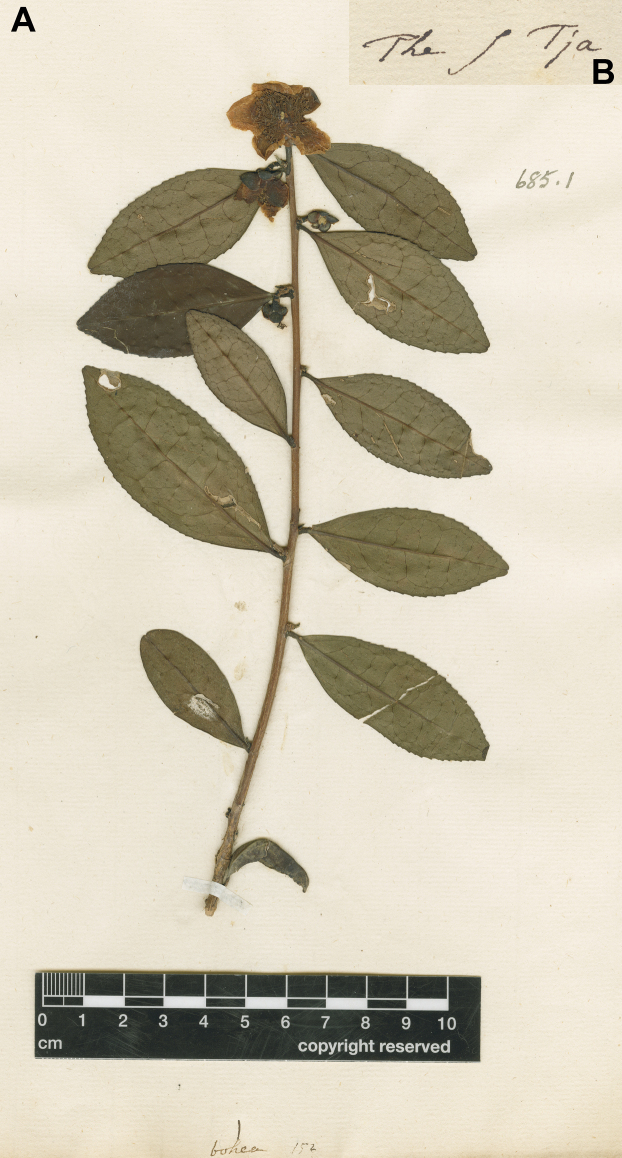 Figure 1
Peer Reviews
No public reviews on file for this paper yet. If you reviewed it on a platform where reviews are public (OpenReview, ICLR, NeurIPS, ICML), you can paste yours below so the community can read it here.
Videos
No videos yet. Explain this paper in a talk, walkthrough, or lecture? Add one.
Taxonomy
TopicsPlant and Fungal Species Descriptions · Plant Diversity and Evolution · Plant and animal studies
Introduction
Tea, Camellia sinensis (L.) Kuntze (Theaceae), is a globally popular beverage source plant (Zhao 2024). It yields huge economic (Li et al. 2022; Silva and Cooray 2022), healthy (Das et al. 2022), and cultural benefits (Zhou et al. 2021). Tea is native to China (Zhao 2024) and was initially documented by the Chinese people (Fang 1998). The beverage was subsequently taken to other countries and enjoyed by different nations (Jackson 1870; Ukers 1935; Zhang et al. 2018).
Linnaeus (1753) created Thea L. for Thea sinensis L. The genus was treated as a heterotypic synonym of Camellia L. (Sweet 1818) and subsequently, tea received its binomial name as a combination proposed by Kuntze (1881) above. The morphological variations of tea were soon discovered by different plant taxonomists. Since Linnaeus’s T. bohea L. (an illegitimate replacement name for T. sinensis) and T. viridis L. were considered to be conspecific (Zhao et al. 2017), more specific and infraspecific names for the species have been proposed (e.g., Hooker 1847; Pierre 1887; Watt 1907; Kitamura 1950; Chang 1981, 1984; Wang et al. 2011; Le et al. 2020). Some taxonomists argued that the diversity occurred within a single species and the efforts to divide them into different taxa were unnecessary (Seemann 1859; Dyer 1874; Cohen-Stuart 1919). By contrast, others suggested that the variations represented distinguishable infraspecific taxa (Pierre 1887; Watt 1907; Kitamura 1950; Sealy 1958; Hô 1991; Ming 2000; Zhao et al. 2017; Zhao 2024) or even distinct species (Wight 1962; Chang 1998).
Griffith (1854) established C. sect. Thea (L.) Griff. to include C. bohea (L.) Sweet, C. theifera Griff., and C. mastersia Griff. The natural diversity of C. sect. Thea has not been adequately described until the works of Chinese taxonomists, such as Zhang (1980), Liang and Zhong (1981), and Chang (1981, 1984), since recent research unveiled that China harbored all taxa of C. sect. Thea (Zhao 2022, 2024, 2025). With comprehensive collections examined, Ming (1992, 1999, 2000; Ming and Bartholomew 2007) accepted four varieties of tea, including C. sinensis var. sinensis, C. sinensis var. assamica (Royle ex Hook.) Steenis, C. sinensis var. dehungensis (Hung T. Chang & B.H. Chen) T.L. Ming, and C. sinensis var. pubilimba Hung T. Chang, largely based on the indumenta of the sepals and ovary, and their geographic distributions. Zhao (2024) added C. sinensis var. sinensis f. formosensis (Masam. & Suzuki) Kitam. based on Ming’s (2000) taxonomy of tea and suggested that there were four varieties and one form of C. sinensis.
However, several more names of infraspecific taxa of tea, including C. sinensis var. niaowangensis Q.H. Chen & H. Peng, T. cantoniensis Lour., T. chinensis var. pubescens Pierre, T. oleosa Lour., T. parvifolia Salisb., and T. viridis L., have been identified with nomenclatural problems, and they are discussed below.
Materials and methods
Specimens or their images conserved at herbaria (acronyms following Thiers [2026], continuously updated) A, BM, E, G, GXFI, HGAS, IBK, IBSC, K, KUN, L, LINN, NY, P, PE, SING, SYS, TAI, TCD, and US were examined. Names were typified under Arts. 7–9 of the Madrid Code (Turland et al. 2025, hereafter ICN), and the single correct name for each living taxon was identified under Art. 11.4 of the ICN.
Taxonomic treatment
Camellia
sinensis
Taxon classificationPlantaeEricalesTheaceae
(L.) Kuntze, Um die Erde: 500. 1881.
A48813A5-558A-5FD2-8F33-DB21FB22B245
≡ Thea sinensis L., Sp. Pl. 1: 515. 1753. ≡ Thea bohea L., Sp. Pl., ed. 2. 1: 734. 1762 ≡ Thea grandifolia Salisb., Prodr. Stirp. Chap. Allerton 370. 1796 ≡ Thea chinensis Sims, Bot. Mag. 25: t. 998. 1807 ≡ Camellia thea Link, Enum. Hort. Berol. Alt. 2: 73. 1822 – Lectotype (designated by Bartholomew in Jarvis et al. 1993: 93): “Tsja” in Kaempfer, Amoen. Exot. Fasc.: 606, f. 1–2. 1712 – Epitype (designated here): The s[ive] Tja, Linnaeus C. 152 (LINN, image! Fig. 1). — An image of the epitype is available at https://linnean.access.preservica.com/uncategorized/IO_fdd28637-3ffd-48a8-bb4a-696bf73fd09b/ = Thea viridis L., Sp. Pl., ed. 2. 1: 735. 1762 – Neotype (designated here): The s[ive] Tja, Linnaeus C. 152 (LINN, image! Fig. 1).
Notes.
Linnaeus (1753) did not designate a type for T. sinensis. He subsequently abandoned the name and adopted T. bohea (Linnaeus 1762), an illegitimate replacement name for T. sinensis (Zhao et al. 2017). After a series of searches of original material in the herbaria listed above, we found that there was a specimen of T. bohea, Linnaeus C. 152, conserved at herbarium LINN (Fig. 1). This collection bears complete leaves and flowers, which is suitable for acting as the lectotype of T. sinensis. Nevertheless, Bartholomew designated an illustration as the lectotype for T. sinensis (Jarvis et al. 1993), and his lectotypification must be followed under Art. 9.19 of the ICN (also see Art. 9 Ex. 2 for lectotyping Linnaean names). The illustration (Kaempfer 1712) does not, however, clearly show the diagnostic character states, such as the indumenta of the leaf buds, sepals, and ovaries, for precise identification of C. sinensis. Therefore, Linnaean specimen of T. bohea, Linnaeus C. 152 at LINN (Fig. 1), is selected as an epitype of T. sinensis to avoid potential confusion (Art. 9.9 of the ICN).
Epitype of Camellia sinensis (L.) Kuntze, Linnaeus C. 152 (LINN). A. The obverse; B. Records on the reverse. Images were downloaded on the website of LINN (https://linnean.access.preservica.com/uncategorized/IO_fdd28637-3ffd-48a8-bb4a-696bf73fd09b/) and adapted by D.W. Zhao. Reproduced under the terms of the Creative Commons Attribution-Non-Commercial 4.0 International License [CC BY-NC 4.0] (https://creativecommons.org/licenses/by-nc/4.0/).
Thea bohea and T. chinensis are illegitimate replacement names for T. sinensis (Zhao et al. 2017). Thea grandifolia and C. thea are also illegitimate replacement names for T. sinensis because T. bohea was the sole name cited in their synonymies (Salisbury 1796; Link 1822; Art. 52.2 [e] of the ICN). Linnaeus (1762) described T. viridis as “floribus enneapetalis” and recognized T. bohea as “floribus hexapetalis”. The number of petals usually varies within a single shrub of tea, so T. viridis was recognized as a heterotypic synonym of C. sinensis by previous taxonomists (e.g., Sealy 1958; Chang 1984; Ming 2000). The only citation under T. viridis, “Hill. exot. t. 22”, is also provided under T. bohea (Linnaeus 1762), so it cannot serve as the type material. To avoid further confusion of the names, the epitype of C. sinensis, Linnaeus C. 152 at LINN (Fig. 1), is selected as the neotype of T. viridis regardless of the number of petals.
Camellia sinensis var. sinensis is native to the subtropical provinces and Guangdong, Guangxi, and Hainan, China. It can be distinguished from other infraspecific taxa by its pubescent leaf buds, acute, shortly attenuate or rounded leaf apex, abaxially glabrous sepals, and pubescent ovaries (Fig. 1; Zhao 2024). As an indigenous popular beverage plant, tea has been collected and planted for at least two millennia in the populous regions of China (Fang 1998). Therefore, it is sometimes difficult to identify a living specimen of tea in the forest as being genuinely wild or having escaped from cultivation (Zhao 2022, 2024).
Camellia
sinensis var. pubilimba
Taxon classificationPlantaeEricalesTheaceae
Hung T. Chang, Acta Sci. Nat. Univ. Sunyatseni 20(1): 98. 1981.
631F278E-5A98-51D2-BDAE-461ACED987E7
= Thea cantoniensis Lour., Fl. Cochinch. 1: 339. 1790, syn. nov. – Holotype: Loureiro s.n. (P00150892, image!). — An image of the holotype is available at https://science.mnhn.fr/institution/mnhn/collection/p/item/p00150892 = Thea oleosa Lour., Fl. Cochinch. 1: 339. 1790, syn. nov. – Holotype: Loureiro s.n. (P00150891, image!). — An image of the holotype is available at https://science.mnhn.fr/institution/mnhn/collection/p/item/p00150891 = Thea parvifolia Salisb., Prodr. Stirp. Chap. Allerton 370. 1796 ≡ Camellia sinensis f. parvifolia (Salisb.) Sealy, Rev. Gen. Camellia 116. 1958, syn. nov. – Neotype (designated here): Loureiro s.n. (P00150891, image!). = Thea chinensis var. pubescens Pierre, Fl. Forest. Cochinch. t. 114 B. 1887, syn. nov. – Lectotype (designated here): Pierre, Fl. Forest. Cochinch. t. 114 B. 1887. var. niaowangensis = Camellia sinensis var. niaowangensis Q.H. Chen & H. Peng, Seed 30(1): 65. 2011, syn. nov. – Holotype: China. Guizhou: Guiding, Pingfa, 1400 m, 5 November 2007, J.H. Wang 07001 (HGAS!).
Holotype.
China • Guangxi: Lingyun, Guangxi Forestry Institute 4209 (GXFI!).
Notes.
Abaxial sepal indumentum of tea plants is a naturally variable character. Chang (1981) proposed a name, C. sinensis var. pubilimba, for the tea plant bearing an abaxially pubescent sepal. However, the earliest names for this kind of plant are T. cantoniensis and T. oleosa, which were described in 1790, and their types are conserved at herbarium P (also see Sealy 1958). Based on molecular phylogenetic analyses (Shen et al. 2025; Zhao 2025), samples of C. sinensis var. pubilimba cannot form a clade, and they are nested in the broad concept of tea, so it should be treated as an infraspecific taxon of tea rather than an independent species. Therefore, T. cantoniensis and T. oleosa do not bear priority at the infraspecific rank under Arts. 11.2 and 11.4 of the ICN.
Sealy (1958) suggested that C. sinensis f. parvifolia bore an abaxially hairy sepal. Since no type was indicated in the protologue of T. parvifolia (Salisbury 1796), the holotype of T. oleosa (P00150891) is selected as the neotype of T. parvifolia. Sealy’s C. sinensis f. parvifolia may be the earliest infraspecific name for the plant based on the literature available. However, it is better to treat the tea plant bearing an abaxially hairy sepal as a variety of C. sinensis because this variation occurs in the natural distribution areas of both tea and Assam tea (C. sinensis var. assamica). Additionally, Chang’s (1981) C. sinensis var. pubilimba has been used so widely (e.g., Chang and Bartholomew 1984; Ming 2000; Ming and Bartholomew 2007; Meng et al. 2018; Nguyen et al. 2022; Zhao 2024; Kong et al. 2025) that sustaining its nomenclatural stability will be very helpful (see Art. 14.2 of ICN). Therefore, the plant remains recognized as a variety of tea, and the name, C. sinensis var. pubilimba, retains the priority at the varietal rank (Art. 11.4 of the ICN) and accordingly, serves as the single correct name for the taxon.
Thea chinensis var. pubescens bore an abaxially hairy sepal according to its illustration (Pierre 1887), which is selected as the lectotype of the taxon. Thea cantoniensis, T. chinensis var. pubescens, T. oleosa, and T. parvifolia are all treated as the earlier heterotypic synonyms of C. sinensis var. pubilimba. A recently published name, C. sinensis var. niaowangensis (Wang et al. 2011), is also treated as a heterotypic synonym of C. sinensis var. pubilimba because it bears the common diagnostic character state of the sepals.
Supplementary Material
XML Treatment for Camellia sinensis
XML Treatment for Camellia sinensis var. pubilimba
The reference list from the paper itself. Each links out to its DOI / PubMed record.
- 1Chang HT (1981) Thea—A section of beveragial tea-trees of the genus Camellia. Acta Scientiarum Naturalium Universitatis Sunyatseni 20(1): 87–99. http://xuebao.sysu.edu.cn/Jweb_zrb/CN/Y 1981/V 20/I 1/89
- 2Chang HT (1984) A revision on the tea resource plants. Acta Scientiarum Naturalium Universitatis Sunyatseni 23(1): 1–12. http://xuebao.sysu.edu.cn/Jweb_zrb/CN/Y 1984/V 23/I 1/3
- 3Chang HT (1998) Theaceae (1) Theoideae 1. Camellia. In: Delectis Florae Reipublicae Popularis Sinicae Agendae Academiae Sinicae Edita (Eds) Flora Reipublicae Popularis Sinicae (Vol. 49[3]). Science Press, Beijing, 3–195.
- 4Das C, Banerjee A, Saha M, Chatterjee S (2022) A review of the health benefits of tea: Implications of the biochemical properties of the bioactive constituents. Current Research in Nutrition and Food Science 10: 458–475. 10.12944/crnfsj.10.2.5 · doi ↗
- 5Dyer WTT (1874) Ternstroemiaceae. In: Hooker JD (Ed.) The Flora of British India (Vol. 1). L. Reeve & Co., London, 279–294. 10.5962/bhl.title.678 · doi ↗
- 6Griffith W (1854) Notulae ad plantas Asiaticas, part 4. Printed by Charles A. Serrao, Calcutta, 764 pp. 10.5962/bhl.title.70352 · doi ↗
- 7Hooker WJ (1847) Kew gardens; or a popular guide to the Royal Botanic Gardens of Kew. Printed for Longman, Brown, Green, and Longmans, London, 56 pp. 10.1017/cbo 9781107324954 · doi ↗
- 8Jackson JR (1870) Tea. Nature 2: 215–217. 10.1038/002215 a 0 · doi ↗