Acute effects of strength training interventions on subjective, neuromuscular, and biochemical fatigue parameters in elite youth soccer players
Björn Kadlubowski, Michael Keiner, Klaus Wirth, Robert Csapo

TL;DR
This study compared two strength training methods in young elite soccer players and found both caused similar short-term fatigue that recovered within 72 hours.
Contribution
The study provides new insights into the acute fatigue responses of two strength training protocols in elite youth soccer players.
Findings
Both strength training protocols induced similar fatigue and recovery patterns over 72 hours.
Subjective fatigue levels aligned with objective neuromuscular and biochemical markers.
Fatigue returned to baseline within 72 hours, supporting safe use of these protocols with proper recovery.
Abstract
This study examined acute neuromuscular, biochemical, and subjective fatigue responses to two strength training protocols—back squats with calf raises vs. back squats with plyometric exercises—in elite youth soccer players. The aim was to track the progression and resolution of fatigue over a 72 h recovery period and evaluate the practical feasibility of both protocols within high-performance training schedules. Thirty-two male athletes from a national youth elite training center participated in a crossover-controlled study. Each player completed both interventions, separated by an 8-day washout period. A comprehensive test battery assessed neuromuscular performance via the countermovement jump (CMJ), drop jump, isometric mid-thigh pull, adductor squeeze, and sit-and-reach test; biochemical markers via creatine kinase (CK); and subjective markers using the Hooper Index, visual analog…
Genes, proteins, chemicals, diseases, species, mutations and cell lines named across the full text — each resolved to its canonical identifier and authoritative record.
Click any figure to enlarge with its caption.
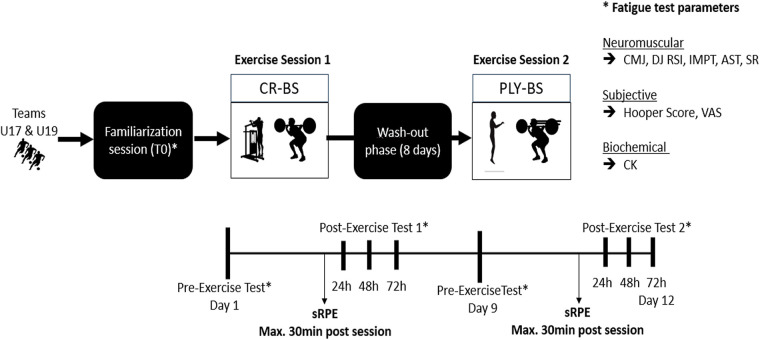 Figure 1
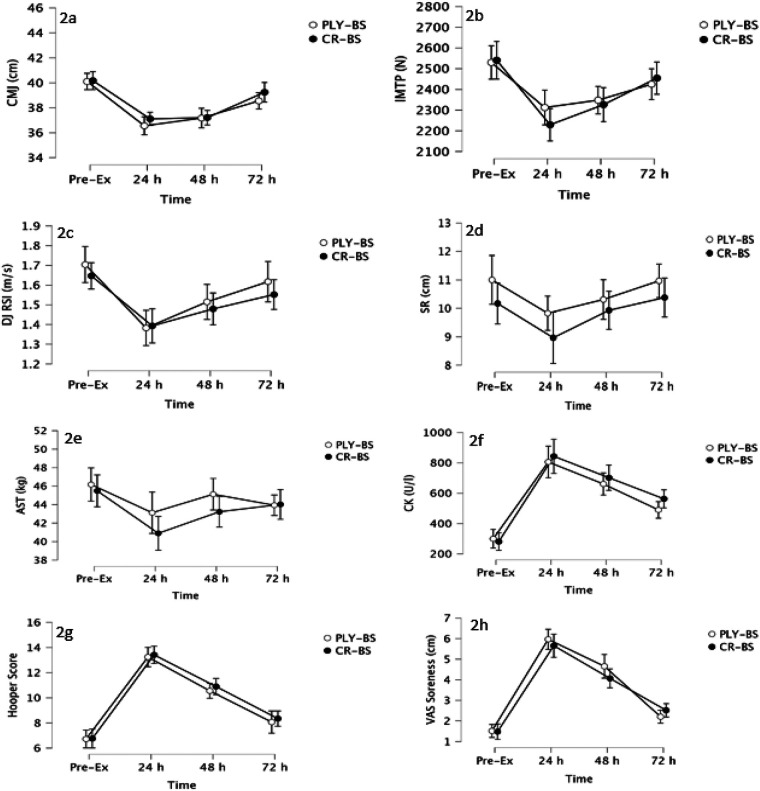 Figure 2
| Sets BS/CR | Repetitions BS/CR | Weight (kg) | Breaks after sets (min) BS/CR |
|---|---|---|---|
| 5/5 | 8–12/8–12 | (80 ± 10)/(50 ± 15) | 3/3 |
| Exercises | Sets/repetitions | Weight (kg) | Breaks after repetitions (s) | Breaks after sets (min.) |
|---|---|---|---|---|
| Hurdle jumps (30 cm) | 4/6 | – | 30 | 2 |
| Drop jumps (45 cm) | 4/6 | – | 20 | 2 |
| BS | 5/8–12 | 80 ± 10 | – | 3 |
| Fitness test | Mean ± SD | ICC (95% CI) |
|---|---|---|
| Counter-movement jump | 40.29 ± 3.89 | 0.991 (0.98–0.99) |
| Isometric mid-tigh pull | 2,418.30 ± 255.74 | 0.848 (0.72–0.92) |
| Drop-jump | 1.63 ± 0.39 | 0.974 (0.95–0.99) |
| Sit-and-reach | 9.23 ± 3.06 | 0.994 (0.99–1.00) |
| Adductor strength test | 38.98 ± 9.21 | 0.980 (0.96–0.99) |
Peer Reviews
No public reviews on file for this paper yet. If you reviewed it on a platform where reviews are public (OpenReview, ICLR, NeurIPS, ICML), you can paste yours below so the community can read it here.
Videos
No videos yet. Explain this paper in a talk, walkthrough, or lecture? Add one.
Taxonomy
TopicsSports Performance and Training · Sports injuries and prevention · Exercise and Physiological Responses
Introduction
Strength and explosiveness are fundamental physical qualities in high-performance soccer players, underpinning key actions such as sprinting, jumping, tackling, and rapid changes of direction that collectively contribute to overall match performance (1–4). Consequently, structured strength and plyometric training interventions are widely implemented within elite youth development programs to enhance neuromuscular performance and prepare players for the increasing physical demands of professional soccer (5–7).
Recent findings by Crotty et al. (8), and Pandy et al. (9), highlight the crucial role of the plantar flexors during acceleration. Traditional strength training, typically involving squats and calf raise exercises, is primarily performed with controlled movement velocities and moderate-to-high external loads and aims to increase maximal force production and foundational strength capacities (10). These adaptations are considered essential for supporting sprint acceleration, jump performance, and force transmission during high-intensity soccer actions. In contrast, plyometric or reactive strength training emphasizes rapid eccentric–concentric muscle actions and focuses on enhancing stretch–shortening cycle efficiency, reactive strength, and neuromuscular coordination (11, 12). Kadlubowski et al. (13), investigated the effects of a 6-month training intervention combining back squats either with standing calf raises or with reactive strength training. Their results showed that both interventions may improve sprint, jump and maximal strength performance, with no significant differences between them. Based on these findings, both approaches could be considered viable components of youth elite soccer training programs.
However, when evaluating the suitability of a training method, it is not sufficient to consider performance improvements alone. The physiological strain imposed on players, and the resulting fatigue, plays a decisive role in determining how well strength and conditioning measures can be integrated into the broader context of soccer-specific development, particularly technical and tactical skill acquisition, which remains the top priority in youth training. Moreover, excessive strain may interfere with match performance and recovery during competitive seasons, underscoring the need for carefully balanced training programs. Given the distinct biomechanical and neuromuscular demands associated with traditional and reactive strength training, it is plausible that different fatigue trajectories may emerge. Understanding these differences is essential for optimizing training loads, supporting athlete development, and ensuring that strength and conditioning measures enhance rather than disrupt overall soccer performance. In applied terms, identifying the short-term fatigue and recovery characteristics of each modality can help coaches schedule strength and plyometric sessions appropriately within weekly training microcycles.
Fatigue responses to strength training are task-dependent and reflect both central and peripheral mechanisms, which vary with the nature of the activity (14–16). Fatigue is a multidimensional phenomenon encompassing both subjective perceptions of effort or tiredness and objective, measurable declines in performance capacity. Kluger et al. (17), distinguish between perceptual fatigue—the subjective feeling of exhaustion—and performance fatigability—the actual decline in physical performance. In the context of strength and conditioning, these dimensions interact dynamically, as neuromuscular impairments can influence perceptual strain, while heightened perceived effort may, in turn, affect neuromuscular performance. Evaluating both subjective and neuromuscular markers therefore provides a more comprehensive understanding of post-exercise fatigue in elite youth soccer players. Traditional strength training, typically involving high external loads and controlled movement velocities, initiates fatigue primarily through central (neural) mechanisms, such as reduced motor unit recruitment. As the session progresses, peripheral factors, such as disruptions in excitation, contraction coupling, accumulation of metabolic by-products, and increased mechanical stress, may further contribute to the observed decline in performance (14, 18, 19). However, the extent and nature of fatigue are strongly influenced by the specific loading scheme (number of sets and repetitions, relative intensity, and recovery duration) which determine the balance between neural and peripheral contributions. For instance, eccentric-biased prescriptions typically induce greater muscle damage and slower recovery than other contraction modes, even at similar external loads (20, 21). At matched intensities, sets performed closer to momentary failure tend to elicit larger acute neuromuscular and metabolic disturbances and slower recovery within 24–48 h (21, 22). As training progresses, peripheral factors such as impaired excitation–contraction coupling, accumulation of metabolic by-products, and mechanical microtrauma further contribute to performance decrements (16, 23). In contrast, reactive strength training (RST), which emphasizes rapid SSC actions, elicits transient neuromuscular fatigue without substantial metabolic disturbance or alterations in tendon stiffness (24, 25). These differences are likely to result in distinct recovery trajectories, which in turn affect how easily each training modality can be integrated into a soccer training schedule.
Empirical studies have shown that neuromuscular performance and biochemical markers such as creatine kinase may remain impaired for 24–72 h after soccer match play and after resistance or plyometric exercise (22, 26–29). In addition to such objective markers, sRPE has become a widely used tool to capture athletes’ global perception of internal load, as values obtained within a short period following exercise are considered to provide a valid representation of the overall session demand while minimizing recall bias (30, 31). However, most available data come from adult players and from studies examining single exercise modalities or single fatigue dimensions, leaving limited evidence on how different strength-training approaches compare when multiple fatigue markers are assessed concurrently in elite youth athletes.
This study aimed to compare the fatigue responses elicited by two commonly used strength training modalities—traditional strength training (squats combined with calf raises) and a program emphasizing reactive strength training (squats combined with plyometric exercises)—over a 72 h recovery period in youth soccer players. To ensure a comprehensive understanding of training-induced fatigue, a multi-faceted methodological approach was chosen, incorporating subjective, biochemical, and neuromuscular measures. While the acute neuromuscular and biochemical responses to strength training are influenced by variables such as training volume and time under tension, hypertrophy-oriented resistance-based exercise stimuli typically impose greater mechanical strain and sustained neural activation than the reactive, plyometric stimulus. We therefore hypothesized that it would result in more pronounced and prolonged fatigue-related responses compared to the combined strength-plyometric session.
Materials and methods
This study employed a crossover-controlled design to examine acute neuromuscular, biochemical, and subjective fatigue responses to two strength training protocols in elite youth soccer players. This classification of players followed internationally recognized criteria (32, 33). Participants were recruited from the under−17 (U17) and under-19 (U19) teams of a German elite youth academy, representing the highest competitive level below professional soccer and competing in the highest national junior division (U17/U19 Junioren-Bundesliga) for these age categories.
The two training protocols included (i) traditional strength training, consisting of back squats combined with standing calf raises (CR-BS), and (ii) a multi-modal exercise protocol emphasizing reactive strength training that consisted of back squats combined with plyometric exercises (PLY-BS). All players completed the CR-BS protocol prior to the PLY-BS protocol, separated by an 8-day washout phase. The order was determined to ensure methodological consistency and because traditional loading was considered a more controlled protocol before exposure to higher reactive demands.
Fatigue assessments were conducted at four time points: pre-exercise (baseline), and 24, 48, and 72 h post-exercise. sRPE was recorded within a maximum of 30 min after each exercise session. While several tests have been validated specifically in soccer populations, others have been primarily validated in athletic or resistance-training contexts. These measures were included based on their established physiological relevance, high reliability, and frequent application in applied sports science research to assess neuromuscular performance and fatigue-related responses. A visual overview of the study design is provided in Figure 1.
Experimental design. U19, under-19; U17, under-17; PLY-BS, black squat and plyometric training group; CR-BS, black squat and standing calf raise group; CMJ, countermovement jump; DJ RSI, drop jump reactive strength index; IMPT, isometric mid-thigh pull; AST, adductor squeeze test; SR, sit and reach test; VAS, visual analogue scale; CK, creatine kinase; sRPE, session rating of perceived exertion.
Subjects
Thirty-two male youth soccer players (age: 16.5 ± 0.7 years; height: 1.78 ± 0.06 m; mass: 72.2 ± 7.3 kg) from the U17 and U19 squads of a German elite youth academy participated in this study. All players had been playing soccer since early childhood, with an average training age of approximately 12 years. All participating players typically engaged in 4–5 weekly soccer-specific training sessions (90 min each), focused on technical and tactical development, along with weekend competitions. In addition, they regularly engaged in two weekly athletic training sessions. These sessions included sprinting, jumping, stabilization exercises, and basic strength work; however, none of the players had prior experience with systematic strength training programs.
The study-specific exercise sessions were conducted over a two-week period during the Easter break—a phase without league matches. In the two weeks prior to the study, no strength or reactive strength training was performed, and in the two days preceding baseline testing no soccer was played and no athletic training was conducted. These measures ensured that players entered the intervention in a standardized and rested condition. To further minimize residual fatigue, the intervention and pre-assessment sessions were scheduled eight days apart.
Due to logistical constraints –players were living at home and attending different schools—systematic monitoring of sleep and nutritional behavior was not feasible. However, all participants were reminded to ensure adequate sleep and maintain a balanced diet. Given the athletes’ competitive level and professional aspirations, it can reasonably be assumed that they adhered to generally healthy lifestyle habits.
None of the subjects reported injuries at the time of testing. All participants—and, in the case of minors, their legal guardians—were informed about the experimental risks associated with the study before providing written informed consent. Ethical approval was obtained from the institutional review board of the German University of Health and Sport (DHGS-EK-2024-008) and the study was conducted in accordance with the Helsinki Declaration.
Measures and procedures
To comprehensively monitor neuromuscular performance, flexibility, and fatigue status, a structured and validated test battery was administered under standardized conditions. All testing sessions were conducted in the morning hours (09:00–11:00) in the gym under standardized indoor conditions to minimize circadian variation and environmental influences. Players refrained from strenuous training for at least 48 h prior to baseline testing. A familiarization session was conducted in a rested state one week prior to the first exercise session. During this session, players performed three trials off the following tests to assess parameters indicative of neuromuscular fatigue: sit and reach test (SR); isometric adductor squeeze test (AST); countermovement jump (CMJ); drop jump (DJ); and isometric mid-thigh-pull (IMTP)). All other measures were obtained in a single trial. A one-minute passive recovery period was provided between individual tests. This interval was selected to reduce the risk of cumulative fatigue while preserving neuromuscular readiness and has been shown to be sufficient for reliable performance assessment in similar neuromuscular testing protocols (34, 35). The consistent use of this rest interval across all testing sessions ensured methodological standardization.
On the two exercise days, the players performed only one trial per test immediately before and within a maximum of 30 min after the exercise session. The test sequence was selected based on current scientific evidence (36) and best-practice recommendations to ensure validity and minimize intra-session fatigue and test interference (37). The consistent use of this rest interval across all testing sessions ensured methodological standardization. Testing lasted approximately 15 min.
Physical testing was supervised by four experienced coaches to ensure strict adherence to protocols and maximize measurement reliability. To maintain consistency and minimize inter-rater variability, all assessments were conducted by the same individuals throughout the study. One coach was responsible for collecting creatine kinase samples, another administered the subjective questionnaires, and two coaches oversaw neuromuscular fatigue assessments. A one-minute break was provided between all tests.
Subjective fatigue markers were assessed first to provide insight into the athletes’ recovery status prior to physical exertion. Flexibility was then measured using the SR, a reliable and widely accepted method for evaluating lower back and hamstring flexibility (Cuenca-Garcia et al., 2022). This was followed by the AST, CMJ, and DJ, all of which served as indicators of neuromuscular fatigue particularly relevant to soccer performance. To avoid potentiation or fatigue effects influencing subsequent tests, the IMTP was performed last to assess maximal muscle strength, as the contractile history of prior maximal or near-maximal efforts may acutely enhance subsequent explosive performance through post-activation potentiation (Tillin & Bishop, 2009; Blazevich & Babault, 2019). Finally, blood samples were collected for creatine kinase analysis.
Jump performance was assessed using a dual force plate system (FD4000, VALD Performance, Brisbane, Australia) sampling at 1,000 Hz, with jump height calculated using the impulse-momentum method in accordance with validated protocols (38). During the baseline test, a one-minute rest was provided between individual trials and a 15 min rest between different jump types.
For the CMJ, players were instructed to bend their knees to 90°, then perform an explosive vertical jump with hands fixed on the hips to ensure a stable posture (39). DJs were performed from a height of 30 cm. Participants stood with their hands on their hips and stepped horizontally off the box, aiming to minimize ground contact time and maximize jump height. To reduce contact duration, they were instructed not to let their heels touch the ground upon landing. The RSI, calculated as the ratio of jump height (cm) and ground contact time (s), was used as gross indicator of DJ performance. Both CMJ height and DJ RSI have demonstrated good-to-excellent reliability in soccer players and are considered sensitive markers of neuromuscular status (40–43).
Flexibility of the hamstrings and lower back was assessed using the SR with a Sit and reach box (Baseline, PhysioSupplies, Groningen, Niederlande). Participants sat on the floor with both legs extended and the soles of their feet flat against the front panel of the box. With one hand placed on top of the other and arms fully extended at shoulder height, they were instructed to take a deep breath, exhale, and reach forward as far as possible without bending their knees. If a trial was deemed invalid due to knee flexion or other form violations, an additional attempt was permitted. The SR is widely used in athletic populations to assess flexibility and can also serve as indirect indicator of muscular fatigue. Reductions in flexibility may reflect transient increases in muscle stiffness and reduced range of motion resulting from exercise-induced muscle damage, inflammation, and elevated passive tension (20, 44). Although the sit-and-reach test has been most extensively validated in adult populations, it has also been widely used in youth and adolescent athletes as a practical field-based measure of posterior chain flexibility. However, flexibility assessments in youth athletes may be influenced by growth- and maturation-related factors, including changes in limb length and musculoskeletal development, which should be considered when interpreting absolute values (45). Previous studies have demonstrated high test–retest reliability in adult males (ICC > 0.97) (46), making it a practical tool for both performance and recovery monitoring.
The AST was used to quantify isometric hip adduction strength and assess fatigue-related strength loss. The test was performed in a supine position with the hips at 45° flexion, the knees at 90°, and the arms positioned alongside the body. A specific dynamometer (KangaTech KT360, North Melbourne, VIC, Australia) was placed between the knees, and participants performed a maximal squeeze for 5 s. Research in semi-professional soccer players has shown high test-retest reliability (ICC > 0.80) (47).
Maximal isometric force and rate of force development (RFD) were assessed using the IMTP. Participants stood on a force platform (FD4000, VALD Performance) in a standardized partial squat position, with the grip fixed at mid-thigh level. A metal bar with a rough surface was connected to the floor via an adjustable chain, which was individually adjusted to each participant's anthropometrics to ensure consistent positioning and tension. Participants performed a maximal pull lasting 5 s, and peak force (N) was calculated. The IMTP is considered a reliable and sensitive measure of neuromuscular fatigue and maximal strength capacity, with ICC values reported in male youth soccer players ranging from 0.84 to 0.98 (48).
The Hooper questionnaire was administered to assess the athletes’ perceived response to the preceding exercise session (49). Each player rated four subjective parameters: (i) sleep quality during the previous night, (ii) perceived stress, (iii) fatigue, and (iv) muscle soreness. Each variable was evaluated using a 7-point Likert scale ranging from 1 (‘very, very low’ or ‘very good’) to 7 (‘very, very high’ or ‘very poor’). The overall Hooper score (HS) was calculated as the sum of these four individual ratings, yielding a single composite measure of the athletes’ psychophysiological status, with higher total scores indicating greater perceived fatigue and poorer recovery status, whereas lower scores reflect a more recovered state. The Hooper Index has been shown to be a practical and sensitive tool for tracking match-induced fatigue and overall wellness in team-sport athletes, with small typical error relative to the smallest worthwhile change and good signal-to-noise characteristics when monitoring recovery in professional soccer players (50). Additionally, its subcomponents, including fatigue, stress, sleep quality, and muscle soreness, have been linked to training load variations in elite soccer, supporting its validity as a psychophysiological indicator of athlete status in both individual and team sport contexts (51).
sRPE was used as a subjective measure of internal load and collected exclusively after completion of the exercise sessions. This tool captures the athletes’ perceived exertion and is commonly used to complement objective indicators such as heart rate or external training load (30, 52). Within a maximum of 30 min after each exercise session, players were asked to rate their overall perceived effort during the session on a 10-point modified Borg scale, ranging from 0 (“rest”) to 10 (“maximal exertion”) (30). sRPE is widely used as a valid indicator of internal training load, showing strong associations with physiological markers such as heart rate and blood lactate across a range of team-sport populations (53–55). It also demonstrates good reliability when collected within a short time window after exercise and provides a practical means to quantify global effort in both training and competition settings (56, 57).
Subjective perceptions of mental and muscular fatigue were evaluated using the VAS, a widely accepted tool for assessing symptoms such as pain, fatigue, and soreness due to its simplicity, sensitivity, and established validity and reliability (58, 59). The VAS consists of a 10 cm horizontal line with descriptive anchors at each end: “no muscle soreness” on the left and “worst imaginable muscle soreness” on the right. To standardize the evaluation, participants performed a barefoot bodyweight squat to a 90° knee angle before indicating the intensity of soreness on the VAS. They were instructed to mark their perceived level along the line.
To evaluate exercise-induced muscle damage, creatine kinase (CK)—one of the most commonly used biomarkers for detecting muscle tissue disruption following physical exertion—was analyzed (60, 61). CK has consistently been shown to rise in response to strenuous exercise and match play in team-sport athletes, supporting its validity as an indicator of muscle disruption (62, 63). Although absolute responses may vary substantially between individuals, repeated measurements demonstrate acceptable within-subject consistency when pre-analytical variation is controlled (64). Capillary blood samples were collected from the fingertip and analyzed using the SimplexTAS™ 101 analyzer with a parameter-specific reagent cartridge (Hitado GmbH, Dreihausen, Möhnesee, Germany). Quality-control procedures were performed in accordance with the manufacturer's guidelines, including internal system checks prior to each testing session. Parameter-specific, single-use reagent cartridges containing pre-calibrated reagents were used for all analyses, minimizing operator-dependent variability.
Exercise interventions
To minimize confounding effects of prior fatigue, overall training load was deliberately reduced during the study period. The two experimental sessions (PLY-BS and CR-BS), each lasting up to 60 min, were performed once per week, with no additional athletic or soccer training scheduled on the respective days. The first session was conducted on a Monday, followed by the second on the Tuesday of the following week.
Between the experimental sessions, only three moderate-intensity training sessions were conducted—on the Thursday, Friday and Saturday following the first session. These sessions explicitly excluded sprinting, jumping, and strength-based exercises to avoid inducing neuromuscular fatigue. This approach provided a controlled training environment and minimized carryover effects between the two experimental conditions. A detailed weekly overview of the experimental and concurrent training sessions is provided as Supplementary Material.
The exercise stimuli implemented in the two experimental conditions consisted of the BS exercise with an Olympic barbell and standing CR on a calf raise machine (CR-BS), or BS combined with plyometric training (PLY-BS). Prior to the first experimental session, participants completed a familiarization session to ensure proper execution. Both protocols followed a hypertrophy-oriented intensity format. Training loads were based on those used during a strength training session conducted three weeks earlier, which also involved the same barbell and calf raise machine. The intensity for both BS and CR exercises was prescribed according to a repetition scheme using moderate loads (from 8 to 12 repetitions per set at 60% to 80% of 1-RM) (65). Importantly, all sets were performed to volitional fatigue, in line with the hypertrophy-focused approach described by Kadlubowski et al. (13). The same weight was used in both experimental sessions.
Warm-up routines were performed both with the barbell and on the calf raise machine, consisting of two unloaded sets of 20 repetitions and one set of 10 repetitions with an additional 20 kg load. In preparation for the plyometric exercises, participants completed ten minutes of coordinative drills and dynamic stretching. Warm-up sets were clearly separated from the working sets and not included in the total working set count.
The CR-BS session began with the BS exercise, followed by the CR. Initial weight selection aimed to allow all players to complete the prescribed repetitions with proper form, avoiding compensatory movements. If execution was incorrect, the set was terminated and the load reduced by 5 kg in the following set. Conversely, if more than 12 repetitions to volitional fatigue were possible, the load was increased by 5 kg in the subsequent set. Further details of the CR-BS exercise session are provided in Table 1.
The exercise stimulus for the PLY-BS condition included reactive bounding jumps over mini hurdles, which required a controlled slow eccentric phase and emphasized horizontal force development. The spacing of the hurdles and the box height were adjusted in accordance with the hypertrophy block described by Kadlubowski et al. (13). The protocol also included drop jumps from a 45 cm height, emphasizing a brief eccentric phase, short ground contact times (<250 ms), and explosive vertical force development. Players, who were already familiar with various forms of plyometric exercise, were specifically instructed to minimize knee and hip flexion upon landing (66). Following completion of the plyometric component, participants performed the BS exercise as described above. A detailed overview of the plyometric exercise protocol combined with the BS is presented in Table 2.
Statistical analysis
The significance level for all statistical tests was set at p < 0.05. The normality of data was assessed using the Kolmogorov–Smirnov test, and results are expressed as mean ± SD for all parameters across training modalities and time points. For the neuromuscular variables, intraclass correlation coefficients (ICC) and 95% confidence intervals (95%) were calculated as measures of test-retest reliability.
To assess the assumption of sphericity, which is a prerequisite for repeated-measures ANOVA, Mauchly's test of sphericity was applied to all within-subject factors. In cases where this assumption was violated (p < 0.05), Greenhouse-Geisser corrections were used to adjust the degrees of freedom and preserve statistical validity.
To examine changes over time and differences in response to the two training protocols (PLY-BS vs. CR-BS), a two-way repeated-measures ANOVA (2 × 4) was performed for each outcome measure, considering both training modality (PLY-BS, CR-BS) and time (PRE-EX, Post24, Post48, Post72) as within-subjects factors. Where significant interaction or main effects were identified, Bonferroni-adjusted pairwise comparisons were conducted to locate differences between specific time points.
For the ANOVA results the effect sizes for the global effects were calculated via the partial square of eta (η^2^). In general, effect sizes of η^2^ ≥ 0.25 are classified as large, η^2^ ≥ 0.1 as moderate and η^2^ ≥ 0.01 as small (67).
Results
Descriptive statistics including means, standard deviations, intraclass correlation coefficients (ICC), and 95% confidence intervals for all baseline performance measures are reported in Table 3. All outcome variables were normally distributed, confirming the suitability of parametric statistical analyses.
The results of the repeated-measures ANOVAs used to analyze the effects of training modality (PLY-BS, CR-BS) and time (PRE-EX, Post24, Post48, Post72) on the performance parameters are presented in the following sections. The time course of all outcome measures by training modality is illustrated in Figures 2a–h. No significant time × training modality interactions were found for any of the outcome measures, indicating that the two training protocols elicited comparable temporal patterns of change. Likewise, main effects of training modality were non-significant across all variables, whereas significant main effects of time were observed for each outcome, reflecting systematic changes over the post-exercise recovery period.
(a–h) time course of the various fatigue test parameters at baseline and 24, 48, and 72 h post-exercise. (a) Countermovement jump performance; (b) Isometric mid-thigh-pull pertformance; (c) Drop jump reactive strength index; (d) Sit and reach test; (e) Adductor squeeze test; (f) Creatine kinase levels; (g) Hooper questionnaire scores; (h) Visual analogue scale results. PLY-BS, back squat and plyometric training group; CR-BS, back squat and standing calf raise on a machine group; Pre-Ex, baseline test; h, hours; cm, centimeter; N, force; m/s, meter per second; kg, kilogram; CK, Creatine kinase; U/L, units per liter; VAS, visual analogue scale; IMPT, isometric mid-thigh pull; Drop jump reactive strength index; SR, sit and reach test; AST, adductor squeeze test; VAS, visual analogue scale; cm, centimeter.
For the CMJ (Figure 2a), no significant interaction [F(3,26) = 1.465, p = 0.247, ηp^2^ = 0.149] or main effect of training modality [F(1,28) = 0.984, p = 0.330, ηp^2^ = 0.034] was found. However, a significant main effect of time was observed [F(3,26) = 29.373, p < 0.001, ηp^2^ = 0.772], indicating performance changes across the post-exercise time points.
The IMTP (Figure 2b) showed no significant interaction effect [F(3,26) = 1.005, p = 0.406, ηp^2^ = 0.104] or main effect of training modality [F(1,28) = 0.156, p = 0.696, ηp^2^ = 0.006], while a significant main effect of time [F(3,26) = 15.061, p < 0.001, ηp^2^ = 0.635] was found.
DJ (Figure 2c) performance also showed no significant interaction effect [F(3,26) = 0.032, p = 0.406, ηp^2^ = 0.031] and no significant differences between training modalities [F(1,28) = 0.612, p = 0.441, ηp^2^ = 0.021], but a significant main effect of time was observed [F(3,26) = 17.200, p < 0.001, ηp^2^ = 0.665].
For SR (Figure 2d), no statistically significant interaction [F(3,26) = 0.058, p = 0.663, ηp^2^ = 0.058] or main effect of training modality [F(1,28) = 1.670, p = 0.207, ηp^2^ = 0.056] was detected, however, a moderate main effect of time was observed [F(3,26) = 6.868, p = 0.002, ηp^2^ = 0.435].
The AST (Figure 2e) showed neither a significant interaction [F(3,26) = 0.176, p = 0.164, ηp^2^ = 0.176] nor a significant main effect of training modality [F(1,28) = 1.055, p = 0.313, ηp^2^ = 0.036], while a significant change over time [F(3,26) = 10.261, p < .001, ηp^2^ = 0.542] was found.
CK (Figure 2f) levels showed neither a statistically significant interaction [F(3,26) = 0.121, p = 0.332, ηp^2^ = 0.121] nor a main effect of training modality [F(1,28) = 0.534, p = 0.471, ηp^2^ = 0.019], but they increased significantly over time [F(3,26) = 51.504, p < 0.001, ηp^2^ = 0.856], indicating elevated muscle damage markers post-exercise.
For the Hooper score (Figure 2g) no significant time × training modality interaction [F (3,26) = 0.145 p = 0.932, ηp^2^ = 0.016] or training modality effects [F (1,28) = 0.457, p = 0.505, ηp^2^ = 0.016] were found, however it was significantly affected by the factor time [F(3,26) = 55.115, p < 0.001, ηp^2^ = 0.864].
Similarly, VAS ratings of muscle soreness (Figure 2h) showed no significant interaction effect [F(3,26) = 0.165, p = 0.189, ηp^2^ = 0.165] and no significant main effect of training modality [F(1,28) = 0.882, p = 0.356, ηp^2^ = 0.031], but a significant main effect of time [F(3,26) = 84.307, p < 0.001, ηp^2^ = 0.907].
Discussion
The present study investigated and compared the acute fatigue responses to two strength training sessions—traditional strength training (CR-BS) and a protocol emphasizing reactive plyometric training (PLY-BS)—in elite youth soccer players over a 72 h recovery period. Contrary to our hypothesis, no significant training modality × time interactions were observed for any of the measured outcome parameters, suggesting that both interventions elicited comparable fatigue trajectories across neuromuscular, biochemical, and subjective markers. Nonetheless, the significant time effects detected across multiple outcomes underscore the importance of monitoring recovery over several days. Even among youth athletes, who generally demonstrate faster recovery kinetics and higher adaptive potential compared to adults due to lower absolute mechanical strain and greater relative oxidative efficiency (68, 69), both training modalities induced measurable fatigue responses within the 72 h post-exercise period.
Consistent with previous findings (2, 22), both interventions induced marked impairments in neuromuscular performance within the first 24 h post-exercise, particularly evident in CMJ (−8.85%), IMTP (−17.29%), and DJ (−17.29%) performance. These decrements are indicative of fatigue affecting both contractile function and SSC efficiency. Although PLY-BS training is typically associated with shorter-lasting neuromuscular impairments due to lower mechanical and metabolic strain (25), our findings indicate that, in youth athletes with limited prior exposure to structured strength training, even moderate-volume plyometric loading can elicit marked neuromuscular fatigue lasting up to 48 h. This aligns with previous evidence showing that plyometric exercises, despite their dynamic and ballistic nature, can induce delayed fatigue responses when performed by unaccustomed individuals (70, 71).
CK levels increased markedly 24 h post-exercise, peaked at 48 h, and declined by 72 h—a pattern consistent with the delayed onset and resolution of muscle damage (21, 72). Although CK is a non-specific marker with high inter-individual variability (60), the observed time course in response to both protocols supports the notion that moderate mechanical tissue stress occurred following both training modalities.
Subjective fatigue markers, including Hooper Index and VAS, mirrored the objective performance decrements, peaking at 24 h and progressively recovering thereafter. This convergence shows the utility of subjective tools in monitoring training responses, especially in youth populations where invasive or equipment-heavy testing is not always feasible (52, 73, 74). Notably, participants reported similar levels of perceived exertion in both sessions, suggesting that internal load perception does not differ markedly between CR-BS and PLY-BS protocols when performed to volitional fatigue.
The AST and SR tests provided additional insight into fatigue responses in specific muscle regions. Hip adductor strength, as measured by the squeeze test, showed significant reductions post-exercise, with partial recovery by 72 h, corroborating recent findings on its sensitivity to hip and groin loading (47). SR scores exhibited only minor fluctuations, suggesting that posterior chain flexibility may be less sensitive to acute fatigue unless substantial muscle damage is present (46). Nonetheless, SR remains a valuable adjunct marker, particularly within holistic athlete monitoring schemes.
One potential explanation for the similar fatigue effects may lie in the limited prior experience of the players with structured strength training over longer period. As previously documented, training history is a critical moderator of both performance gains and fatigue responses, with less-experienced athletes often exhibiting heightened sensitivity to novel mechanical stimuli, irrespective of the specific modality used (10, 75). This is particularly relevant in youth populations, where neuromuscular coordination and load tolerance are still developing, potentially attenuating the specificity of adaptations (76). Consequently, the comparable fatigue responses observed in both CR-BS and PLY-BS conditions may reflect a generalized training stimulus for players with only a few experience in structured strength training, rather than modality-specific fatigue dynamics.
From a practical perspective, these findings underscore the importance of recovery planning in high-performance settings after strength training sessions. Both traditional and plyometric training programs can be safely integrated into youth soccer microcycles, provided that adequate recovery windows between strength training sessions are ensured. As most fatigue markers returned to near-baseline levels within 72 h, a recovery period of 2–3 days appears appropriate before subsequent high-intensity strength training sessions. In practice, this means that coaches can flexibly alternate traditional and plyometric-oriented sessions within the same microcycle, depending on the technical or tactical emphasis of the week, without increasing cumulative fatigue risk. At a macrocycle level, these findings support the continued use of structured strength training throughout the competitive season to maintain neuromuscular and physical performance, rather than restricting such training exclusively to preparatory phases (77, 78).
Several limitations of this study should be acknowledged and considered when interpreting the findings. The lack of long-term follow-up precludes conclusions regarding chronic adaptations. However, previous work by Kadlubowski et al. (2025) demonstrated that both training approaches—traditional strength training combined with calf raises and a program emphasizing reactive strength training—can produce comparable improvements in sprint performance, jump height, and maximal strength over a six-month period in youth soccer players. The present study complements those findings by showing that both protocols also induce similar short-term fatigue responses and may therefore be equally well integrated into weekly training schedules in elite youth soccer. The relatively high training volume in the present study, combined with the participants’ limited prior exposure to structured resistance training, likely contributed to the magnitude of neuromuscular and biochemical fatigue observed. Future studies should consider stratifying participants by strength training experience and systematically varying load and volume to better isolate the contribution of training background to fatigue and recovery dynamic. Furthermore, because both experimental sessions included the back squat, a substantial portion of the total workload was shared between conditions. While this design enhanced ecological validity by replicating actual soccer strength-training practice, it may have attenuated between-condition differences in some global fatigue markers. Another limitation is that CK and jump tests, while providing useful proxies for biochemical or neuromuscular status, do not fully capture central fatigue or sport-specific performance outcomes. In particular, the inclusion of linear sprint testing would have further strengthened the ecological validity of the monitoring battery, as sprint performance represents a key determinant of decisive match actions in soccer. However, sprint assessments were deliberately omitted to limit overall testing time and to avoid additional neuromuscular loading that might have interfered with the repeated follow-up measurements across the 72 h recovery period. Given the well-established associations between CMJ, DJ, IMTP variables and sprint ability in youth soccer players, the selected tests were considered appropriate surrogate markers of neuromuscular performance, although future studies should complement these with direct speed assessments. Finally, the absence of sleep and nutritional monitoring introduces potential confounding effects, as individual differences in recovery behavior may have influenced the observed fatigue responses.
Nonetheless, the study's crossover design, high measurement reliability, and the combined use of objective and subjective fatigue markers strengthens the study's internal validity. While improvements in sprint performance, jump height, and maximal strength following these training modalities have already been demonstrated (13), future studies should investigate how these physical adaptations translate to technical and tactical performance in youth soccer. Additionally, integrating central fatigue markers (e.g., heart rate variability) may help to monitor autonomic recovery status, which can be influenced by sleep and other recovery behaviors.
In conclusion, both CR-BS and PLY-BS protocols induced significant but transient fatigue across neuromuscular, biochemical, and subjective parameters in youth elite soccer players. No significant differences in fatigue responses were found between the strength training interventions. Therefore, both training protocols appear viable for integration into structured athletic development programs, provided that adequate recovery is allowed between sessions.
The reference list from the paper itself. Each links out to its DOI / PubMed record.
- 1Comfort P Stewart A Bloom L Clarkson B. Relationships between strength, sprint, and jump performance in well-trained youth soccer players. J Strength Cond Res. (2013) 28(1):173–177. 10.1519/JSC.0b 013e 318291 b 8c 723542878 · doi ↗ · pubmed ↗
- 2Chatzinikolaou A Fatouros IG Gourgoulis V Avloniti A Jamurtas AZ Nikolaidis MG Time course of changes in performance and inflammatory responses after acute plyometric exercise. J Strength Cond Res. (2010) 24(5):1389–98. 10.1519/JSC.0b 013e 3181 d 1d 31820386477 · doi ↗ · pubmed ↗
- 3Faude O Koch T Meyer T. Straight sprinting is the most frequent action in goal situations in professional football. J Sports Sci. (2012) 30:625–31. 10.1080/02640414.2012.66594022394328 · doi ↗ · pubmed ↗
- 4Haugen T Tønnessen E Hisdal J Seiler S. The role and development of sprinting speed in soccer. Int J Sports Physiol Perform. (2014) 9(3):432–41. 10.1123/ijspp.2013-012123982902 · doi ↗ · pubmed ↗
- 5de Hoyo M Gonzalo-Skok O Sanudo B Carrascal C Plaza-Armas J Camacho-Candil F Comparative effects of in-season full-back squat, resisted sprint training, and plyometric training on explosive performance in U-19 elite soccer players. J Strength Cond Res. (2016) 30(2):368–77. 10.1519/JSC.000000000000109426813630 · doi ↗ · pubmed ↗
- 6Keiner M Brauner T Kadlubowski B Sander A Wirth K. The influence of maximum squatting strength on jump and sprint performance: a cross-sectional analysis of 492 youth soccer players. Int J Environ Res Public Health (IJERPH). (2022) 19:5835. 10.3390/ijerph 1910583535627371 PMC 9140541 · doi ↗ · pubmed ↗
- 7Otero-Esquina C de Hoyo Lora M Gonzalo-SkokÓ Domínguez-Cobo S Sánchez H. Is strength-training frequency a key factor to develop performance adaptations in young elite soccer players? Eur J Sport Sci. (2017) 17(10):1241–51. 10.1080/17461391.2017.137837228944722 · doi ↗ · pubmed ↗
- 8Crotty ED Furlong LM Harrison AJ. Ankle and plantar flexor muscle-tendon unit function in sprinters: a narrative review. Sports Med. (2024) 54(3):585–606. 10.1007/s 40279-023-01967-137989833 · doi ↗ · pubmed ↗