A case of perianal condylomata acuminata in a pregnant woman
Qi He, Jianping Zhou

Abstract
Genes, proteins, chemicals, diseases, species, mutations and cell lines named across the full text — each resolved to its canonical identifier and authoritative record.
Click any figure to enlarge with its caption.
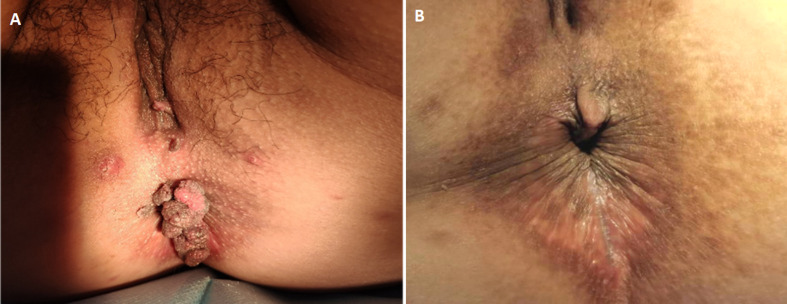 Figure 1
Peer Reviews
No public reviews on file for this paper yet. If you reviewed it on a platform where reviews are public (OpenReview, ICLR, NeurIPS, ICML), you can paste yours below so the community can read it here.
Videos
No videos yet. Explain this paper in a talk, walkthrough, or lecture? Add one.
Taxonomy
TopicsCervical Cancer and HPV Research · Reproductive tract infections research · Female Genital Mutilation/Cutting Issues
Image in medicine
We report a case of perianal condylomata acuminata in a pregnant woman. The patient is a 28-year-old female. During a prenatal checkup in the third trimester of pregnancy, a large cauliflower structure was found around the anus. She then visited the dermatology department of our hospital. The patient's syphilis testing and HIV testing were both negative. Samples collected from genital lesions were positive for HPV types 6 and 11. Biopsy pathology suggests condylomata acuminata. Based on these examinations, we ultimately diagnosed it as perianal condylomata acuminata. We provided the patient with a cryotherapy treatment. Two weeks later, when the patient returned for a follow-up visit, it was observed that the perianal warts had increased in size compared to before. The patient refused to continue cryotherapy. The patient delivered a baby by cesarean section at 37 weeks without any complications. After delivery, our department provided three sessions of laser combined with photodynamic therapy, followed by regular follow-ups, and no recurrence was observed. We followed up on the newborn delivered by the patient before the age of one and found no warts.
A) a large cauliflower structure around the anus; B) perianal skin after treatment