Efficacy and safety of secukinumab in conjunction with surgery in moderate to severe hidradenitis suppurativa
Junyou Zheng, Qingyun Wu, Ke Zhang, Qian Zhang, Qun Lv, Lili Wang, Liming Huang, Yan Wang, Xiangdong Gong, Xiaofang Li, Fang Fang, Wenbo Bu

Abstract
Genes, proteins, chemicals, diseases, species, mutations and cell lines named across the full text — each resolved to its canonical identifier and authoritative record.
Click any figure to enlarge with its caption.
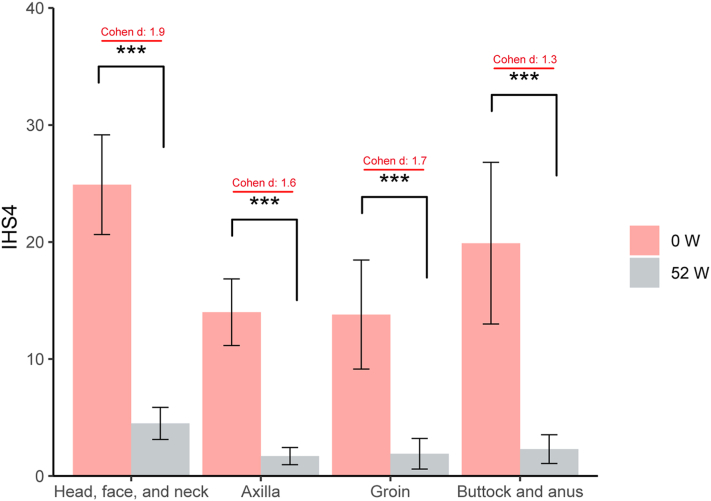 Figure 1
Peer Reviews
No public reviews on file for this paper yet. If you reviewed it on a platform where reviews are public (OpenReview, ICLR, NeurIPS, ICML), you can paste yours below so the community can read it here.
Videos
No videos yet. Explain this paper in a talk, walkthrough, or lecture? Add one.
Taxonomy
TopicsHidradenitis Suppurativa and Treatments · Autoimmune and Inflammatory Disorders · Acne and Rosacea Treatments and Effects
To the Editor: Secukinumab, an interleukin-17A inhibitor, improved outcomes in moderate-to-severe hidradenitis suppurativa (HS) in 2 phase 3 trials.1 Surgery remains essential for established tunnels, and expert guidance supports integrating medical and surgical approaches in selected patients.2 However, real-world evidence on efficacy of secukinumab combined with surgery is limited. We evaluated effectiveness and safety of secukinumab in conjunction with deroofing and/or excision in a retrospective cohort.
Adults (aged ≥ 18 years) with Hurley stage II to III HS treated at our center (2021-2024) were eligible if they received secukinumab plus local/wide deroofing and/or excision and had complete 52-week follow-up. Secukinumab was given as 300 mg weekly for 5 weeks, then every 4 weeks thereafter. Timing varied: 13 patients initiated secukinumab 3 months preoperatively, 8 during the perioperative period, and the remainder postoperatively. The primary endpoint was change in the International Hidradenitis Suppurativa Severity Score System3 from baseline to week 52, assessed by anatomical domain (head/face/neck, axillae, groin, and buttocks/anogenital). Secondary end points were Hidradenitis Suppurativa Clinical Response (HiSCR),4 site-specific HiSCR (Local HiSCR), and patient-reported outcomes (Visual Analogue Scale pain, Dermatology Life Quality Index, and Work Productivity and Activity Impairment Questionnaire [General Health v1.0]).
Seventy patients were included (Table I). Most participants were men (81.4%) with mean age 28.8 ± 9.8 years, and 74.3% had Hurley stage III disease. The cohort was clinically challenging: most had prior antibiotic exposure and some had inadequate response to adalimumab. At week 52, results showed that mean International Hidradenitis Suppurativa Severity Score System decreased significantly across all anatomical regions (all P < .001, Fig 1). Overall, HiSCR was achieved by 65/70 patients (92.9%); rates were similar in single-site and multisite diseases (93.5% vs 91.7%; P = .65). Local HiSCR ranged from 85.7% to 87.8% across regions (Supplementary Table I, available via Mendeley at https://data.mendeley.com/datasets/stg3trtwm8/1). Patient-reported outcomes improved from baseline to week 52: Visual Analogue Scale pain 7.2 ± 1.7 to 1.5 ± 1.2, Dermatology Life Quality Index 19.8 ± 5.6 to 6.1 ± 4.6, and Work Productivity and Activity Impairment Questionnaire [General Health v1.0] 10.8 ± 4.2 to 3.5 ± 2.6 (all P < .001, Supplementary Table II, available via Mendeley at https://data.mendeley.com/datasets/xm4hk98k2h/1).Table IPatient’s demographics and clinical featuresParametersValuesSex, n (%) Men57 (81.4) Women13 (18.6)Age, mean ± SD, y28.8 ± 9.8BMI, mean ± SD, kg/m^2^26.6 ± 4.1Disease course, mean ± SD, y5.1 ± 4.4Smoking habit, n (%)20 (28.6)Family history, n (%)6 (8.6)Hurley stage, n (%) II18 (25.7) III52 (74.3)Number of affected areas∗, n (%) 146 (65.7) 219 (27.1) 32 (2.9) 43 (4.3)Comorbidities, n (%) Hyperuricemia15 (21.4) Hyperlipidemia and fatty liver12 (17.1) Acne10 (14.3) Psychiatric disorder‡4 (5.7) Diabetes3 (4.3) Hypertension2 (2.9) Psoriasis1 (1.4) Systemic lupus erythematosus1 (1.4)Previous treatment, n (%) Antibiotics†59 (84.3) Glucocorticoid12 (17.1) Isotretinoin21 (30.0) Adalimumab13 (18.6) Surgery ± PDT23 (32.9)BMI, Body mass index; PDT, photodynamic therapy; SD, standard deviation.∗Head, face, neck, axillae, groin, buttock, and anus.†Includes topical and oral antibiotics, such as doxycycline, clindamycin, rifampicin, and metronidazole.‡Anxiety, depression, and obsessive-compulsive disorder (OCD).Fig 1. Differences in IHS4 scores of 4 anatomical sites between week 52 and baseline after treatment with secukinumab combined with surgery. ∗∗P < .01, ∗∗∗P < .001. IHS4, International Hidradenitis Suppurativa Severity Score System.
Adverse events occurred in 17/70 patients (24.3%), including 14 considered treatment-related. The most common treatment-related events were upper respiratory tract infection (n = 5), HS flares (n = 5), and delayed wound healing (n = 4). No serious adverse events occurred, and no patient discontinued secukinumab for safety.
Limitations include retrospective design, lack of a control arm, and assessments limited to baseline and week 52. Nonetheless, in a real-world cohort of moderate-to-severe HS undergoing deroofing or excision, secukinumab used in conjunction with surgery was associated with marked clinical improvement and meaningful quality-of-life gains without new safety signals. Perioperative biologic–surgery integration has also been supported in a randomized trial of adalimumab plus surgery.5 Prospective controlled studies should define optimal timing around surgery and quantify incremental benefit over either modality alone.
Conflicts of interest
None disclosed.
The reference list from the paper itself. Each links out to its DOI / PubMed record.
- 1Kimball A.B.Jemec G.B.E.Alavi A.Secukinumab in moderate-to-severe hidradenitis suppurativa (SUNSHINE and SUNRISE): week 16 and week 52 results of two identical, multicentre, randomised, placebo-controlled, double-blind phase 3 trials Lancet 4011037820237477613674617110.1016/S 0140-6736(23)00022-3 · doi ↗ · pubmed ↗
- 2Zouboulis C.C.Bechara F.G.Fritz K.S 2k guideline for the treatment of hidradenitis suppurativa/acne inversa-short version J Dtsch Dermatol Ges 22620248688893877098210.1111/ddg.15412 · doi ↗ · pubmed ↗
- 3Zouboulis C.C.Tzellos T.Kyrgidis A.European Hidradenitis Suppurativa Foundation Investigator Group Development and validation of the International Hidradenitis Suppurativa Severity Score System (IHS 4), a novel dynamic scoring system to assess HS severity Br J Dermatol 17752017140114092863679310.1111/bjd.15748 · doi ↗ · pubmed ↗
- 4Kimball A.B.Jemec G.B.Yang M.Assessing the validity, responsiveness and meaningfulness of the Hidradenitis Suppurativa Clinical Response (Hi SCR) as the clinical endpoint for hidradenitis suppurativa treatment Br J Dermatol 17162014143414422504042910.1111/bjd.13270 · doi ↗ · pubmed ↗
- 5Aarts P.van Huijstee J.C.van der Zee H.H.van Doorn M.B.A.van Straalen K.R.Prens E.P.Adalimumab in conjunction with surgery compared with adalimumab monotherapy for hidradenitis suppurativa: a randomized controlled trial in a real-world setting J Am Acad Dermatol 89420236776843711661510.1016/j.jaad.2023.04.034 · doi ↗ · pubmed ↗