UzbekPOS: A multi-domain dataset for Uzbek part-of-speech tagging
Maksud Sharipov, Elmurod Kuriyozov, Jernej Vičič

TL;DR
UzbekPOS is a large, manually annotated dataset for the Uzbek language, designed to support natural language processing and linguistic research.
Contribution
UzbekPOS is the largest publicly available POS-tagged corpus for Uzbek, with a fine-grained tagset tailored to its morphological and syntactic features.
Findings
The dataset contains 4.5K sentences and 53K token/tag pairs, annotated by professional annotators.
It includes a diverse range of text sources to reflect linguistic and topical diversity in Uzbek.
The dataset supports multiple formats (txt, TSV, JSON, conllu) and can be used for training models and linguistic studies.
Abstract
In this paper, we introduce UzbekPOS — a part-of-speech (POS) tagged dataset manually annotated for the Uzbek language, designed for natural language processing, artificial intelligence models, and corpus linguistics applications. This tagged corpus is currently the largest publicly available POS-tagged corpus for the Uzbek language. The dataset comprises sentences drawn from a diverse range of Uzbek text sources, including literature, news outlets, science, education, and public speaking, to reflect linguistic and topical diversity. The sentences are tokenized and annotated by professional annotators, utilizing a finely grained POS tagset which integrates standard Universal Dependencies with additional labels that are specific to the morphological and syntactic features of the Uzbek language, comprising 16 tags in total. The UzbekPOS contains almost 4.5K sentences and more than 53K…
Click any figure to enlarge with its caption.
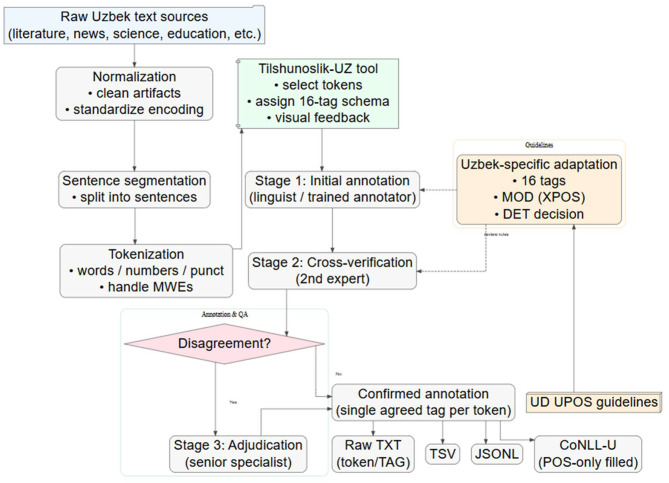 Figure 1
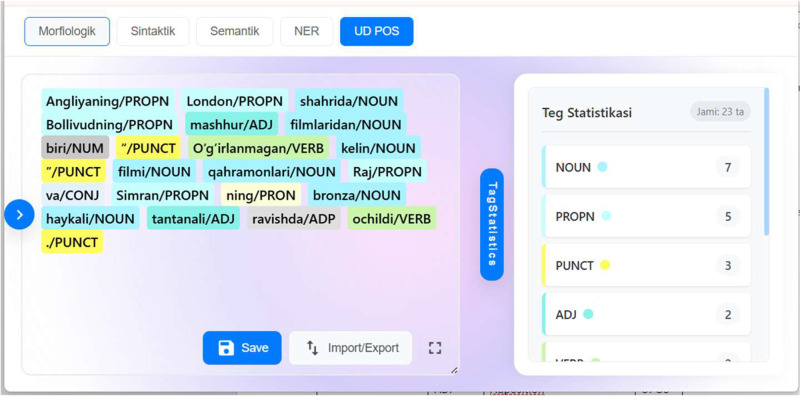 Figure 2
Peer Reviews
No public reviews on file for this paper yet. If you reviewed it on a platform where reviews are public (OpenReview, ICLR, NeurIPS, ICML), you can paste yours below so the community can read it here.
Videos
No videos yet. Explain this paper in a talk, walkthrough, or lecture? Add one.
Taxonomy
TopicsNatural Language Processing Techniques · Topic Modeling · Second Language Acquisition and Learning
Specifications TableSubjectComputer Science, Linguistics;Specific subject areaNatural language processing, Computational Linguistics, Corpus Linguistics;Type of dataText corpus (sentences, tokens); Json, TSV, Conllu formatted data.Data collectionRaw text sentences were gathered from various sources of Uzbek texts, such as literary texts, news articles, and teaching materials. Texts are balanced over fields, tokenized and normalized before annotation. Manual POS tagging was done by several expert annotators using a pre-defined tagset, while disagreement among them was resolved by adjudication.Data source locationHigher educational institution: Urgench State University named after Abu Rayhan Biruni 14, Kh.Alimdjan str, Urgench city, 220100, UzbekistanData accessibility1. Repository name: Mendeley data - UzbekPOS: Multi-domain Part-Of-Speech Dataset for the Uzbek LanguageData identification number: 10.17632/55f889ncnx.1Direct URL to data: https://doi.org/10.17632/55f889ncnx.12. Repository name: Github - UzbekPOS: Multi-domain Part-Of-Speech Dataset for the Uzbek LanguageDirect URL to data: https://github.com/MaksudSharipov/UzbekPOS3. Code availability: The Python scripts used to generate the corpus statistics and tag distributions (Table 3, Table 4) are available in the GitHub repository.Related research articleThe older version of the dataset was used in this research paper:M. Sharipov, E. Kuriyozov, O. Yuldashev, and O. Sobirov, ‘UzbekTagger: The rule-based POS tagger for Uzbek language’, in 10th Language & Technology Conference: Human Language Technologies as a Challenge for Computer Science and Linguistics, 2023.
Value of the Data
1
- •The largest publicly available POS-Tagged dataset for the Uzbek language. These annotated sentences present an openly available expert-annotated corpus of POS for Uzbek that is the largest in size compared to the ones publicly available. This resource allows for further and more intrinsic experiments in the natural processing of the language.
- •Supports Natural Language Processing (NLP) tool construction and benchmarking. The presented dataset is reusable in terms of training and testing POS taggers, morphological analyzers, and syntactic parsers. Predefined train, development, and test sets are included in the dataset repository to allow standardized benchmarking and comparison of created models.
- •Supports cross-linguistic and comparative research. Given that the annotation guideline followed in this dataset follows the format of the Universal Dependencies [1] with little additions for Uzbek-specific tags and rules, it is perfect for cross-linguistic and typological analyses of Turkic languages. These features can be used for a comparative basis of low-resource highly inflectional languages scenarios.
- •Valid resource for both educational and applied settings. The created dataset serves in the teaching of corpus linguistics, NLP, and computational linguistics classes and in the creation of Uzbek-language applications, such as intelligent tutoring systems, spell and grammar checkers, to name a few.
- •Framework for transfer to other Turkic languages. Apart from Uzbek, the corpus serves as a blueprint to create parallel sets in other Turkic-related languages, such as Karakalpak, Kyrgyz, and Kazakh, for cross-lingual transfer learning and the building of NLP tools with a multiplicity of linguistic support.
Background
2
The Uzbek language1 is one of the most spoken languages in the Turkic language family, and is characterized by its rich and complex agglutinative morphology [1]. Despite the rapid development of resources and models recently, the language remains relatively under-resourced in the field of NLP. Developing robust NLP tools for fundamental tasks like part-of-speech (POS) tagging, morphological analysis, and syntactic parsing requires large-scale, high-quality annotated datasets that reflect the linguistic characteristics of the language [2]. Previous efforts in Uzbek POS tagging, which are only a few, have often relied on rule-based systems or smaller datasets with limited POS tags [3,4].
Beyond part-of-speech tagging, the recent trends for Uzbek NLP have seen rapid growth through the development of diverse linguistic resources and tools, including the implementation of algorithms for Named Entity Recognition (NER) [5] and the creation of corpora for aspect-based sentiment analysis [6]. Also, the development of specialized tools for punctuation analysis [7], lemmatization and stemming [8,9] reflects a concerted effort to address the unique morphological challenges of the Uzbek language.
POS tagset creation
2.1
For the development of UzbekPOS, we adopted the Universal POS (UPOS) guidelines2 from the Universal Dependencies (UD) project3 to ensure the dataset's compatibility with global linguistic standards [10]. In order to capture the specific morphological and syntactic features of Uzbek at an expert level, the standard UPOS tagset was slightly adapted. The major change being the Determiner (DET) tag was intentionally omitted because Uzbek lacks articles, which form the bulk of this category in many other languages. Also, one more tag, Modal (MOD), which is not included in the UPOS tags list, was incorporated as a language-specific tag (XPOS) to reflect the unique functional structure in Uzbek grammar [11]. The final tagset list, together with their categories as well as types are presented in Table 1.Table 1. The list of tags used for annotating the Uzbek raw text data, followed by their categories, types, and names.Table 1 dummy alt textCategoryTagNameTypeOpen class wordsADJAdjectiveUPOSADVAdverbUPOSINTJInterjectionUPOSNOUNNounUPOSPROPNProper nounUPOSVERBVerbUPOSClosed class wordsADPAdpositionUPOSAUXAuxiliary verbUPOSCCONJCoordinating conjunctionUPOSDETDeterminerUPOSNUMNumeralUPOSPARTParticleUPOSPRONPronounUPOSSCONJSubordinating conjunctionUPOSOtherPUNCTPunctuationUPOSSYMSymbolUPOSXOtherUPOSLanguage specificMODModalXPOS
The Determiner class tag “DET” from the closed class words has been omitted in the case of the Uzbek language, since it is mostly used to tag articles and Uzbek does not have articles [12]. By aligning with the UD framework as well as considering the linguistic characteristics of Uzbek grammar, this dataset represents a valuable resource that is both standardized and linguistically authentic, which is important for training accurate Uzbek NLP applications.
Data Description
3
The UzbekPOS dataset is provided in a single repository, with the same annotated texts over four distinct file formats to ensure accessibility for researchers and developers across various domains. Each format is designed to serve specific user needs:
- 1.Raw annotated format file (uzpos_raw.txt): This version provides the raw data in a human-readable string format with <token>/<tag> structure. It is ideal for quick inspection and simple pattern-matching tasks.
- 2.TSV format file(uzpos.tsv): A structured, tab-separated format for easy manipulation using both spreadsheet software and basic data processing libraries. This format file is useful for those who prefer a tabular view of token-level annotations.
- 3.JSONL format (uzpos.jsonl): This format stores each sentence as a JSON object on a new line, facilitating integration with the latest programming environments, proving efficient for large-scale data parsing in Python, Javascript or TypeScript.
- 4.CoNLL-U format (uspos.conllu): Following the global standards of the Universal Dependencies project [1]. It ensures that the UzbekPOS dataset can be directly utilized by existing NLP toolkits and facilitates cross-linguistic comparative studies.
An example snippet of these formats for a single pos-annotated Uzbek sentence is presented in Table 2 below:Table 2. Snippets of an example sentence from the dataset in four formats used.Table 2 dummy alt textRaw annotated format (.txt) sentence exampleBu/PRON tizimda/NOUN modda/NOUN va/CCONJ energiya/NOUN almashinuvi/VERB kuzatib+kelinmoqda/VERB ./PUNCT**TSV format (.tsv) sentence examplesent_id token_id form upos22 1 Bu PRON22 2 tizimda NOUN22 3 modda NOUN22 4 va CCONJ22 5 energiya NOUN22 6 almashinuvi VERB22 7 kuzatib+kelinmoqda VERB22 8 . PUNCTJSONL format (.jsonl) sentence example*{"sent_id": 22, tokens'': [Bu'', tizimda'', modda'', va'', energiya'', almashinuvi'', kuzatib+kelinmoqda'', .''], upos'': [PRON'', NOUN'', NOUN'', CCONJ'', NOUN'', VERB'', VERB'', PUNCT'']}CONLL-U format (.conllu) sentence example# sent_id = 221 Bu _ PRON _ _ _ _ _ _2 tizimda _ NOUN _ _ _ _ _ _3 modda _ NOUN _ _ _ _ _ _4 va _ CCONJ _ _ _ _ _ _5 energiya _ NOUN _ _ _ _ _ _6 almashinuvi _ VERB _ _ _ _ _ _7 kuzatib+kelinmoqda _ VERB _ _ _ _ _ _8 . _ PUNCT _ _ _ _ _ _*
Corpus statistics and tag distribution
3.1
The created UzPOS dataset is a multi-domain resource covering the linguistic diversity of the Uzbek language as much as possible. To provide an overview of the dataset's scale and characteristics, a summary of basic counts and averages are given in Table 3. These statistics include metrics such as the total number of sentences, unique tokens, and average sentence length.Table 3. Basic statistical information regarding the dataset with counts and averages.Table 3 dummy alt textStatistics typeStatistic metricQuantityBasic countsSentences (lines):4412Token/TAG pairs:53113Unique surface tokens:16904Unique tags:16Bad/unparsed items:0 (None)AveragesAvg tokens per sentence:12Avg token length (chars, token only):6.6Special tokensMulti-word expressions3493Tokens containing emoji24
The statistics above are provided for the entire dataset and lack per-tag information. Hence, a detailed breakdown of the 16 unique POS tags with their frequencies in the dataset, density, and type-token ratios is presented in Table 4, to better illustrate the morphological distribution within the annotated corpus. This analysis includes the density of each tag, the Type-Token Ratio (TTR) to measure lexical variation, and the most frequent tokens associated with each category. As shown in the following table, nouns and verbs constitute the majority of the annotated tokens, reflecting the core structural elements of the Uzbek language.Table 4. All 16 POS tags with their frequencies, density percentage, and type-token ratios, followed by the top-5 example words/tokens taken from the dataset. TTR- Type-token ratio is a metric to display the lexical variation of the tag. The bigger the ratio more diverse the set of words used for the tag, lower the ratio means fewer words are repeatedly used for the tag.Table 4 dummy alt textTagCountDensity (%)TTRTop occurring tokensNOUN1791233.7%0.46"Misol"(106), suv''(84), ega''(84), moddalar''(61)***VERB**885416.7%0.53*"bo‘lgan"(100), bo‘lib''(61), deyiladi''(55), bo‘ladi''(48)PUNCT793414.9%0.004.''(4033), ,''(3167), –''(126), :''(123), ?''(102)***ADJ**48269.%0.3*boshqa''(104), katta''(89), turli''(80), asosiy''(68)***PRON**26695.%0.12*U''(273), Bu''(156), u''(141), bu''(139), uning''(97)ADP20613.9%0.07"bilan"(539), “uchun”(278), “orqali”(92), “bo‘yicha”(74)CCONJ18753.5%0.03"va"(1419), “yoki”(133), “esa”(108), “hamda”(67)ADV14802.79%0.28"juda"(119), “eng”(96), “ko‘p”(80), “o‘zaro”(49)NUM12602.4%0.38"bir"(148), “ikki”(63), “birinchi”(37), “ikkinchi”(31), “2”(30)PROPN11222.1%0.52"O‘zbekiston"(35), “Toshkent”(21), “Lui”(20), “Eron”(15)AUX9871.9%0.05"edi"(343), “ekan”(256), “mumkin”(94), “emish”(65)SCONJ8001.5%0.08"chunki"(171), “deb”(95), “bo‘lsa”(92), “negaki”(58)MOD4250.8%0.2"bor"(58), “kerak”(44), “yo‘q”(33), “mavjud”(32)PART3880.7%0.07"ham"(266), “faqat”(34), “hech”(12), “xuddi”(9)SYM3200.6%0.42"-"(82), “km”(14), “A”(10), “m”(8), “%”(8)INTJ2000.4%0.7"Xo‘sh"(4), “E”(4), “Mah-mah”(4), “Hoy”(2), “Salom”(2)Total**53841100%0.31“.”(4033), “,”(3167), “va”(1419), “bilan”(539), “edi”(343)*
Experimental Design, Materials and Methods
4
This study significantly extends the dataset originally developed for the UzbekTagger project [9], which consisted of 1,581 sentences across 23 categories using a 12-tag scheme. We incorporated these initial sentences and augmented the corpus with over 2,800 newly collected sentences, introduced two additional text categories, and expanded the annotation schema to 16 tags. These enhancements were designed to improve domain coverage and enable more granular linguistic analysis. Crucially, the inherited subset underwent the same rigorous re-annotation and validation pipeline as the new data to integrate the expanded tagset, correct prior inconsistencies, and ensure uniform quality across the entire corpus.
Source material and data collection
4.1
The raw text corpus chosen for this task was designed to be as representative as possible of the official Uzbek language, so we collected data from various sources like websites, books, educational materials, and many more, with 25 diverse categories, ensuring a balance between formal academic registers and informal digital communication.
The UzbekPOS dataset was curated from three primary sources to ensure both linguistic diversity and legal compliance. Except for the “Interactions and Comments” category, all textual data were sourced from the following:
- 1.Educational and Literary Texts: A significant portion of the corpus was extracted from the Republican Youth E-Library4. This source provided access to openly available school textbooks and contemporary literature, ensuring the inclusion of formal and pedagogical Uzbek language structures.
- 2.Journalistic and News Media: Current events and media-style Uzbek were represented through data from Darakchi news platfrom5. The authors obtained a formal written letter of agreement from the publisher, granting permission to utilize their archival news text for research purposes.
- 3.Social Media and Synthetic Data: The specific category in the dataset “Suhbat va kommentlar” (Interactions and Comments) was developed to capture informal, colloquial, and digitally-mediated Uzbek. These data were manually collected by the authors and annotators from public social media channels or, where necessary to represent specific linguistic phenomena, synthetically generated by the expert team to maintain grammatical variety. Adding this section was necessary for the fact that it captures the colloquial and often morphologically non-standard use of the language in digital spaces [13].
All the fields of texts included in the dataset are listed in Table 5 with their relative counts.Table 5. Names of the fields covered in the dataset with their sentence counts.Table 5 dummy alt text№CategorySentences№CategorySentences1Adabiyot (Literature)20014Madaniyat (Culture)2002Anatomiya (Anatomy)20015Matematika (Mathematics)1503Biologiya (Biology)20016Ona tili (Mother tongue)2004Botanika (Botany)20017Qishloq xo‘jaligi (Agriculture)2005Din tarixi (Religion)20018Siyosat (Politics)1506Dunyo (World)20019Sport (Sports)2007Fizika (Physics)15020Tarix (Hitory)2008Geografiya (Geography)20021Texnologiya (Technology)1509Huquq (Law)15022Tibbiyot (Medicine)20010Informatika (Informatics)15023Zoologiya (Zoology)15011Iqtisodiyot (Economy)15024San’at (Art)11212Jamiyat (Society)20025Suhbat va kommentlar (Interactions and comments)15013Kimyo (Chemstry)150Total:4412
Annotation pipeline
4.2
Once the quality raw text collection process is finished, an annotation pipeline was implemented that includes the steps of text normalisation, sentence segmentation, annotation, quality assurance, adjudication, as well as formatted output. The sequence and logic of all these stages are visualised in Fig. 1.Fig. 1. Illustration of the pos-tagging annotation process with all the stages included.Fig 1 dummy alt text
Although the pipeline is well-visualised, some stages require more explanation than just naming. One of those steps is the annotation tool choice, where we have used the POS-tagging annotation tool from Tilshuoslik UZ platform6, which is part of fundamental NLP tools for the Uzbek language created by the same authors [14]. This platform provides a user-friendly interface that allows annotators to select tokens and assign tags from the predefined 16-tag schema. The tool was designed to minimize human error by providing a streamlined workflow and immediate visual feedback for each tagged sentence. An example user interface of the annotation toolfrom the Tilshunoslik-UZ platform is presented in Fig. 2.Fig. 2. Tilshunoslik.uz POS-tagging annotation tool user interface with a sample sentence.Fig 2 dummy alt text
As for the annotation protocol and tagset adaptation, the annotation process followed the Universal Dependencies (UD) UPOS guidelines, ensuring the dataset's compatibility with international NLP standards [15]. As noted in the Background section, we adapted the standard set to fit Uzbek’s linguistic profile —specifically omitting the DET tag and utilizing the MOD (Modal) tag to capture language-specific nuances [16].
To ensure the highest possible reliability (Gold Standard), a three-stage validation process was employed:
- 1.Initial Annotation: Each sentence was first processed by a professional linguist or trained annotator.
- 2.Cross-Verification: Every annotated sentence was independently reviewed by a second expert to identify potential inconsistencies or errors.
- 3.Adjudication: In cases of disagreement between the first and second annotators, a senior adjudicator (a specialist in Uzbek linguistics) performed a final review to resolve the conflict and determine the correct tag.
The annotation process was conducted by a team of native Uzbek speakers to ensure linguistic precision. The team consisted of two lead experts with PhDs in AI and NLP—the first two authors of this study—and 12 Master’s students specializing in Computational Linguistics. The annotation team was assembled using a purposive convenience sampling technique, recruiting from within a specialized academic environment because accurately annotating the complex agglutinative morphology of the Uzbek language requires deep theoretical linguistic knowledge rather than relying solely on native fluency. To ensure high reliability, strict inclusion criteria mandated that all selected annotators be native Uzbek speakers holding a formal Bachelor’s degree in Uzbek Linguistics, be actively enrolled in a Master’s program for Computational Linguistics or a closely related NLP field, and successfully complete a rigorous one-month preliminary training phase focused specifically on the project's custom 16-tag schema. Conversely, the exclusion criteria strictly disqualified individuals who were non-native speakers, lacked a documented academic background in formal linguistics, or failed to demonstrate sufficient competency with the annotation guidelines during the mandatory training period prior to the commencement of the formal labelling task.
Inter-annotator agreement was measured prior to the adjudication stage using Cohen’s κ, yielding a value of 0.86, which indicates a high level of annotation consistency.
Finally, the final version of the tagged gold standard dataset was transformed into 4 different formats, from simple raw text all the way to the CONLLU format. It is worth mentioning that the dataset content and token-tag pairs are all the same in all the files reported with their own formats, except in the case of the CONLLU format, where the language-specific “MOD” tag was given the “AUX” UPOS tag in the POS tags columns, moving the original language-specific tag to the fifth column.
Limitations
Although the dataset has large-scale, expert-annotated POS data for Uzbek, some limitations might still remain. The corpus has only part-of-speech classes, and no other kind of morphological or syntactic feature annotations were given, but this does not lower the value of the dataset. Although the whole data was annotated with multiple experts and all possible annotation conflicts were resolved at the adjudication stage, some small annotation bias could still have preserved. However, the UzbekPOS dataset has been quality-controlled and hand-curated, and it is a robust and reliable source for developing the POS tagging models for Uzbek.
Ethics Statement
The authors confirm that the annotated dataset and additional scripts reported in this manuscript do not involve human subjects, animal testing, or any data from social networks. All the initial resources to annotate were collected from publicly available texts and some licensed materials, with special permission to obtain. We confirm that we have read and followed the publication guidelines in Data in Brief.
Credit Author Statement
Maksud Sharipov: Conceptualization, Methodology, Formal analysis, Resources, Writing – Review & Editing, Supervision, Project administration; Elmurod Kuriyozov: Software, Investigation, Data Curation, Writing - Original Draft, Visualization; Jernej Vičič: Conceptualization, Investigation, Writing – Review & Editing, Validation, Funding acquisition.
The reference list from the paper itself. Each links out to its DOI / PubMed record.
- 1Nivre J.Universal dependencies v 2: an evergrowing multilingual treebank collection Proceedings of the Twelfth International Conference on Language Resources and Evaluation (LREC 2020)Marseille, France 202040344043
- 2A. Madvaliyev, N. Mahkamov, N. Mahmudov (Rahbar), D. Xudoyberganova, O. Odilov, O‘zbek tilining izohli lug‘ati. Toshkent: “O‘zbekiston nashriyoti”, 2021.
- 3Mengliev D.Barakhnin V.Abdurakhmonova N.Eshkulov M.Developing named entity recognition algorithms for Uzbek: dataset insights and implementation Data Brief 54202411041310.1016/j.dib.2024.110413 PMC 1106737438708296 · doi ↗ · pubmed ↗
- 4Madatov K.Bekchanov S.VičičJ.Dataset of stopwords extracted from Uzbek texts Data Brief 43202210.1016/j.dib.2022.108351 PMC 919483835712366 · doi ↗ · pubmed ↗
- 5Matlatipov S.Rahimboeva H.Rajabov J.Kuriyozov E.Uzbek Sentiment analysis based on local restaurant reviews CEUR Workshop Proc.33152022126136
- 6M. Sharipov and O. Sobirov, “Development of a rule-based lemmatization algorithm through finite state machine for Uzbek language,” in CEUR Workshop Proceedings, V. J. and K. B., Eds., CEUR-WS, 2022, pp. 154–159. [Online]. Available: https://www.scopus.com/inward/record.uri?eid=2-s 2.0-85146112590&partner ID=40&md 5=e 1080 c 39d 101c 0e 351cfed 1a 8228 d 391.
- 7Maksud S.Elmurod K.Ollabergan Y.Ogabek S.Uzbek Verb Detection: rule-based detection of verbs in Uzbek texts 2024 Joint International Conference on Computational Linguistics, Language Resources and Evaluation, LREC-COLING 2024 - Main Conference Proceedings 2024
- 8Benko V.Garabík R.Khamroyeva S.M.Araneum Uzbecicum: a gigaword web-crawled Uzbek corpus Proceedings of the 9th International Conference on Computer Science and Engineering (UBMK 2024)202423824310.1109/UBMK 63289.2024.10773454 · doi ↗