Reflecting on 25 years of SPIKES: bad news communication in our modern era
Joseph McCollom, Mazie Tsang

Abstract
Genes, proteins, chemicals, diseases, species, mutations and cell lines named across the full text — each resolved to its canonical identifier and authoritative record.
Click any figure to enlarge with its caption.
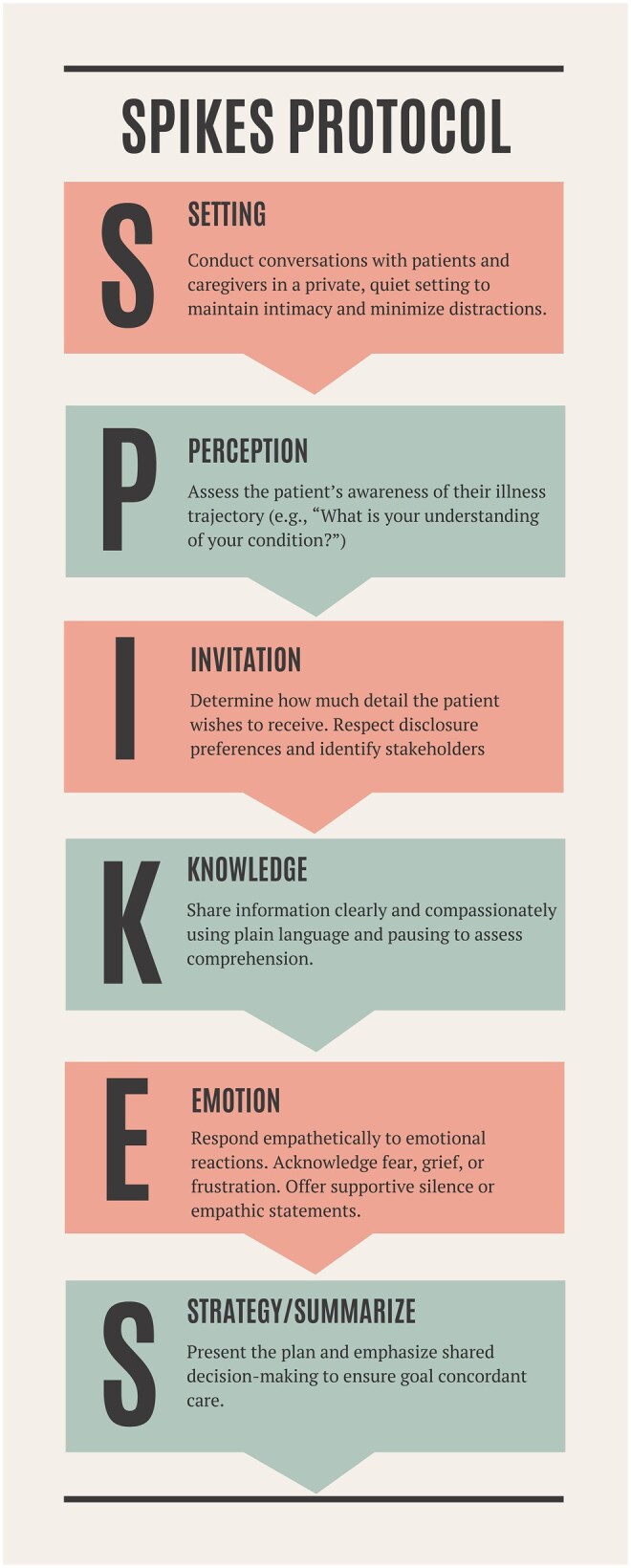 Figure 1
Peer Reviews
No public reviews on file for this paper yet. If you reviewed it on a platform where reviews are public (OpenReview, ICLR, NeurIPS, ICML), you can paste yours below so the community can read it here.
Videos
No videos yet. Explain this paper in a talk, walkthrough, or lecture? Add one.
Taxonomy
TopicsClimate Change Communication and Perception · Media Influence and Health · Media Studies and Communication
The turn of the millennium marked a pivotal transition in serious illness communication. At that time, cancer prognosis remained poor, and many clinicians felt pressured to withhold information from patients and their loved ones, fearing that disclosure might diminish hope. Articles published in the late 1990s described clinical conversation but lacked empirical data,1 or they assessed patient needs without offering practical guidance.2 Guidelines were coalescing around best practices but lacked teachable structures.3 In this context, Baile et al. introduced the SPIKES protocol in 2000,4 a six-step approach to delivering bad news (Figure 1), which remains the most frequently accessed article in The Oncologist to date—it has over twice as many citations and an Altmetric score 10 times higher than other articles published that year.
SPIKES has provided a structured framework for the most challenging conversations in everyday oncology practice, such as disease relapse, new metastasis, treatment toxicity, or end-of-life discussions. This concise protocol has had a profound impact on serious illness communication over the past 25 years, shaping teaching and training, as well as inspiring complementary communication models. Its profound yet straightforward structure is teachable to any medical professional, regardless of background or training. The six components of SPIKES include:
The SPIKES protocol was rapidly integrated into medical education due to its concise and teachable structure. Practical, skills-based workshops enabled learners to practice SPIKES in simulated scenarios. Clinicians trained with SPIKES demonstrated measurable improvements following targeted instruction.5 The protocol has been adapted for diverse trainees, including emergency medicine residents,6 pharmacy students,7 and medical students.8 In some instances, the focus of SPIKES has been expanded beyond the patient–clinician relationship to strengthen feedback from instructors to learners.9 Importantly, SPIKES laid the foundation for subsequent communication training initiatives. OncoTalk introduced intentional small-group workshops for oncology professionals,10 while VitalTalk expanded this model into faculty development programs and bedside coaching, thereby transforming the field of serious illness communication.11
Although originally designed for oncology, SPIKES has influenced multiple disciplines. In mental health, for example, the PEWTER (Prepare, Evaluate, Warning, Telling, Emotional Response, Regrouping) model drew on the SPIKES structure,12 while the REMAP (Reframe, Expect emotion, Map out patient goals, Align with goals, and Propose a plan) framework expanded the concept from a single disclosure to longitudinal goals-of-care conversations.13 Adaptations of the SPIKES format have been published to fit different clinical environments, such as time-pressured emergency departments.14 Disclosures have been customized to cultural contexts, including Germany15 and the Middle East.16 Within oncology, SPIKES has informed treatment failures,17 patient-centered decision making,18 and oncology nursing.19 Adaptations have reworked the SPIKES model for cultural impact20 or diagnosis-tailored needs, such as SPIKES-D for dementia care.21
In 2015, Walter F. Baile, the lead author on the original SPIKES, revisited SPIKES’ enduring impact in The Oncologist.22 He discussed the model’s influence on patient and clinician communication, from disclosure to the expansion of emotional intelligence among oncology professionals. Baile reflected that conceptualizing the cancer experience as “a war” and death as “defeat” has made delivering bad news in this field even more challenging.22 He acknowledges the expansion of the SPIKES protocol to address stress management, anticipatory emotional experiences, and cultural sensitivity. He emphasizes the increasing significance of mindfulness practices and role play in enhancing communication training for serious illness conversations.22
As digital transformation—from telehealth to artificial intelligence (AI)—reshapes the landscape of serious illness communication, the SPIKES protocol remains an important guide for clinicians navigating these technological shifts while preserving human connection and communication of sensitive information. The COVID pandemic accelerated the widespread adoption of telehealth, requiring many oncology professionals to adapt face-to-face conversations to virtual platforms.23 Although virtual interviews might make patients feel more comfortable when they are at home, they can lead to more distractions in public settings and a decreased ability to interpret nonverbal cues or include off-screen family members. Beyond telehealth, the rise of AI and large language models has led to exploration of their role in improving clinician communication and patient care. For example, “virtual patient” simulations have helped emergency medicine physicians and residents break bad news,24^,^25 and predictive AI algorithms may identify patient outcomes or distress26—yet the human connection fostered by SPIKES remains irreplaceable. Another digital challenge is electronic health record transparency, which sometimes leads patients to learn difficult news before meeting with their oncologist. The SPIKES protocol can help clinicians prepare for these scenarios, ensuring that patients receive guidance before attempting to navigate in isolation. This framework ensures that conversations remain patient-centered despite technological shifts. The efforts to incorporate SPIKES into modern practice require intentional patient education that is tailored to their personal preferences.27 Table 1 outlines strategies to adapt SPIKES to our digital healthcare environment. Although these digital revolutions have transformed how serious news is communicated, SPIKES endures as a foundation for compassionate communication in an evolving healthcare landscape.
The lasting strength of SPIKES lies in its adaptability. Over the past 25 years, it has transformed serious illness communication in oncology, grounding these difficult conversations in intentionality, compassion, and structure. As healthcare delivery continues to evolve, SPIKES remains an indispensable cornerstone for a compassionate and patient-centered approach that must always be at the heart of serious illness conversations.
The reference list from the paper itself. Each links out to its DOI / PubMed record.
- 1Ptacek JT , Eberhardt TL. Breaking bad news. A review of the literature. JAMA. 1996;276:496-502. https://www.ncbi.nlm.nih.gov/pubmed/86915628691562 · pubmed ↗
- 2Maguire P. Breaking bad news. Eur J Surg Oncol. 1998;24:188-191. 10.1016/s 0748-7983(98)92929-89630858 · doi ↗ · pubmed ↗
- 3Buckman R. How To Break Bad News: A Guide for Health Care Professionals. University of Toronto Press; 1992.
- 4Baile WF , Buckman R, Lenzi R, Glober G, Beale EA, Kudelka AP. SPIKES-A six-step protocol for delivering bad news: application to the patient with cancer. Oncologist. 2000;5:302-311. 10.1634/theoncologist.5-4-30210964998 · doi ↗ · pubmed ↗
- 5Shanks A , Brann M, Bute J, Borse V, Tonismae T, Scott N. Breaking bad news: a randomized trial assessing resident performance after novel video instruction. Cureus. 2021;13:e 15461. 10.7759/cureus.1546134258123 PMC 8256762 · doi ↗ · pubmed ↗
- 6Park I , Gupta A, Mandani K, Haubner L, Peckler B. Breaking bad news education for emergency medicine residents: a novel training module using simulation with the SPIKES protocol. J Emerg Trauma Shock. 2010;3:385-388. 10.4103/0974-2700.7076021063562 PMC 2966572 · doi ↗ · pubmed ↗
- 7Galal SM , Vyas D, Mayberry J, et al Training pharmacy students to deliver bad news using the SPIKES model. Curr Pharm Teach Learn. 2023;15:283-288. 10.1016/j.cptl.2023.03.00837032264 · doi ↗ · pubmed ↗
- 8Zemlin C , Nourkami-Tutdibi N, Schwarz P, Wagenpfeil G, Goedicke-Fritz S. Teaching breaking bad news in a gyneco-oncological setting: a feasibility study implementing the SPIKES framework for undergraduate medical students. BMC Med Educ. 2024;24:134. 10.1186/s 12909-024-05096-938347593 PMC 10863240 · doi ↗ · pubmed ↗