A Mechanochemical Kolbe–Schmitt Reaction: Catechol Carboxylation Provides Building Blocks for Renewable Plasticizers
Dries De Vos, Victoria S. Pfennig, Arno Goddé, Robby Vroemans, Tobias Krückel, Nicole Marcinkowska, Ettore Bartalucci, Thomas Wiegand, Carsten Bolm, Bert U. W. Maes

TL;DR
Researchers developed a new method to create renewable plasticizers from catechol using a low-energy mechanochemical reaction, producing efficient alternatives to commercial plasticizers.
Contribution
The first mechanochemical Kolbe–Schmitt reaction at low CO2 pressure and room temperature for carboxylating catechol.
Findings
Mono- and dicarboxylated catechol derivatives were synthesized under mild conditions.
Renewable plasticizers made from these derivatives showed plasticizing efficiency comparable to commercial products.
Separation of reaction products was unnecessary for optimal performance in plastics.
Abstract
Catechol, an important aromatic platform molecule which can be derived from biomass, was carboxylated by mechanochemical Kolbe–Schmitt reaction of disodium catecholate with CO2, providing a mixture of mono‐ and dicarboxylated catechol derivatives. While classical protocols require harsh reaction conditions, involving a high temperature and/or CO2 pressure, a mild ball milling method was developed. This represents the first mechanochemical Kolbe–Schmitt reaction featuring a low CO2 pressure and reactivity at room temperature. From the individual catechol‐based mono‐ and dicarboxylic acid reaction products, a library of novel renewable plasticizers was synthesized through esterification of the carboxylic acid functionalities and O‐acylation of the phenolic hydroxy groups. The resulting esters were evaluated in poly(vinylchloride) (PVC) and poly(lactic acid) (PLA), revealing plasticizing…
Genes, proteins, chemicals, diseases, species, mutations and cell lines named across the full text — each resolved to its canonical identifier and authoritative record.
Click any figure to enlarge with its caption.
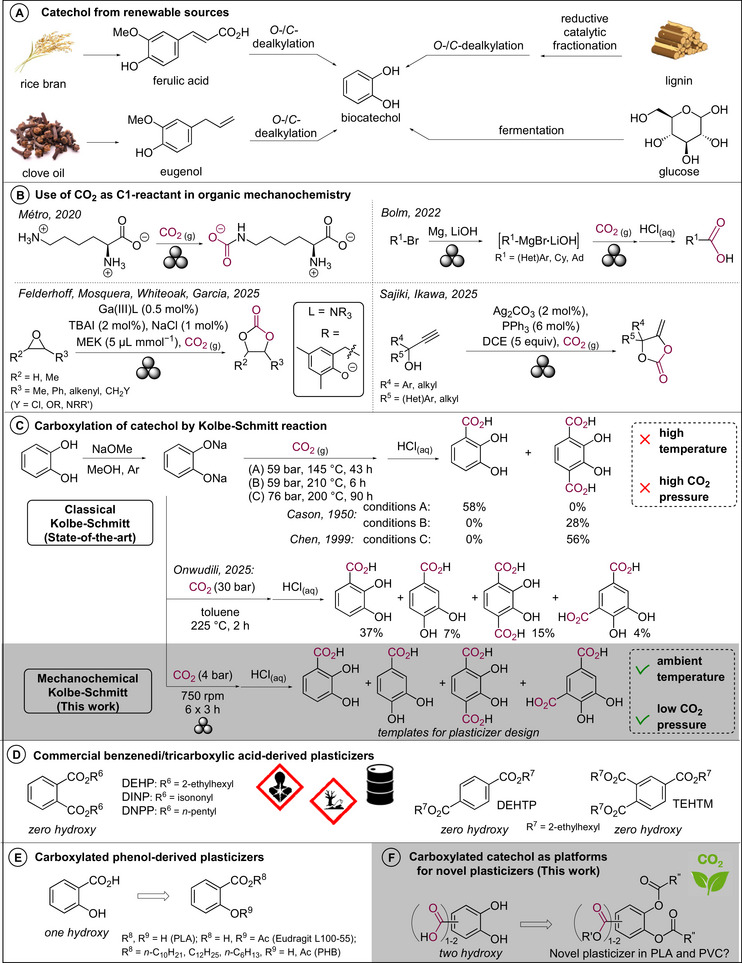 FIGURE 1
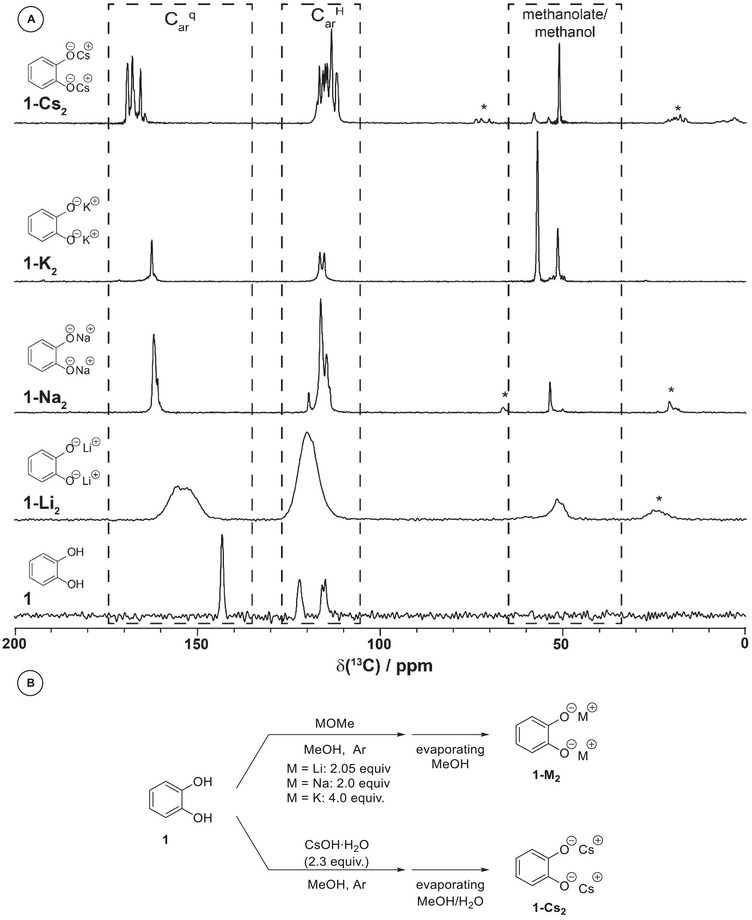 FIGURE 2
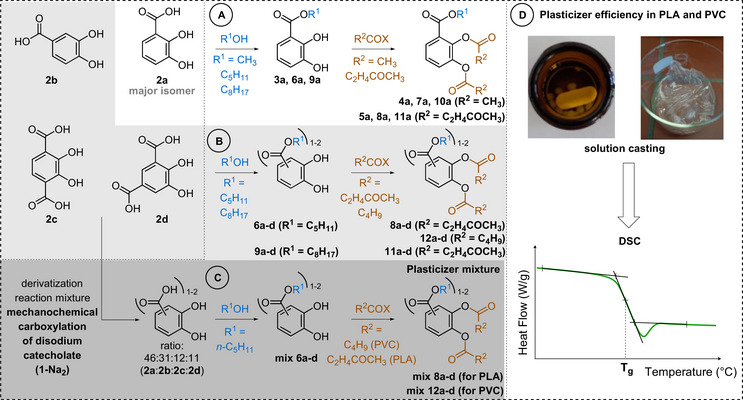 FIGURE 3
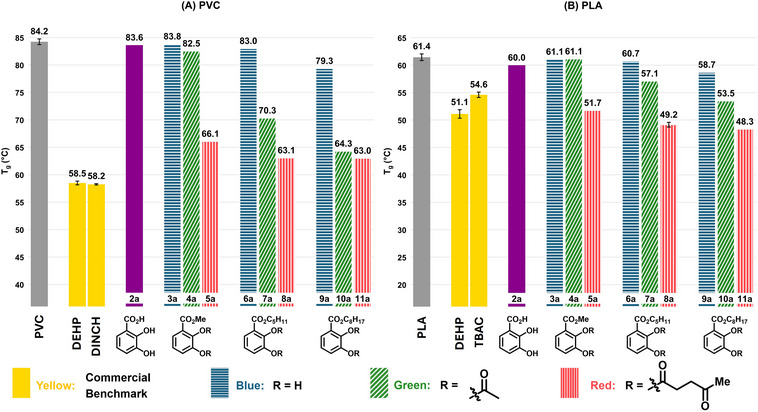 FIGURE 4
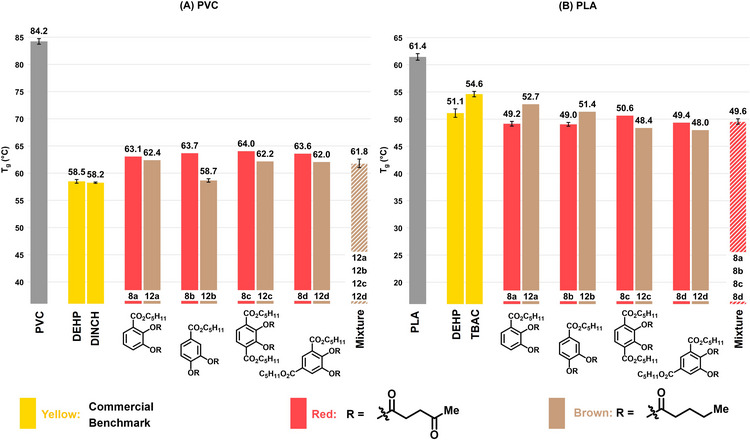 FIGURE 5
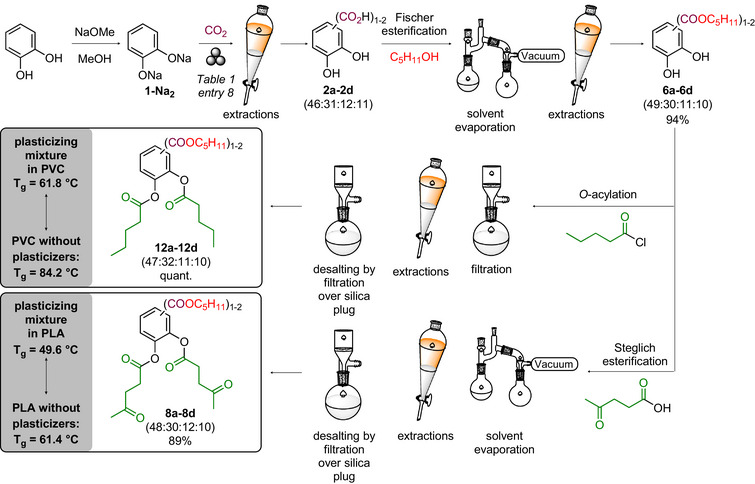 FIGURE 6
|
| ||||||||
|---|---|---|---|---|---|---|---|---|
| Grinding conditions | Yield | |||||||
| Entry |
|
| 1 [%] | 2a [%] | 2b [%] | 2c [%] | 2d [%] | Σ(2a‐d) [%] |
| 1 | 800 | 240 | n. d. | 3 | — | — | — | — |
| 2 | 800 | 3×240 | 17 | 26 | 18 | 13 | 6 | 63 |
| 3 | 800 | 3×240 | 13 | 26 | 21 | 11 | 11 | 69 |
| 4 | 800 | 6×180 | 20 | 32 | 23 | 9 | 5 | 69 |
| 5 | 850 | 6×180 | 20 | 24 | 18 | 5 | 5 | 52 |
| 6 | 850 | 6×180 | 11 | 22 | 22 | 8 | 12 | 64 |
| 7 | 850 | 6×180 | 8 | 7 | 7 | 1 | 3 | 18 |
| 8 | 750 | 6×180 | 19 | 33 | 26 | 13 | 10 | 82 |
| 9 | 700 | 6×180 | 37 | 33 | 20 | 7 | 4 | 64 |
| 10 | 400 | 6×180 | 62 | 10 | 7 | 1 | Traces | 18 |
|
| ||||||||
|---|---|---|---|---|---|---|---|---|
| Yield | ||||||||
| Entry | 1‐M2 |
| 1 [%] | 2a [%] | 2b [%] | 2c [%] | 2d [%] | Σ(2a‐d) [%] |
| 1 |
| 1.0 | 99 | Traces | Traces | Traces | Traces | Traces |
| 2 |
| 1.5 | 99 | Traces | Traces | Traces | Traces | Traces |
| 3 |
| 1.5 | 19 | 33 | 26 | 13 | 10 | 82 |
| 4 |
| 2.0 | 27 | 37 | 19 | 6 | 4 | 66 |
| 5 |
| 1.5 | 94 | 0 | 0 | 0 | 0 | 0 |
| 6 |
| 1.5 | 37 | 33 | 20 | 7 | 4 | 64 |
|
| |||||||||
|---|---|---|---|---|---|---|---|---|---|
| Yield | |||||||||
| Entry | Additive | Additive [equiv.] |
| 1 [%] | 2a [%] | 2b [%] | 2c [%] | 2d [%] | Σ(2a‐d) [%] |
| 1 | — | — | — | 19 | 33 | 26 | 13 | 10 | 82 |
| 2 | NaOCO2Me | 1.0 | — | 69 | 19 | 10 | 2 | Traces | 31 |
| 3 | DMC | 1.0 | 0.55 | 99 | — | — | — | — | — |
| 4 | 15‐crown‐5 | 1.0 | — | 99 | — | — | — | — | — |
| 5 | Cyrene | 0.38 | 0.25 | 51 | 25 | 16 | 5 | 3 | 49 |
| 6 | Toluene | 0.36 | 0.25 | 24 | 33 | 24 | 11 | 8 | 76 |
| 7 | Na2CO3 | 1.05 | — | 38 | 17 | 11 | 9 | 1 | 38 |
| 8 | NaOMe | 1.05 | — | 98 | — | — | — | — | — |
| 9 | DBU | 3.0 | 2.91 | 81 | — | — | — | — | — |
- —Max‐Planck‐Gesellschaft10.13039/501100004189
- —Deutsche Forschungsgemeinschaft10.13039/501100001659
- —Herculesstichting10.13039/501100012541
- —Fonds Wetenschappelijk Onderzoek10.13039/501100003130
- —Vlaamse Overheid10.13039/501100002913
- —UAntwerpen
Peer Reviews
No public reviews on file for this paper yet. If you reviewed it on a platform where reviews are public (OpenReview, ICLR, NeurIPS, ICML), you can paste yours below so the community can read it here.
Videos
No videos yet. Explain this paper in a talk, walkthrough, or lecture? Add one.
Taxonomy
TopicsPolymer Science and PVC · biodegradable polymer synthesis and properties · Polymer Foaming and Composites
Introduction
1
With an annual production of 40 kt, catechol is an important commodity chemical prepared from phenol derived from crude oil [1]. In recent years, it was shown that it is accessible from platform molecules obtained in biorefineries using diverse non‐edible biomass. Notably, 4‐propylguaiacol derived from softwood by reductive catalytic fractionation [2], eugenol obtained from clove oil by steam distillation and extraction [3], and ferulic acid from rice bran oil by saponification and extraction [4], can each be O‐ and C‐defunctionalized to obtain biocatechol (Figure 1A) [1, 5, 6, 7, 8, 9]. Alternatively, fermentation of sugars toward catechol has also been explored [10, 11].
State‐of‐the‐art and aim of the work.
Given the need to replace fossil carbon by renewable carbon in chemicals to combat global warming, procedures to transform catechol into drop‐in and new chemicals is a contemporary field of research. An interesting transformation is its carboxylation with the greenhouse gas CO_2_ as a C1‐reactant, thereby allowing to generate dihydroxybenzoic acids with 100% renewable carbon featuring handles for further derivatization [12, 13, 14, 15]. The carboxylation of such phenolic compounds using CO_2_ can be achieved through the Kolbe–Schmitt reaction [16, 17]. Although several modifications of this reaction have been developed, generally, these require high temperatures (up to 225°C) and/or CO_2_ pressures (up to 100 bar) (Figure 1C) [18, 19, 20]. Recently, the solvent‐based classical Kolbe–Schmitt reaction on catechol was revised and shown to form a mixture of four distinct mono‐ and dicarboxylated catechols in contrast to the original reports [20]. Attempts to use milder carboxylations at lower temperature only alleviate the CO_2_ pressure requirements or are limited to a specific substrate, excluding catechol [21, 22, 23]. To counteract these restrictions, we envisioned exploring mechanochemistry for the reaction, an emerging field in which ball milling devices among others are used to apply mechanical energy to chemical reactions [24, 25, 26, 27, 28, 29]. Mechanochemical activation enables reactions to occur in the solid state without a liquid medium and allows for reactivity at decreased bulk temperatures. Recently, the use of gaseous reactants and solid gas surrogates in ball mills has increased steadily, including CO_2_ [30, 31, 32, 33, 34, 35, 36]. However, the use of gaseous CO_2_ as C1‐reactant in synthetic organic mechanochemistry has only received limited attention (Figure 1B) [37, 38]. Métro and coworkers observed the formation of l‐lysine ammonium carbamate when milling l‐lysine in the presence of gaseous CO_2_ [39]. Bolm and coworkers reported a one‐pot three step mechanochemical synthesis of carboxylic acids starting from organobromides through the combination of an in situ formed Grignard reagent and CO_2_ gas [40]. This method has recently been extended to a one‐step procedure in an electromagnetic mill [41]. Recently, Felderhoff, Mosquera, Whiteoak, Garcia, and coworkers developed a Ga(III)‐catalyzed mechanochemical synthesis of cyclic carbonates from CO_2_ gas and epoxides [42]. Sajiki, Ikawa, and coworker likewise obtained cyclic carbonates from propargyl alcohols and CO_2_ gas using Ag(I)‐catalysis [43]. Given only such few examples of organic mechanosynthesis with gaseous CO_2_ are known and the Kolbe–Schmitt reaction requires harsh conditions, the development of a mild mechanochemical Kolbe–Schmitt reaction on catechol providing ortho‐dihydroxybenzene(di)carboxylic acids is appealing, as these are interesting templates for the development of novel renewable plasticizers.
Plasticizers are added to rigid and brittle polymer materials to increase flexibility and ease polymer processing [44, 45], and are the most used additives (both by value and by volume) in plastics worldwide with a total market share of 28.0 billion by 2030 [46]. These are performance chemicals which can be individual compounds or mixtures. PVC is the third most produced polymer globally and approximately 80%‒90% of the total amount of plasticizers produced is eventually blended with PVC [47, 48], while PLA is the market leader in the field of biobased plastics [49, 50]. Despite their advantages, both PVC and PLA are known to be rigid and brittle polymers. As a result, PVC and PLA are thoroughly researched polymers in the plasticizer field. Aromatic di/triesters such as phthalates, terephthalates, and trimellitates (Figure 1D), despite being commonly used and petroleum oil derived, have been under heavy scrutiny based on their human and ecotoxicity issues (e.g. endocrine disruption, bioaccumulation, carcinogenic, mutagenic, and reprotoxic) [51, 52]. Hence, structurally different aromatic compounds easily derived from biomass are required. Considering esters of the phenolic hydroxy and carboxylate groups of salicylic acid are known as plasticizers [53, 54, 55] (Figure 1E), the introduction of an additional hydroxy group for esterification, that is ortho‐dihydroxybenzenecarboxylic acid, is expected to be beneficial (Figure 1F). Also, when an additional second carboxylic acid, that is ortho‐dihydroxybenzenedicarboxylic acids, can be introduced in the Kolbe–Schmitt reaction, it offers additional handles for further introduction of ester moieties. Hence, a mild mechanochemical Kolbe–Schmitt reaction of disodium catecholate was envisioned to access these platform molecules (Figure 1C).
Results and Discussion
2
Mechanochemical Kolbe–Schmitt Carboxylation of Catechol
2.1
The reactions were conducted in a planetary mill in ZrO_2_‐M milling vessels with gas valves using milling balls of the same material. The vessels loaded with the reaction mixture and grinding balls were sealed, pressurized with 4 bar of gaseous CO_2_ and subjected to the milling procedure. Based on the classical Kolbe–Schmitt reaction (Figure 1C) the doubly deprotonated disodium catecholate (**1‐Na_2_ **) was selected as starting material. This disodium salt was prepared in quantitative yield from catechol using sodium methanolate (NaOMe) as a base in methanol to allow an easy removal of the conjugated acid byproduct MeOH by simple evaporation [18, 19, 20]. An initial experiment using disodium catecholate (**1‐Na_2_ **) with 4 bar of CO_2_ pressure yielded a small amount of 2,3‐dihydroxybenzoic acid (2a) after 4 h reaction time and aqueous, acidic work‐up (Table 1, entry 1). With extended milling time to a total of 12 h (entry 2), the conversion drastically increased, providing a mixture of 2a, 3,4‐dihydroxybenzoic acid (2b), 2,3‐terephthalic acid (2c), and 4,5‐dihydroxyisoterephthalic acid (2d). The total yield of mono and dicarboxylated catechols was 63% with 17% of unreacted catechol (1) remaining.
TABLE 1: Optimization of the Kolbe–Schmitt mechanochemical carboxylation of disodium catecholate (1‐Na2 ) a .
While an increase in CO_2_‐pressure to 8 bar inside the vessel barely improved the conversion and individual yields (entry 3), the extension of the milling time to a total of 18 h favored higher yields for the monocarboxylation products 2a and 2b (entry 4). Attempts to increase the energy input by using a milling frequency to 850 rpm (entry 5) and additionally increasing the number of balls (entry 6) did not further improve the conversion of **1‐Na_2_ ** to the desired carboxylic acids 2a‐d. Moreover, replacing the increased number of grinding balls with smaller balls amounting to the same weight proved detrimental for the mass balance (entry 7). Gratifyingly, at a decreased milling speed of 750 rpm an 82% yield of carboxylated catechol products 2a‐d was observed (entry 8). This counterintuitive result, where lowering milling speed results in better performance, is a known phenomenon in mechanochemical literature, where higher energy input does not universally lead to better performance [56]. Excessive impact energy may reduce mixing efficiency or alter the impact regime. Furthermore, planetary ball milling is well documented to generate significant heat at higher rotational frequencies [57]. When comparing the results of our Kolbe–Schmitt reaction at different rotational speeds [i.e. the reaction at 750 rpm (entry 8), 800 rpm (entry 4), and 850 rpm (entry 5)] the remaining amount of catechol (1) is always 19%–20%. Nevertheless, the combined yield of products 2a‐2d is 82%, 69%, and 52%, respectively. This indicates that the partial degradation of the reaction products under the milling conditions is also a result of more energy input. With rotational speeds below 750 rpm, such as 700 rpm (entry 9) and 400 rpm (entry 10), we observe a larger amount of catechol (1) remaining (resp. 37% and 62%), concomitantly with lower combined yields of carboxylated products (resp. 64% and 18%).
Next, we investigated the influence of the alkali metal cation (Cs, K, Na, Li) on the selectivity of the mechanochemical carboxylation. Hence, the corresponding dialkali metal catecholates **1‐M_2_ ** were synthesized (see Figure 2B) and tested under the optimum milling conditions (Table 2). While with **1‐Cs_2_ ** and **1‐K_2_ ** only traces of the desired carboxylic acids 2a‐d were obtained, **1‐Li_2_ ** gave 66% overall yield of carboxylated catechol products 2a‐d (Table 2, entries 1, 2, and 4) [58]. This was lower than obtained with **1‐Na_2_ **. Sodium was therefore the preferred cation (entry 3). Next, we studied whether monoalkali metal catecholate (**1‐M_1_ **) would be sufficient to activate the aromatic compound for carboxylation. To investigate this hypothesis, monosodium catecholate (**1‐Na_1_ **) was synthesized [59] and compared to the performance of **1‐Na_2_ ** under mechanochemical carboxylation conditions (Table 2, entries 5 and 6). However, the ^1^H NMR spectrum of the crude product showed only catechol (1). The additional proton completely blocked the reaction, indicating that acidic protons are not tolerated.
(A) Comparison of the 1H‐13C CP‐MAS spectra of catechol (1, bottom) and the prepared dialkali metal catecholates, (1‐Li2 , 1‐Na2 , 1–K2 , 1‐Cs2 ), * indicate MAS sidebands. Resonance assignments are given in the Figure. All spectra have been recorded at a static magnetic‐field strength of 11.7 T and MAS frequencies ranging in‐between 12 to 20 kHz. (B) Synthetic procedure for the synthesis of 1‐M2 .
TABLE 2: Effect of alkali metal on the Kolbe–Schmitt mechanochemical carboxylation reaction of dialkali metal catecholates (1‐M2 ) a .
Remarkably, only CO_2_ (gas) was a suitable reactant, as the addition of sodium methyl carbonate (NaOCO_2_Me) and dimethylcarbonate (DMC) as CO_2_ surrogates proved detrimental (Table 3, entry 2–3). The addition of sodium‐complexing 15‐crown‐5 inhibited the reaction completely (entry 4). The use of liquid‐assisted grinding (LAG) agents had a negative influence too (entries 5–6). Finally, the addition of bases [Na_2_CO_3_, NaOMe, 1,8‐diazabicyclo(5.4.0)undec‐7‐ene (DBU)] was studied. While NaOMe and DBU blocked the reaction, Na_2_CO_3_ gave a moderate reactivity (entries 7–9). The result with DBU is surprising as it is known for its ability to enhance CO_2_ availability from the gas phase to chemical reactions in the liquid phase [60, 61, 62]. Hence, the optimal reaction conditions involve **1‐Na_2_ **, 4 bar of CO_2_ milled at 750 rpm for 6×180 min by 5 ZrO_2_‐M balls (Ø = 1 cm) providing a mixture of products 2a‐d (ratio of 46:31:12:11) (Table 1, entry 8).
TABLE 3: Effect of additives on the Kolbe–Schmitt mechanochemical carboxylation reaction of disodium catecholate (1‐Na2 ) a .
Solid‐State NMR Characterization of the Dialkali Metal Catecholate Salts (1‐M2)
2.2
The dialkali metal catecholates **1‐M_2_ ** were characterized by solid‐state NMR spectroscopy under magic‐angle spinning (MAS) conditions to explore whether their solid‐state properties reveal explanations for the observed differences in reactivity in the mechanochemical carboxylation reactions. In that vein, ^1^H–^13^C cross polarization (CP‐MAS) [63, 64, 65] spectra have shown to be a highly beneficial tool in studying mechanochemical reactions and were therefore recorded in the present case as well [66]. In general, the range of ^13^C chemical‐shift values of the catechol and dialkali metal catecholate salts observed in the spectra agree with the expectations (Table S2). The quaternary carbon nuclei shift to higher ^13^C frequencies in the series Li, Na, K, and Cs (Figure 2A), which is for instance in contrast to a previous study on m‐bromocinnamates for which no systematic variation in ^13^C chemical‐shift values of the carboxylate group as a function of the coordinating alkali metal ion was observed [67]. Furthermore, there is no pronounced change in the ^13^C chemical‐shift values of other aromatic signals, suggesting that they possess comparable electron density and nucleophilicity. In the aromatic region, more sets of resonances than expected are observed for the Na (**1‐Na_2_ **) and Cs (**1‐Cs_2_ **) dialkali metal catecholates, pointing to several crystallographically‐distinct molecules in the asymmetric unit, the presence of polymorphs or pseudo‐polymorphs (solvent molecules are incorporated in the **1‐M_2_ ** structures) or an incomplete formation of the dialkali catecholates (remaining alkali metal methanolate). The ^13^C resonances of **1‐Li_2_ ** are furthermore strongly broadened, suggesting pronounced structural disorder in this sample. Additionally, the spectra of **1‐M_2_ ** reveal ^13^C resonances ranging in‐between 50–55 ppm assigned to alkali metal methanolate and methanol species, originating from the synthesis of **1‐M_2_ ** (^13^C spectra of NaOMe and KOMe support such assignments, see Figure S4). Although present in all **1‐M_2_ ** spectra, the methanol/methanolate resonances are more prevalent in the **1‐Cs_2_ ** and **1‐K_2_ ** samples which required a higher excess of base in their synthesis (Figure 2B). We also observe intense alkali methanolate resonances for the dipotassium catecholate sample (**1‐K_2_ **), whose spectrum points to the presence of only a single (pseudo‐)polymorph, hence the presence of multiple (pseudo‐)polymorphs is most likely not the reason for the non‐reactivity of **1‐K_2_ **. Note, however, that all ^13^C MAS‐NMR spectra have been recorded with a cross‐polarization transfer step, such that a direct quantification of the ^13^C resonances needs to be done with some care.
We hypothesize that the presence of remaining alkali metal methanolate (or methanol by‐product) in the solid matrix influences the reactivity of the dialkali metal catecholates **1‐M_2_ ** in the mechanochemical carboxylation reaction. After all, these resonances are present in **1‐K_2_ ** and **1‐Cs_2_ ** (50‐55 ppm, see Figure 2A), which are both unreactive (Table 2, entries 1–2). Furthermore, externally added alkali methanolate inhibits the reaction of **1‐Na_2_ ** (Table 3, entry 8), which can be explained by its reaction with CO_2_ producing sodium methyl carbonate, a known inhibitor in our reaction as well (Table 3, entry 2). Additionally, remaining protic species (such as methanol) could also be detrimental to Kolbe–Schmitt‐type reactivity [17]. Hence, the lack of reactivity of **1‐K_2_ ** and **1‐Cs_2_ ** likely originates from the way they were synthesized, requiring excess base, and may therefore not necessarily reflect their innate properties. Comparing the ^13^C CP‐MAS spectra of monosodium catecholate (**1‐Na_1_ **) to the ones of the corresponding disodium catecholate **1‐Na_2_ ** clearly revealed the absence of the monoalkali catecholate phase in the latter (Figure S2), which we found to be non‐reactive in the mechanochemical reaction (Table 2, entry 5). All these observations underline the importance of solid‐state NMR spectroscopy to analyze solids used in mechanochemical reactions for the presence of remaining (by‐)products from their synthesis.
Synthesis and Evaluation of Novel Plasticizers
2.3
Next, the transformation of the mixture of 2,3‐dihydroxybenzoic acid (2a), 3,4‐dihydroxybenzoic acid (2b), 2,3‐dihydroxyterephthalic acid (2c), and 4,5‐dihydroxyisophthalic acid (2d) obtained by the mechanochemical Kolbe–Schmitt carboxylation reaction of **1‐Na_2_ ** (Table 1, entry 8) in renewable plasticizers for PLA and PVC was studied. To this end, the major component of the obtained mixture, 2,3‐dihydroxybenzoic acid (2a), was first derivatized and evaluated. The carboxyl group of 2a was esterified with methanol, pentan‐1‐ol, or 2‐ethylhexan‐1‐ol (Figure 3A). The three esters still feature two free phenolic hydroxyl groups which were subsequently O‐acylated, that is O‐acetylated and O‐levulinoylated, resulting in a total of nine compounds for plasticizer evaluation. The carboxylic acids [68, 69, 70, 71] and alcohols [72, 73, 74, 75] selected for derivatization into esters were chosen because they can be retrieved from renewable sources and are also known plasticizer motifs [44, 76, 77, 78, 79, 80, 81].
Strategy for the synthesis and efficiency evaluation of novel plasticizers by derivatizing the products of the ball mill mixture. (A) Esterification of the carboxyl group and O‐acylation of the phenolic hydroxy groups of the major component 2,3‐dihydroxybenzoic acid (2a); (B) Esterification of the carboxyl group and O‐acylation of the phenolic hydroxy groups of the other dihydroxybenzoic acids (2b, 2c, 2d) present in the ball mill mixture (Table 1, entry 8); (C) Esterification of the carboxyl group and O‐acylation of the phenolic hydroxy groups of the ball‐mill reaction mixture (2a‐2d). (D) Preparation of PVC and PLA blended with 10 wt% plasticizer. Determination of the glass transition temperature (T g). C5H11 = n‐pentyl, C8H17 = 2‐ethylhexyl, C4H9 = n‐butyl.
With the synthesized plasticizer candidates derived from 2,3‐dihydroxybenzoic acid (2a) in hand, their plasticizer performance was investigated in PVC and PLA (Figure 3D). To this end, the solution casting method (Figure S21) was used in which plasticizer candidates (10 wt%) were mixed with the polymers PVC or PLA (90 wt%) by fully dissolving both components in a compatible solvent (for detailed experimental procedures, see Supporting Information section 4). The glass transition temperature (T g) determined by differential scanning calorimetry (DSC) serves as a measure for plasticizing efficiency in which a decrease of the T g indicates an increased plasticizing effect of the added plasticizer. The performance of the compounds was consequently compared with state‐of‐the‐art commercial benchmark plasticizers such as bis(2‐ethylhexyl) phthalate (DEHP) (for a complete overview, see Figures S23 and S24). The non‐derivatized 2,3‐dihydroxybenzoic acid (2a) does not possess a typical plasticizer structure (lacking ester spacer groups) and was therefore used as a reference. As expected, no plasticizing effect was observed for 2a in PVC and PLA indicating that derivatization is crucial to access plasticizers (Figure 4, purple). The benzenecarboxylic ester derivatives featuring free hydroxyl groups (3a, 6a, 9a) also do not show considerable plasticizing properties in PVC and PLA (Figure 4, blue). Only the 2‐ethylhexyl ester 9a shows slight plasticizing effect in both matrices. The insufficient presence of spacer moieties circumvents efficient plasticization here. Therefore, the phenolic hydroxyl groups of the esterified derivatives of 2a (i.e. 3a, 6a, 9a) were further O‐acylated with acetyl (4a, 7a, 10a) (Figure 4, green) and levulinoyl groups (5a, 8a, 11a) (Figure 4, red). Examination of the plasticizing results revealed that the O‐acetylated alkyl 2,3‐dihydroxybenzoates exhibited superior performance with pentyl (7a, 8a) and 2‐ethylhexyl (10a, 11a) esters, relative to the compounds with free hydroxyl groups (6a, 9a) (Figure 4). On the other hand, the O‐acetylated methyl ester 4a only showed a marginal effect both in PVC and PLA. Interestingly, in both polymer matrices, the O‐levulinoylated compounds (5a, 8a, 11a) (Figure 4, red) generally showed enhanced performance versus the O‐acetylated compounds (4a, 7a, 10a) (Figure 4, green), irrespective of the benzenecarboxylic ester. The O‐acylations introduce additional ester functionalities, which are clearly beneficial in terms of plasticizing properties. The O‐levulinoylation offers a longer carbon chain spacer (featuring a ketone moiety) compared to the O‐acetyl derivatives explaining their superiority. Upon comparing the different O‐levulinoylated esters, again the methyl ester 5a displays the lowest performance, while the longer chain pentyl (8a) and 2‐ethylhexyl (11a) esters deliver the best results.
Plasticizing efficiency of 2,3‐dihydroxybenzoic acid (2a)‐derived plasticizer candidates in PVC (A) and PLA (B). DEHP: bis(2‐ethylhexyl) phthalate; DINCH: bis(7‐methyloctyl) cyclohexane‐1,2‐dicarboxylate; TBAC: tributyl O‐acetyl citrate. Glass transition temperature (T g) determined using Differential Scanning Calorimetry (DSC) of polymers containing 10 wt% of the respective plasticizer candidate. T g values for pure polymer and benchmark plasticizers are shown as the average of four measurements with standard deviation shown. T g values for 2a‐11a originate from single measurements, except for 8a in PLA, which is shown as the average of four measurements with standard deviation shown. C5H11 = n‐pentyl, C8H17 = 2‐ethylhexyl.
Following the plasticizing performance of 2,3‐dihydroxybenzoic acid‐derivatives, the O‐levulinoylated pentyl (8b, 8c, 8d) and O‐levulinoylated 2‐ethylhexyl esters (11b, 11c, 11d) of the other mono‐ [3,4‐dihydroxybenzoic acid (2b)] and dicarboxylated catechols [2,3‐dihydroxyterephthalic acid (2c) and 4,5‐dihydroxyisophthalic acid (2d)] present in the mechanochemical reaction mixture were synthesized (Figure 3B) and each tested separately as plasticizer in PVC and PLA (see Supporting Information section 7). Surprisingly, the plasticizing properties of these other compounds are largely independent on the regioisomer and the presence of one or two carboxylic acids. These behave very similar to those derived from the major component 2a in both PVC and PLA, which is very appealing as the compound mixture 2a‐2d generated in the mechanochemical synthesis can then be derivatized (esterification with alcohol and carboxylic acid) and used as a plasticizer mixture. In PVC, the O‐levulinoylated pentyl esters (8a, 8b, 8c, 8d) (Figure 5A) and the O‐levulinoylated 2‐ethylhexyl esters (11a, 11b, 11c, 11d) (Figure S26A) each show good plasticizer potential, with T g values between 63.1‒64.0°C and 63.0‒65.1°C, respectively (vs. 58.2°C for the commercial DINCH benchmark). In PLA, the O‐levulinoylated pentyl (8a, 8b, 8c, 8d) (Figure 5B) and 2‐ethylhexyl esters (11a, 11b, 11c, 11d) (Figure S26B) all outperformed the benchmarks, with T g values between 49.0‒50.6°C and 47.9‒49.4°C, respectively (vs. 51.1°C for commercial DEHP benchmark). Due to the high boiling point of 2‐ethylhexan‐1‐ol, its removal after Fischer esterification was tedious and energy‐intensive. For this reason, we opted to continue with the O‐levulinoylated pentyl esters (8a, 8b, 8c, 8d) for both PVC and PLA.
Plasticizer efficiency the O‐pentanoylated pentyl esters 12a‐12d (brown) compared with that of the O‐levulinoylated pentyl esters 8a‐8d (red) in PVC (A) and PLA (B). Mixtures of plasticizer families 12a‐12d for PVC and 8a‐8d for PLA were synthesized from the mixture of 2a‐2d obtained from catechol via mechanochemical carboxylation (Table 1, entry 8) and compared to the individual compounds in PVC and PLA, respectively. DEHP: bis(2‐ethylhexyl) phthalate; DINCH: bis(7‐methyloctyl) cyclohexane‐1,2‐dicarboxylate; TBAC: tributyl O‐acetyl citrate. Glass transition temperature (T g) determined using Differential Scanning Calorimetry (DSC) of polymers containing 10 wt% of the respective plasticizer candidate. T g values for pure polymer, benchmark plasticizers, mixtures (12a‐12d in PVC and 8a‐8d in PLA), and best performing individual plasticizers (12b in PVC and 8a, 8b in PLA) are shown as the average of four measurements with standard deviation shown. All other T g values originate from single measurements. C5H11 = n‐pentyl.
With the commercial benchmarks hitherto not matched in PVC, the search toward improved plasticizers was continued with the exchange of the levulinoyl group in the best performing pentyl ester family (8a, 8b, 8c, 8d) by the less polar pentanoyl group. The O‐pentanoylated derivatives (12a, 12b, 12c, and 12d) generally performed better compared to their O‐levulinoylated analogues with T g values between 58.7‒62.4°C (vs. 58.2°C for commercial DINCH benchmark) in PVC (Figure 5A). Gratifyingly, the 3,4‐dihydroxy regioisomer (12b) was now found to be competitive with the commercial benchmarks. To allow a proper comparison, these O‐pentanoylated derivatives 12a, 12b, 12c, and 12d were also tested in PLA. Interestingly, the relative performance compared to the O‐levulinoylated derivatives is dependent on the derivative of 2a‐d. With T g values between 48.0‒52.7°C (vs. 51.1°C for DEHP benchmark), the O‐levulinoylated derivatives are still preferred in PLA (Figure 5B). The difference in polarity between the O‐levulinoylated and O‐pentanoylated compounds, matching polarity of the polymer better, explain their varying behavior in PVC and PLA.
Considering the mechanochemical synthesis directly delivers a mixture of 2a, 2b, 2c, and 2d, the derived O‐pentanoylated pentyl esters (12a, 12b, 12c, and 12d) and O‐levulinoylated pentyl esters (8a, 8b, 8c, and 8d) were then synthesized starting from the mixture of the mono‐ and dicarboxylated catechols (2a, 2b, 2c, and 2d) obtained in the mechanochemical procedure (ratios: 46:31:12:11) (Table 1, entry 8). This allows the assessment of their performance as a mixture, which avoids a separation of the regioisomeric carboxylic acids. After all, the mixture might perform similar in terms of plasticizing properties compared to the individual compounds and specialty chemicals are commonly applied as mixtures [76, 82]. To this end, the mixture of carboxylic acids obtained from the mechanochemical Kolbe–Schmitt reaction was derivatized in two esterification steps toward two plasticizer families in high yield, using simple and cheap work‐up techniques avoiding column chromatography (for synthesis optimization and details, see Supporting Information sections 10 and 11) (Figure 6). In PVC, the mixture of O‐pentanoylated pentyl esters (12a, 12b, 12c, and 12d) resulted in excellent plasticizing properties with a T g of (61.8 ± 0.8)°C, roughly corresponding to the weighted average of the T g’s of the individual compounds (Figure 5A). In PLA, the mixture of O‐levulinoylated pentyl esters (8a, 8b, 8c, and 8d) resulted in a T g of (49.6 ± 0.5)°C, which is comparable with each of the individual components and outperforms the commercial benchmarks in PLA (Figure 5B). Gratifyingly, the mixtures perform similar to the individual compounds, thereby allowing to directly valorize the mixture of the carboxylic acids (2a, 2b, 2c, and 2d) obtained in the ball milling carboxylation reaction. Furthermore, mixtures 12a–12d and 8a–8d both demonstrate concentration‐dependent reductions in T g in respectively PVC and PLA (Figure S30).
Transformation of the mixture of carboxylated catechols (2a‐2d) obtained by mechanochemistry into novel plasticizer families for PVC (12a−12d) and PLA (8a−8d) using esterifications and simple and cheap work‐up techniques (i.e. distillation, extraction, filtration). C5H11 = n‐pentyl.
Conclusion
3
In conclusion, a mild mechanochemical method for the carboxylation of catechol using gaseous CO_2_ has been disclosed. Under the optimized conditions, a mixture of two mono‐ and two dicarboxylic acids was obtained. Similar to the thermal process disodium catecholate is used as substrate for the Kolbe–Schmitt reaction. Solid‐state NMR spectroscopy was employed to characterize the synthesized disodium catecholate and allows to check for remaining unreactive monosodium catecholate as well as sodium methanolate base and methanol byproduct inhibiting the reaction. From the obtained individual mono‐ and dicarboxylic acids, a library of plasticizers was synthesized by Fischer esterification of the carboxylic acid groups and O‐acylation of the phenolic hydroxyls. Subsequently, the individual synthesized compounds were tested in PVC and PLA, showcasing dihydroxybenzoic, ‐terephthalic and ‐isophthalic acids as novel and versatile renewable platform molecules. Interesting trends in plasticizing behavior were observed. While in PVC, a single isomer, that is pentyl 3,4‐bis(pentanoyloxy)benzoate, was found to be competitive with commercial petrochemical plasticizers (DEHP and DINCH), in PLA, each member of the family of O‐levulinoylated pentyl esters outcompeted the commercial petrochemical (DEHP) and edible citric acid‐derived renewable (TBAC) benchmark plasticizers. Moreover, plasticizer blends directly derived from the mixture of dihydroxybenzoic, ‐terephthalic and ‐isophthalic acids obtained by the mechanochemical Kolbe–Schmitt reaction and subsequent esterifications, also showed excellent plasticizer performance in PVC and PLA. This allows to valorize the ball mill reaction mixture without separation and, combined with simple and cheap esterification downstream processing gives access to a novel class of renewable plasticizers. Further work will involve the evaluation of other (mechanical) properties of the plasticized PVC and PLA as well as the (bio)degradability of the plasticizers. While this work directly valorizes the mixture of carboxylated catechols (2a‐2d), separation of the isomers in individual compounds or mixtures in other ratios will open other applications. Membrane separation has shown to be a promising technique to (partly) separate these structurally similar and polar phenolic carboxylic acids [83].
Conflicts of Interest
The authors declare no conflicts of interest.
Supporting information
Supporting File 1: anie71291‐sup‐0001‐SuppMat.pdf.
The reference list from the paper itself. Each links out to its DOI / PubMed record.
- 1X. Wu , E. Smet , F. Brandi , et al., “Advancements and Perspectives Toward Lignin Valorization via O‐Demethylation,” Angewandte Chemie International Edition 63 (2024): e 202317257, 10.1002/anie.202317257.38128012 · doi ↗ · pubmed ↗
- 2M. M. Abu‐Omar , K. Barta , G. T. Beckham , et al., “Guidelines for Performing Lignin‐First Biorefining,” Energy & Environmental Science 14 (2021): 262–292, 10.1039/D 0EE 02870 C. · doi ↗
- 3R. Morales‐Cerrada , S. Molina‐Gutierrez , P. Lacroix‐Desmazes , and S. Caillol , “Eugenol, a Promising Building Block for Biobased Polymers with Cutting‐Edge Properties,” Biomacromolecules 22 (2021): 3625–3648, 10.1021/acs.biomac.1c 00837.34464094 · doi ↗ · pubmed ↗
- 4I. Antonopoulou , E. Sapountzaki , U. Rova , and P. Christakopoulos , “Ferulic Acid from Plant Biomass: A Phytochemical with Promising Antiviral Properties,” Frontiers in Nutrition 8 (2022): 777576, 10.3389/fnut.2021.777576.35198583 PMC 8860162 · doi ↗ · pubmed ↗
- 5J. Bomon , E. Van Den Broeck , M. Bal , et al., “Brønsted Acid Catalyzed Tandem Defunctionalization of Biorenewable Ferulic Acid and Derivates Into Bio‐Catechol,” Angewandte Chemie International Edition 59 (2020): 3063–3068, 10.1002/anie.201913023.31765514 · doi ↗ · pubmed ↗
- 6J. Bomon , M. Bal , T. K. Achar , et al., “Efficient Demethylation of Aromatic Methyl Ethers with H Cl in Water,” Green Chemistry 23 (2021): 1995–2009, 10.1039/D 0GC 04268 D. · doi ↗
- 7X. Wu , Y. Liao , J. Bomon , et al., “Lignin‐First Monomers to Catechol: Rational Cleavage of C−O and C−C Bonds Over Zeolites,” Chem Sus Chem 15 (2022): e 202102248, 10.1002/cssc.202102248.34927813 · doi ↗ · pubmed ↗
- 8M. Bocus , E. Van Den Broeck , X. Wu , et al., “Confined Hot‐Pressurized Water in Brønsted‐Acidic Beta Zeolite Speeds up the O‐Demethylation of Guaiacol,” Nature Catalysis 8 (2025): 33–45, 10.1038/s 41929-024-01282-6. · doi ↗