The complete chloroplast genome and phylogenetic analysis of Artocarpus nitidus subsp. lingnanensis (Moraceae)
Qianying Qiu, Xuemei Chen, Wei Lin

TL;DR
This paper reports the first complete chloroplast genome of Artocarpus nitidus subsp. lingnanensis and clarifies its evolutionary relationships with related species.
Contribution
The study provides the first complete chloroplast genome sequence for Artocarpus nitidus subsp. lingnanensis and establishes its phylogenetic position.
Findings
The chloroplast genome is 161,009 bp long with a GC content of 35.79%.
Phylogenetic analysis shows A. nitidus subsp. lingnanensis forms a distinct clade with four related Artocarpus species.
The genome contains 132 genes, including 87 protein-coding genes, 37 tRNAs, and 8 rRNAs.
Abstract
Artocarpus nitidus subsp. lingnanensis is an evergreen tree species bearing sour-sweet fruits. Although its economic and medicinal potential has been indicated by some phytochemical studies, the phylogenetic position of this species remains unclear. To address this, we sequenced and assembled its complete chloroplast genome for the first time. The genome with a total length of 161,009 bp and a GC content of 35.79%, displays the conventional quadripartite organization comprising four segments: an 89,552 bp large single-copy (LSC) region, a 20,093 bp small single-copy (SSC) region, and two 25,682 bp inverted repeat (IR) regions. Annotation identified 132 genes, encompassing 87 protein-coding genes, 37 tRNAs, and 8 rRNAs. Phylogenetic analysis revealed that A. nitidus subsp. lingnanensis forms a distinct clade with its closest relatives, A. petelotii, A. tonkinensis, A. hypargyreus, and A.…
Genes, proteins, chemicals, diseases, species, mutations and cell lines named across the full text — each resolved to its canonical identifier and authoritative record.
Click any figure to enlarge with its caption.
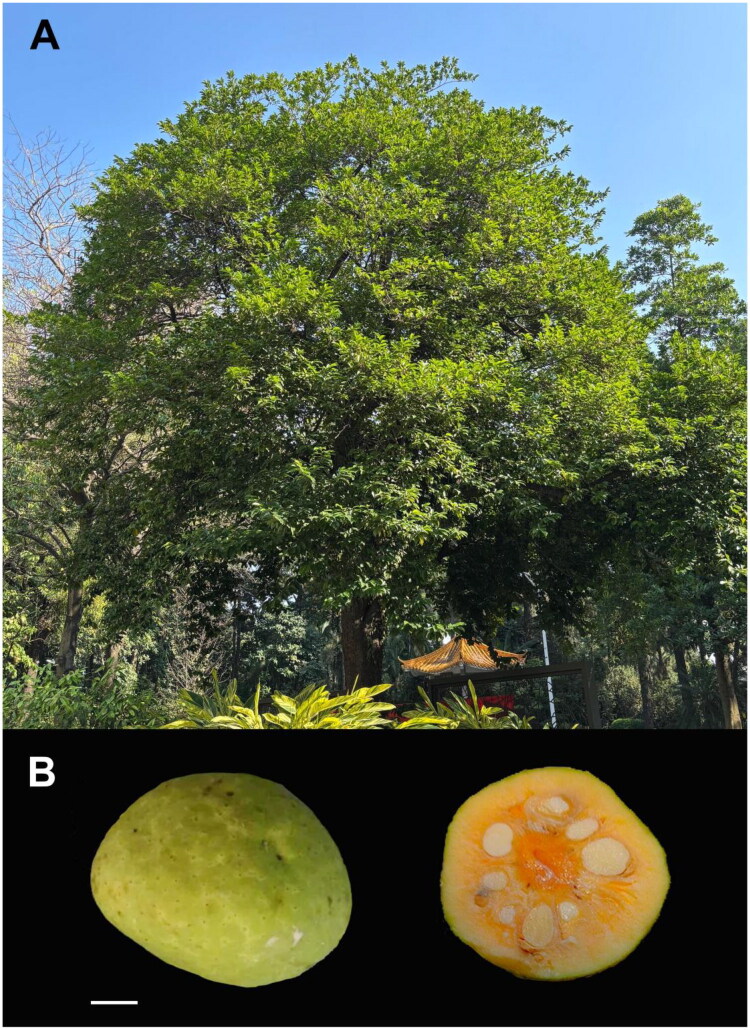 Figure 1
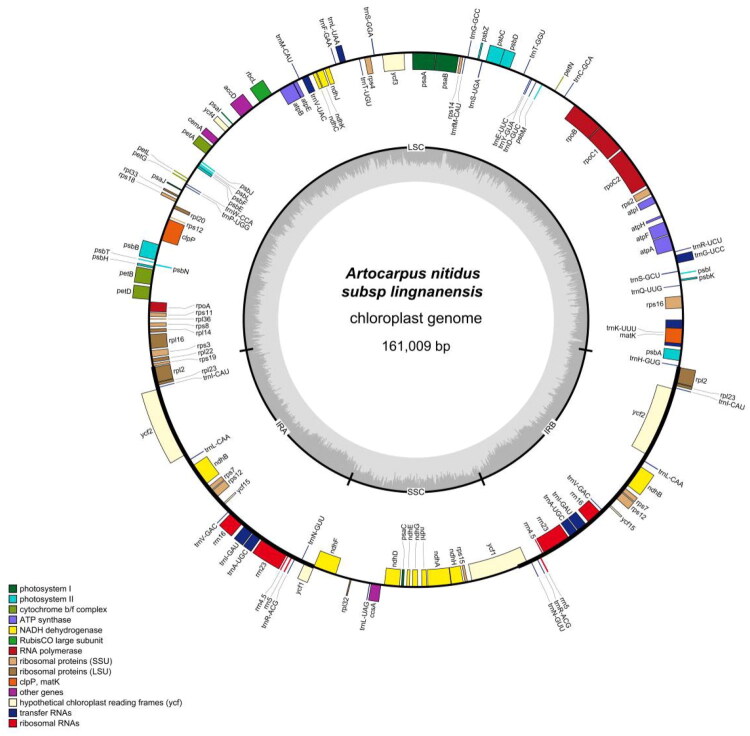 Figure 2
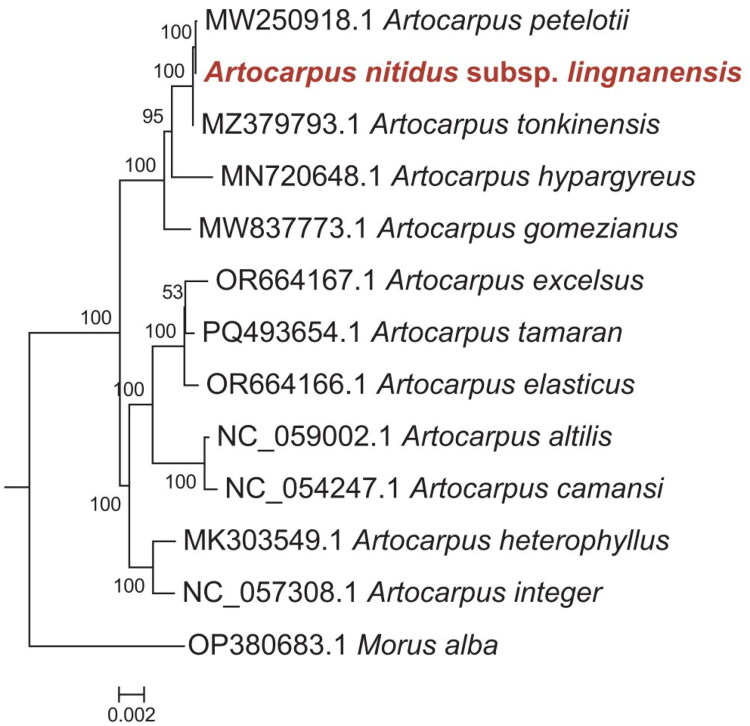 Figure 3
Peer Reviews
No public reviews on file for this paper yet. If you reviewed it on a platform where reviews are public (OpenReview, ICLR, NeurIPS, ICML), you can paste yours below so the community can read it here.
Videos
No videos yet. Explain this paper in a talk, walkthrough, or lecture? Add one.
Taxonomy
TopicsGenomics and Phylogenetic Studies · Bioactive natural compounds · Biological and pharmacological studies of plants
Introduction
Artocarpus nitidus subsp. lingnanensis (Merr.) F.M. Jarrett 1960 (Moraceae family) is an evergreen tree species can grow up to 17 meters in height (Zhang and Wu 1998). It is native to southern China, and also cultivated in parts of Southeast Asia. The bark of A. nitidus subsp. lingnanensis is dark and its timber is dense and durable, making it suitable for construction and furniture. Its edible fruits possess orange flesh with a sweet-sour taste and can be processed into many products (Luo et al. 2025). Fruit contains many active substances that can be used to treat diseases (Luo et al. 2018). Owing to its broad, dense canopy, it is also planted as an ornamental street tree.
Despite its various uses, taxonomic and phylogenetic knowledge of A. nitidus subsp. lingnanensis remains limited. In particular, the characteristics of its chloroplast genome have not been previously reported. The unclear species boundaries and phylogenetic placement hinder accurate identification, leading to potential mislabeling in germplasm collections and obscuring conservation priorities. Furthermore, the lack of genomic resources, prevents the development of reliable molecular markers for population genetics studies and breeding programs. Chloroplast genomes are valuable for understanding plant phylogeny and supporting genetic studies, as they contain conserved genes related to photosynthesis and other essential functions (Lestari et al. 2024). To elucidate its phylogenetic relationships, we generated and analyzed the first complete chloroplast genome of A. nitidus subsp. lingnanensis. These findings provide new genomic resources that will facilitate further research on this species and its relatives (Figure 1).
Morphology of A. nitidus subsp. lingnanensis. (A) The whole plant, 7–8 m tall, showing the evergreen canopy and the brown bark. (B) The aggregate fruit and its cross section, revealing the green rind and orange pulp. Scale bar represent 1 cm. Photographed by Xuemei Chen at Foshan Botanical Garden, Guangdong Province, China.
Materials and methods
Fresh leaf samples of A. nitidus subsp. lingnanensis were obtained from the Foshan Botanical Garden in Guangdong Province, China (23°11′23″N, 113°00′52″E). The voucher specimen was deposited in the herbarium of Foshan Botanical Garden (Foshan, China, Xueyi Tian, [email protected]) under the number FBA-1. Total genomic DNA was extracted from approximately 100 mg of fresh leaf tissue using a modified CTAB method (Doyle and Doyle 1987). The concentration and quality of the extracted DNA were assessed with a NanoDrop 2000 spectrophotometer and agarose gel electrophoresis. A paired-end sequencing library was constructed with the NEBNext® Ultra™ II DNA Library Prep Kit (Illumina, USA) following the manufacturer’s protocol and sequenced on an Illumina novaseq X plus platform to generate 150-bp paired-end reads. Raw sequencing reads were quality-filtered using fastp (v0.23.4) (Li et al. 2025). The chloroplast genome was then de novo assembled with GetOrganelle (v1.7.5.0) with the k-mer values of 55, 87 and 121 (Jin et al. 2020). Annotation was performed using CPGAVAS2 and GeSeq (Tillich et al. 2017), with tRNA genes further verified by tRNAscan-SE. A circular map of the chloroplast genome was generated with OGDraw (Lohse et al. 2007). The cis/trans-splicing genes maps were drawn by CPGView software (Liu et al. 2023). The complete chloroplast genome sequence was deposited in GenBank under the accession number PX696983.
Chloroplast genome sequences were aligned using MAFFT (v7.505) with the “auto” strategy (Katoh et al. 2019), following the removal of one copy of the inverted repeats to eliminate redundant sites. The alignment comprised 17 sequences in total: 12 Artocarpus genomes downloaded from NCBI, plus the newly sequenced A. nitidus subsp. lingnanensis. The alignment was trimmed with trimAI (v1.4.rev15). A maximum likelihood phylogeny was reconstructed in RAxML (v8.2.10) under the GTRGAMMA model, which was previously determined to be the best-fit model by jModelTest (v2.1.10) using the Bayesian information criterion. The analysis, which included the designated outgroup Morus alba (NCBI accession: OP380683.1), employed 1000 rapid bootstrap replicates for branch support estimation (Stamatakis 2014).
Results
Featuring the conserved quadripartite structure (Figure 2), the chloroplast genome of A. nitidus subsp. lingnanensis comprises an 89,552 bp LSC, a 20,093 bp SSC, and two 25,682 bp IRs, with a total length of 161,009 bp, with an average sequencing depth of 824.1× (Figure S1). The overall GC content is 35.79%. A total of 132 genes are annotated, including 87 protein-coding genes, 37 tRNAs, and 8 rRNAs (Tables S1). Thirteen cis-splicing genes and the trans-splicing gene rps12 were detected (Figures S2).
Circular map of the A. nitidus subsp. lingnanensis chloroplast genome. Genes drawn inside the circle are transcribed clockwise, while those outside are transcribed counterclockwise. The inner ring denotes the borders of the large single-copy (LSC), small single-copy (SSC), and inverted repeat (IRA/IRB) regions. Genes are color-coded by functional category, as shown in the legend. The innermost gray ring illustrates the GC content.
Using the complete chloroplast genome sequences, a maximum likelihood (ML) tree was reconstructed to clarify the phylogenetic placement of A. nitidus subsp. lingnanensis within Artocarpus. Our dataset included the newly sequenced genome along with 11 additional Artocarpus species. M. alba, a closely related genus within Moraceae, was used as the outgroup for rooting the phylogenetic tree. As depicted in Figure 3, the first clade including A. nitidus subsp. lingnanensis, A. petelotii, A. tonkinensis, A. hypargyreus and A. gomezianus, among them A. nitidus subsp. lingnanensis and A. petelotii are closely related, with a bootstrap support rate of 100%. The second clade contains 7 Artocarpus species, including A. excelsus, A. tamaran, A. elasticus, A. camansi, A. altilis, A. integer and A. heterophyllus. And the outgroup clustered into a distinct branch.
Phylogenetic tree constructed from complete chloroplast genomes to determine the evolutionary position of A. nitidus subsp. lingnanensis (highlighted). Bootstrap support values (>50%) are shown on the branches. The sequences used were as followed: A. nitidus subsp. lingnanensis (PX696983, this study); Artocarpus tonkinensis, MZ379793.1; Artocarpus heterophyllus, MK303549.1; Artocarpus hypargyreus, MN720648.1; Artocarpus petelotii, MW250918.1; Artocarpus gomezianus, MW837773.1; Artocarpus altilis, NC059002.1; Artocarpus camansi, NC054247.1; Artocarpus tamaran, PQ493654.1; Artocarpus elasticus, OR664166.1; Artocarpus integer, MT900597.1; Artocarpus excelsus, OR664167.1; Morus alba, OP380683.1.
Discussion and conclusion
Plants of the genus Artocarpus are tall trees valued for their edible fruit, high quality timber, and therapeutic properties, which give them significant economic importance (Chaurasia and Pandey 2023). However, chloroplast genome data are available for only a few species in this genus, limiting our understanding of its evolution and taxonomy. For the first time, the complete chloroplast genome of A. nitidus subsp. lingnanensis has been assembled and annotated. The resulting sequence displays the common quadripartite circular organization, which includes one large single-copy (LSC), one small single-copy (SSC), and two inverted repeat (IR) regions. Its size (161,009 bp), GC content (35.79%), and gene repertoire (132 genes) are highly conserved and fall within the range reported for other Artocarpus species (Chen and Liu 2021), which reinforces the structural stability of chloroplast genomes in this genus.
Phylogenetic analysis placed the five Artocarpus species within a single, strongly supported clade (bootstrap value > 95%), with A. nitidus subsp. lingnanensis being most closely related to A. petelotii. Despite this close genetic affinity, the two species can be easily distinguished by several morphological traits. A. petelotii has papery leaves covered with reddish-brown pubescence and features bears dense, prominent veins. In contrast, leaves of A. nitidus subsp. lingnanensis are glabrous with inconspicuous reticulate venation. Furthermore, A. petelotii exhibits longer inflorescences and petioles compared to those of A. nitidus subsp. lingnanensis. These morphological differences highlight the importance of integrating molecular and morphological data for accurate species delimitation within this complex group. The consistency between our phylogenetic results and those from previous chloroplast genome studies improves the resolution of species relationships within Artocarpus (Ho et al. 2025). The chloroplast genome of A. nitidus subsp. lingnanensis assembled in this study will facilitate future phylogenetic, evolutionary, and molecular identification research within the genus Artocarpus.
Supplementary Material
Revised manuscript clean.docx
Figure S1.jpg
Table S1.xlsx
Figure S2.jpg
The reference list from the paper itself. Each links out to its DOI / PubMed record.
- 1Chaurasia S, Pandey A. 2023. Phytochemistry and pharmacology of genus Artocarpus: a review on current status of knowledge. Russ J Bioorg Chem. 49(3):481–514. 10.1134/S 1068162023030081 · doi ↗
- 2Doyle JJ, Doyle JL. 1987. A rapid DNA isolation procedure for small quantities of fresh leaf tissue. Phytochem Bull. 19:11–15.
- 3Ho VT, Ngo TKA, Gebre YG, Nguyen DK, Widiarsih S. 2025. Characterization of the complete chloroplast genome seedless jackfruit (Artocarpus heterophyllus var. seedless) and its relatives. Not Bot Horti Agrobo. 53(1):14244.10.15835/nbha 53114244. · doi ↗
- 4Jin JJ et al. 2020. Get Organelle: a fast and versatile toolkit for accurate de novo assembly of organelle genomes. Genome Biol. 21(1):241. 10.1186/s 13059-020-02154-532912315 PMC 7488116 · doi ↗ · pubmed ↗
- 5Katoh K, Rozewicki J, Yamada KD. 2019. MAFFT online service: multiple sequence alignment, interactive sequence choice and visualization. Brief Bioinform. 20(4):1160–1166. 10.1093/bib/bbx 10828968734 PMC 6781576 · doi ↗ · pubmed ↗
- 6Lestari R et al. 2024. Characterization of the complete chloroplast genome of the endangered and endemic bornean fruit Artocarpus tamaran Becc. Front Plant Sci. 15:1513364. 10.3389/fpls.2024.151336439726425 PMC 11669497 · doi ↗ · pubmed ↗
- 7Li B, Wang W, Liu Y, Wang L. 2025. Characteristics and phylogenetic analysis of the complete chloroplast genome of Rubus swinhoei Hance 1866 from the family Rosaceae. Mitochondrial DNA B Resour. 10(2):119–123. 10.1080/23802359.2025.244969039840349 PMC 11749290 · doi ↗ · pubmed ↗
- 8Liu S et al. 2023. CPG View: a package for visualizing detailed chloroplast genome structures. Mol Ecol Resour. 23(3):694–704. 10.1111/1755-0998.1372936587992 · doi ↗ · pubmed ↗