Effects of Formal Metal Oxidation State on the Preferred Structure Types in Binuclear Actinide Carbonyl Derivatives: Predicted Tetramerization of Carbon Monoxide to a Bridging Squarate Group in Uranium Chemistry
Amr A. A. Attia, Alexandru Lupan, R. Bruce King

TL;DR
This paper uses computational methods to explore how uranium oxidation states influence the structures of uranium carbonyl compounds, predicting a novel squarate bridging group formed from CO tetramerization.
Contribution
The prediction of CO tetramerization to a bridging squarate group in uranium chemistry is a novel structural finding.
Findings
The tetracarbonyl system forms a bridging C4O4 squarate unit, predicted as a low-energy structure.
The tricarbonyl structure is less stable compared to the squarate tetracarbonyl structure.
Uranium's oxidation states from +3 to +6 allow diverse spin states and bonding modes, unlike thorium systems limited to +4.
Abstract
The structures and energetics of the binuclear cyclooctatetraene uranium carbonyls (C8H8)2U2(CO) n (n = 2, 3, 4, 5) have been studied by density functional theory. The most interesting observation from this work is the prediction of low-energy structures in the tetracarbonyl system of the type (C8H8)2U2(η4-μ-C4O4), in which the four CO groups couple to form a bridging C4O4 squarate unit. Such a tetramerization of carbon monoxide to give a squarate unit by organouranium compounds has been observed experimentally by Cloke and co-workers in sandwich compounds of the type (η5-Me5C5)U(η8-C8H6{SiR3}2) containing both five-membered and eight-membered rings. However, tetramerizations of CO groups to squarate were not predicted in theoretical studies of related (C8H8)2Th2(CO)4 or (C5H5)2M2(CO)4 systems (M = Th, U). These bridging squarate (C8H8)2U2(η4-μ-C4O4) structures found in this work are…
Genes, proteins, chemicals, diseases, species, mutations and cell lines named across the full text — each resolved to its canonical identifier and authoritative record.
Click any figure to enlarge with its caption.
 1
1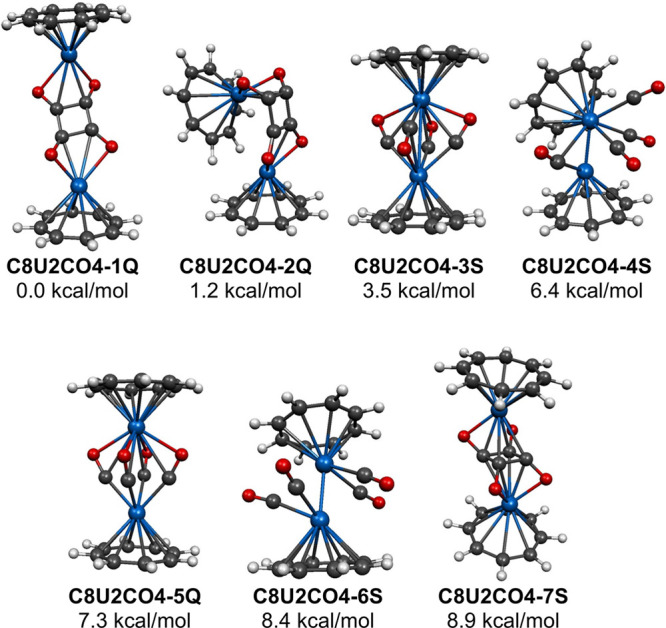 2
2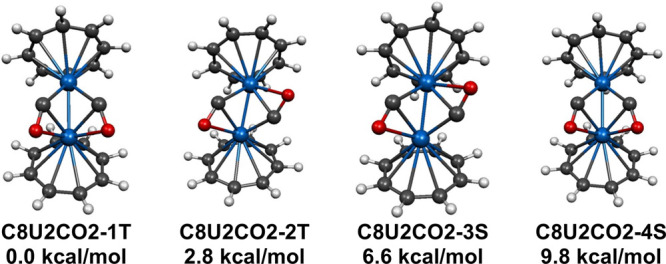 3
3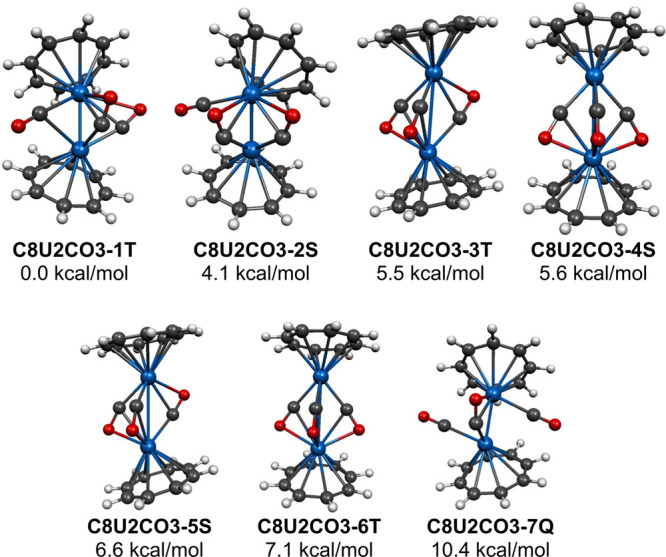 4
4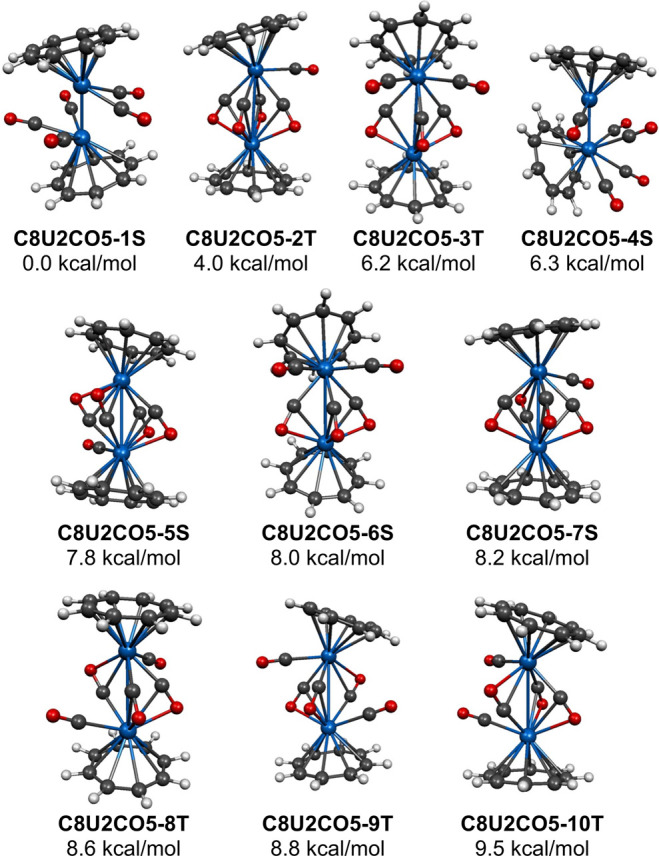 5
5| central framework | dissection | M–M bonding | literature |
|---|---|---|---|
| Cp2Ln2(η4-μ-C2O2) | 2Ln3++2Cp– + η4-μ-C2O2 4– | none |
|
| Cp2Th2(η2-μ-CO)2 | 2Th3+ + 2Cp– + 2η2-μ-CO | Th–Th ∼ 3.4 Å |
|
| Cp2Th2(η2-μ-CO)3 | 2Th4+ + 2Cp– + 3η2-μ-CO | none (Th···Th ∼ 3.7 Å) |
|
| (η8-C8H8)2Th2(η4-μ-C2O2) | 2Th4+ + 2C8H8 2– + η4-μ-C2O2 4– | none |
|
| Cp2U2(η2-μ-CO)2 | 2U3+ + 2Cp2 + 2η2-μ-CO | UU ∼ 2.4 Å |
|
| Cp2U2(η2-μ-CO)3 | 2U4+ + 2Cp2 + 3η2-μ-CO | U=U ∼ 2.45 Å |
|
| Cp2U2(η2-μ-CO)4 | 2U5+ + 2Cp2 + 4η2-μ-CO | U–U ∼ 3.4 Å |
|
| (η°-C8H8)2U2(η2-CO)2 | 2U4+ + 2C8H8 2– + 2η2-μ-CO | U=U ∼ 2.5 Å | this work |
| Δ | U–U bonding | bridging CO groups | ||||||
|---|---|---|---|---|---|---|---|---|
| structure | BP86 | M06L | length | WBI | MBO | order | type | ν(CO) |
|
| 0.0 | 0.4 | 5.358 | 0.08 | 0.09 | 0 | η4-μ-C4O4 | 1289, 1328, 1495, 1631 |
|
| 1.2 | 0.0 | 4.021 | 0.24 | 0.27 | 0 | η4-μ-C4O4 | 1296, 1377, 1407, 1547 |
|
| 3.5 | 22.0 | 3.460 | 1.52 | 1.07 | 1 | 4η2-μ-CO | 1464, 1542, 1561, 1653 |
|
| 6.4 | 25.0 | 2.480 | 3.66 | 2.12 | 2 | all terminal CO groups | |
|
| 7.3 | 11.1 | 4.004 | 0.42 | 0.52 | 0 | 4η2-μ-CO | 1566, 1572, 1587, 1658 |
|
| 8.4 | 29.2 | 2.536 | 3.54 | 1.80 | 2 | all terminal CO groups | |
|
| 8.9 | 30.7 | 4.598 | 1.10 | 1.12 | 1 | η4,4-μ-C4O4 | 1201, 1214, 1221, 1299 |
| Δ | U–U bonding | bridging CO groups | ||||||
|---|---|---|---|---|---|---|---|---|
| structure | BP86 | M06L | length | WBI | MBO | order | type | ν(CO) |
|
| 0.0 | 0.0 | 2.550 | 2.88 | 2.16 | 2 | 2η2-μ-CO | 1504, 1560 |
|
| 2.8 | 4.7 | 2.537 | 2.98 | 2.32 | 2 | 2η2-μ-CO | 1524, 1585 |
|
| 6.6 | 10.8 | 2.501 | 3.48 | 2.28 | 2 | 2η2-μ-CO | 1544, 1609 |
|
| 9.8 | 12.5 | 2.515 | 3.20 | 2.15 | 2 | 2η2-μ-CO | 1494, 1552 |
| Δ | U–U bonding | bridging CO groups | ||||||
|---|---|---|---|---|---|---|---|---|
| structure | BP86 | M06L | length | WBI | MBO | order | type | ν(CO) |
|
| 0.0 | 0.0 | 2.581 | 2.96 | 2.04 | 2 | η2-μ-CO | 1588 |
|
| 4.1 | 4.6 | 2.501 | 3.48 | 2.01 | 2 | 2η2-μ-CO | 1632, 1680 |
|
| 5.5 | 8.5 | 3.604 | 1.10 | 1.10 | 1 | 3η2-μ-CO | 1457, 1465, 1532 |
|
| 5.6 | 14.5 | 3.530 | 1.39 | 1.12 | 1 | 3η2-μ-CO | 1419, 1424, 1484 |
|
| 6.6 | 16.6 | 3.525 | 1.43 | 1.22 | 1 | 3η2-μ-CO | 1382, 1402, 1455 |
|
| 7.1 | 4.5 | 3.809 | 0.82 | 0.83 | 0–1 | 3η2-μ-CO | 1440, 1496, 1549 |
|
| 10.4 | 7.4 | 2.609 | 2.63 | 2.05 | 2 | 1η2-μ-CO | 1550 |
| Δ | U–U bonding | bridging CO groups | ||||||
|---|---|---|---|---|---|---|---|---|
| structure | BP86 | M06L | length | WBI | MBO | order | type | ν(CO) |
|
| 0.0 | 3.3 | 2.560 | 3.49 | 1.74 | 2 | all terminal CO groups | |
|
| 4.0 | 0.0 | 3.793 | 0.83 | 0.78 | 0 | 4η2-μ-CO | 1565, 1583, 1598, 1637 |
|
| 6.2 | 3.9 | 3.850 | 0.72 | 0.69 | 1 | 3η2-μ-CO | 1506, 1539, 1577 |
|
| 6.3 | 7.0 | 2.519 | 3.63 | 1.90 | 2 | all terminal CO groups | |
|
| 7.8 | 10.0 | 3.425 | 1.64 | 1.17 | 1 | 4η2-μ-CO | 1535, 1575, 1606, 1649 |
|
| 8.0 | 13.8 | 3.546 | 1.35 | 0.98 | 1 | 3η2-μ-CO | 1462, 1466, 1509 |
|
| 8.2 | 11.0 | 3.479 | 1.48 | 1.07 | 1 | 4η2-μ-CO | 1470, 1536, 1550, 1675 |
|
| 8.6 | 9.7 | 3.618 | 1.07 | 1.00 | 1 | 3η2-μ-CO | 1513, 1533, 1585 |
|
| 8.8 | 8.1 | 3.681 | 0.98 | 0.82 | 1 | 3η2-μ-CO | 1559, 1567, 1676 |
|
| 9.5 | 10.5 | 3.672 | 1.04 | 0.99 | 1 | 3η2-μ-CO | 1525,1528,1610 |
| reaction | Δ | Δ |
|---|---|---|
|
| 12.6 | 11.9 |
|
| 17.5 | 15.4 |
|
| 24.6 | 21.7 |
|
| 35.1 | 32.1 |
|
| 18.5 | 16.8 |
- —Ministry of Education and Research, Romania10.13039/501100006730
- —European Regional Development Fund10.13039/501100008530
Peer Reviews
No public reviews on file for this paper yet. If you reviewed it on a platform where reviews are public (OpenReview, ICLR, NeurIPS, ICML), you can paste yours below so the community can read it here.
Videos
No videos yet. Explain this paper in a talk, walkthrough, or lecture? Add one.
Taxonomy
TopicsOrganometallic Complex Synthesis and Catalysis · Radioactive element chemistry and processing · Nuclear Materials and Properties
Introduction
1
The richness of metal carbonyl chemistry of the d-block transition metals, as exemplified by stable binary metal carbonyls such as Ni(CO)4, Fe(CO)5, and M(CO)6 (M = Cr, Mo, W), ?−? ? is not matched by that of the f-block metals such as the lanthanides and actinides. Initially this could seem rather surprising since both d-block and f-block transition metals have available d-orbitals for the dπ→pπ* back-bonding to carbonyl groups coordinated to the central metal atom(s) solely through the carbon atom. However, a major factor limiting the scope of metal carbonyl chemistry of the f-block metals is their high affinity for oxygen. This leads to preferred structures in which carbonyl groups are bonded to the metals not only through their carbon atoms but also through their oxygen atoms. This high affinity of the f-block metals for bonding to oxygen is supported by our theoretical studies on the binuclear derivatives Cp_2_Ln_2_(CO)_ n _ (Ln = La, Lu; Cp = η^5^-C_5_H_5_),? Cp_2_Th_2_(CO)_ n ,? (C_8_H_8)2_Th_2(CO)_ n ,? and Cp_2_U_2(CO)_ n .? In most of the low-energy structures found in all of these binuclear systems, at least two carbonyl groups are bridging η^2^-μ-CO groups that are bonded to a metal atom not only through their carbon atoms but also through their oxygen atoms. In addition, a number of low-energy structures were found in which two carbonyl groups couple to form a bridging C_2_O_2 unit that uses both of its oxygen atoms for bonding to the central M_2_ unit. In addition to a central MC_ n O n M unit in a Cp_2_M_2(CO)_ n _ or (C_8_H_8_)2_M_2(CO)_ n _ derivative, terminal CO groups are predicted for some of the carbonyl richer structures. Such terminal CO groups in f-block metal carbonyl derivatives are predicted to exhibit ν(CO) frequencies in a similar region to that of similar terminal CO groups in related d-block metal derivatives, typically above 1800 cm^–1^.
Experimentally known viable carbonyl derivatives of the f-block metals stable under ambient conditions are very limited. Several mononuclear substituted triscyclopentadienyluranium carbonyls of the type Cp_3_U(CO) are known in which Cp corresponds to a suitably substituted pentahapto cyclopentadienyl ligand. ?−? ? ? The steric requirements of three such Cp ligands around a single uranium atom restrict the available space for a fourth ligand. Because of the resulting blocking effect of the uranium coordination sphere by three such ligands, addition of a carbonyl group to a Cp_3_U system to form a Cp_3_U(CO) derivative leads to a linearly coordinated CO group bonded to the metal atom through only its carbon atom rather than the more sterically demanding laterally bonding mode involving coordination of both its carbon and oxygen atoms. More recently the stable uranium carbonyl sterically hindered aryloxy derivative Cp_2_U(OC_6_H_2_Bu^ t ^ _2_Me)(CO) (Cp = η^5^-Me_5_C_5_) has been synthesized and structurally characterized by X-ray crystallography.? The related Cp*2_U(As_2_Mes_2)(CO) (Mes = mesityl) has also been prepared in solution and characterized spectroscopically.? However, it was only stable in a CO atmosphere and thus could not be structurally characterized. The binary actinide metal carbonyls M(CO)_ n _ (M = Th, n = 1–6 ?,? ; M = U, n = 1, 2, 6?) have been observed at low temperatures in reactions of laser ablated metal atoms with carbon monoxide. However, they are not stable under normal laboratory conditions.
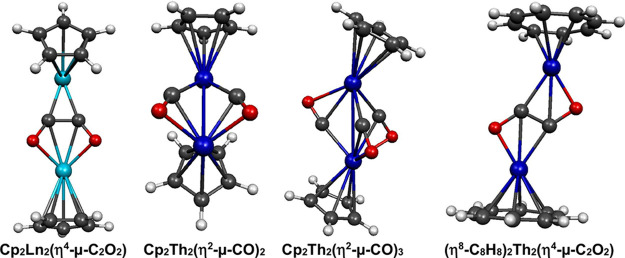
Carbonyl groups as well as their C_2_O_2_ dimers bridging central M_2_ units of f-block metals by forming both U–C and U–O bonds can be considered as dianions formed by deprotonation of simple molecules. Thus, a bridging η^2^-μ-CO group can be considered as a CO^2–^ dianion derived from double deprotonation of formaldehyde, HC(O)H, or its C(OH)2 tautomer. Similarly, a bridging η^4^-μ-C_2_O_2_ group can be considered as a C_2_O_2_ ^4–^ tetraanion derived from a quadruple deprotonation of acetaldehyde, CH_3_C(O)H, or its enol tautomer vinyl alcohol, CH_2_=CHOH. Such interpretations can be very helpful in accounting for the lowest energy binuclear lanthanide and thorium Cp_2_M_2_(CO)_ n _ and (C_8_H_8_)2_M_2(CO)_ n _ structures since lanthanides have a strongly preferred +3 oxidation state and thorium has a strongly preferred +4 oxidation state (Figure ? and Table). Thus, a typical central structural unit in Cp_2_Ln_2_(CO)_ n _ derivatives is of the type Ln^III^ 2(η^2^-μ-C_2_O_2_) with the favorable +3 lanthanide oxidation state after considering the uninegative Cp^–^ anions bonded to each lanthanide. Similarly, a typical central structural unit in (C_8_H_8_)2_Th_2(CO)_ n _ derivatives is of the type Th^IV^ 2(η^2^-μ-C_2_O_2_) after considering the dinegative C_8_H_8_ ^2–^ dianion bonded to each thorium atom. For the Cp_2_Th_2_(CO)_ n _ systems a central triply bridging Th^IV^ 2(η^2^-μ-CO)3 unit leads to the favorable +4 oxidation state for each thorium atom. Cp_2_Th_2_(CO)_ n _ systems with only two bridging η^2^-μ-CO units correspond to the d^1^ or f^1^ Th(III) oxidation state suggesting the possibility of a Th–Th single bond in such systems. Note, however, that the rigid geometry of the η^2^-μ-CO or η^4^-μ-C_2_O_2_ bridges across a central M_2_ unit can restrict severely the range of metal–metal bond distances. This complicates any relationship between such distances and formal metal–metal bond order. Mayer Bond Orders (MBO) appear to be closer to the apparent formal metal–metal bond orders deduced from other considerations than the Wiberg Bond Indices (WBI).?
1: Formal f-Block Metal Oxidation States in Cp2M2(CO) n and (C8H8)2M2(CO) n Derivatives and the Nature of Their Metal–Metal Bonds
Sample structures of the binuclear lanthanide and thorium carbonyl complexes listed in Table .
The metal–metal bonding situation with the f-block metal uranium in its binuclear derivatives is significantly more complicated than that with the lanthanides and thorium because of the variety of reasonably favorable uranium oxidation states ranging from +3 to +6. For any uranium formal oxidation state below +6 in a binuclear derivative, electrons remain on each uranium atom to provide opportunities for diverse types of uranium–uranium bonding. The complexity of such uranium–uranium bonding is illustrated by the unusual bonding in the bare uranium dimer U_2_. Thus, the formal quintuple bond in U_2_ consists of a normal σ + 2π triple bond similar to the CC triple bond in acetylene, supplemented by four single-electron “half bonds”. ?,? This, coupled with two unpaired nonbonding electrons leads to a septet ground state for U_2_. Furthermore, a computational study on the permethylated “diuranocene,” (η^5^-Me_5_C_5_)2_U_2, suggests an unusual σ + ^2^/_2_π + ^2^/2_δ net triple UU bond consisting of a full σ-bond supplemented by four one-electron “half-bonds” with π and δ symmetries.? Such a formal UU triple bond with four unpaired electrons within the bond corresponds to a formal f^2^ U(IV) oxidation state with two additional unpaired electrons on each uranium atom. The total of eight unpaired electrons predicted for (η^5^-Me_5_C_5)2_U_2 corresponds to an unusually high spin nonet ground state for the molecule.
Experimental work on interaction of carbon monoxide with organouranium systems provides examples of coupling of several CO units to give uranium complexes containing oxocarbon ligands? such as ethynediolate (C_2_O_2_ ?),? deltate (cyclo-C_3_O_3_ ^2–^),? and squarate (cyclo-C_4_O_4_ ^2–^).? Thus, two types of formal uranium(III) derivatives, namely sandwich compounds (η^5^-Me_5_C_5_)U(η^8^-C_8_H_6_{SiR_3_}2) containing both cyclopentadienyl and cyclooctatetraene ligands as well as the uranium(III) tris(amide) complex? [(Me_3_Si)_2_N]_3_U, promote the reductive dimerization of CO to give complexes with a coordinated ethynediolate ligand. For the uranium sandwich compounds, the extent of CO coupling appears to depend on the steric demands of the substituents on the cyclooctatetraene ring. The mechanism of CO dimerization on the mixed sandwich system is suggested by computational studies to involve a binuclear uranium intermediate containing a bridging ethynediolate group.?
A variety of binuclear uranium carbonyl systems of the general type (C_ x H x )(C y H y )U_2(CO)_ n _ containing various combinations of the anionic planar hydrocarbon ligands C_5_H_5_ ^–^ (Cp^–^), C_7_H_7_ ^3–^, and C_8_H_8_ ^2–^ with either 6 or 10 π-electrons conforming to the Hückel 4n + 2 rule are of potential interest. The aggregate negative charge provided by these hydrocarbon ligands in their (C_ x H x )(C y H y )U_2(CO)_ n _ complexes is anticipated to have a major effect on the nature of their carbonyl groups in the lowest energy structures. For our initial studies in this area, we chose the Cp_2_U_2_(CO)_ n _ systems containing two monoanionic Cp^–^ ligands so that the uranium atoms have an average formal U(I) oxidation state if the carbonyl ligands are neutral ligands. Such carbonyl groups are similar to the CO groups bonded only through carbon atoms found in almost all carbonyl derivatives of the d-block metals. Numerous cyclopentadienyluranium derivatives are known that could be the precursors of the synthesis of such molecules. The low formal U(I) oxidation states in Cp_2_U_2_(CO)_ n _ complexes might be expected to lead to reduction of some of the CO groups to formally dianionic bridging η^2^-μ-CO groups or reductive coupling to tetraanionic C_2_O_2_ ^4–^ groups. However, no examples of CO reductive coupling to form C_2_O_2_ ^4–^ tetraanionic ligands were found in the lowest energy structures.? In this way the uranium Cp_2_U_2_(CO)_ n _ systems differ significantly from the analogous thorium systems Cp_2_Th_2_(CO)_ n _ where a number of examples of reductive coupling to form C_2_O_2_ ^4–^ ligands were predicted.? The retention of uranium valence electrons not involved in metal–ligand bonding in the low-energy Cp_2_U_2_(CO)_ n _ (n = 3, 4) structures, even after reduction of CO to η^4^-μ-CO^2–^ or η^4^-μ-C_2_O_2_ ^4–^, was found to lead to a complicated variety of predicted U–U bonding modes including formal multiple bonds containing unpaired electrons in single-electron half-bond components. This leads to spin states in low-energy structures ranging from singlet to quintet.
We now report a study of (C_8_H_8_)2_U_2(CO)_ n _ complexes containing two dianionic C_8_H_8_ ^2–^ ligands so that each uranium atom has the formal U(II) oxidation state if all of the CO groups are neutral terminal ligands bonded exclusively through their carbon atoms. This change in the hydrocarbon ligands is expected to have a profound effect in the energetically preferred structures. The most striking finding from this study is the presence of a bridging squarate tetraanion C_4_O_4_ ^4–^ in the lowest energy structures of the tetracarbonyl (C_8_H_8_)2_U_2(CO)4 arising from the tetramerization of carbon monoxide. The long U···U distances in these bridging squarate structures combined with the quintet spin state of the two lowest energy (C_8_H_8_)2_U_2(η^4^-μ-C_4_O_4_) indicate that these are high-spin f^2^ U(IV) complexes. A higher energy low-spin singlet bridging squarate (C_8_H_8_)2_U_2(η^4^-μ-C_4_O_4_) complex was also found. This prediction of low-energy bridging squarate structures in the (C_8_H_8_)2_U_2(CO)4 system is not totally surprising because of the experimental observation of tetramerization of carbon monoxide to squarate observed by Cloke and co-workers in related organouranium sandwich compounds.?
However, this tetramerization of carbon monoxide was the only example of coupling of carbonyl groups found in the entire series of (C_8_H_8_)2_U_2(CO)_ n _ (n = 2, 3, 4, 5) found in this work. The carbonyl groups in all of the other lowest energy such structures are either bridging η^2^μ-CO groups or terminal CO groups using only their carbon atoms for bonding to a uranium atom similar to the terminal CO groups in the ubiquitous d-block transition metal carbonyl derivatives.
Theoretical Methods
2
The initial (C_8_H_8_)2_U_2(CO)_ n _ (n = 2, 3, 4, 5) structures were constructed by systematic placement of CO molecules as terminal and bridging ligands coordinating through only the carbon atom or through both the carbon and oxygen atoms. This led to 19 different starting structures for (C_8_H_8_)2_U_2(CO)2, 71 starting structures for (C_8_H_8_)2_U_2(CO)3, 104 starting structures for (C_8_H_8_)2_U_2(CO)4 and 189 starting structures for (C_8_H_8_)2_U_2(CO)5. All structures were optimized as singlets, triplets, quintets, and septets.
Full geometry optimizations were carried out on the (C_8_H_8_)2_U_2(CO)_ n _ systems by using the BP86 DFT functional coupled with the def2-TZVP basis set for all atoms except uranium for which the ECP60MWB basis set including pseudopotentials was used. ?−? ? ? ? ? ? The nature of the stationary points after optimization was checked by calculations of the harmonic vibrational frequencies. If significant imaginary frequencies were found, the optimization was continued by following the corresponding normal modes to ensure that genuine minima were obtained. In addition, single point energy calculations were performed on all optimized structures by utilizing the BP86 DFT functional and the def2-TZVP basis set coupled with the zero-order regular approximation (ZORA)? as implemented in the ORCA 3.0.3 software package.? These calculations were performed using very tight convergence criteria; the resulting energetics are discussed in the text. Single point calculations of the relative energies of the structures optimized by the PB86 method were performed using the M06L/def2-TZVP/ZORA method and are listed in the tables.
All geometry optimizations were performed using the Gaussian 09 package? with the default settings for the SCF cycles and geometry optimization. Wiberg bond indices (WBIs) for the U–U interactions in the optimized (C_8_H_8_)2_U_2(CO)_ n _ structures were determined using NBO analysis? since they are well-established as means for evaluating M–M interactions. In addition, U–U Mayer bond order values (MBOs)? were also calculated since they were often found to be more reliable than WBIs for many inorganic systems. Indeed for a number of the compounds discussed in this paper, their MBOs were found to give more reasonable values than their WBIs. The structures, total and relative energies, and relevant interatomic distances for all of the optimized structures are given in the Supporting Information. Structures in the main text are designated as C8U2COn-xA where n refers to the number of CO groups, A refers to the spin state with S, T, and Q corresponding to singlet, triplet, and quintet spin states, respectively, and x orders the structures according to their relative energies by the BP86 method. Only the lowest energy and thus potentially chemically significant structures are considered in detail in this paper. However, more comprehensive lists of structures, including higher energy structures, are given in the Supporting Information.
Results and Discussion
3
The (C8H8)2U2(CO)4 Tetracarbonyl System Including Bridging
Squarate Structures
3.1
Seven (C_8_H_8_)2_U_2(CO)4 tetracarbonyl structures were found within 13 kcal/mol of the lowest energy structure C8U2CO4-1Q using the BP86 method (Figure and Table). However, single point calculations of the energies of these seven optimized (C_8_H_8_)2_U_2(CO)4 structures using the M06L/def2-TZVP/ZORA method showed the three quintet structures to have far lower energies than any of the other four (C_8_H_8_)2_U_2(CO)4 structures. Thus, using this M06L method gave an energy of the highest energy of the three quintet (C_8_H_8_)2_U_2(CO)4 structures, namely C8U2CO4-5Q, more than 10 kcal/mol below the lowest energy lower spin structure, namely the singlet structure C8U2CO4-1S.
Seven (C8H8)2U2(CO)4 structures within 13 kcal/mol of energy.
2: Seven (C8H8)2U2(CO)4 Structures within 13 kcal/mol of Energy by the BP86 Method with ΔE in kcal/mol, Bond Lengths in Å, and ν(CO) Frequencies in cm–1
The two lowest-energy (C_8_H_8_)2_U_2(CO)4 structures, namely the energetically very closely spaced quintet structures C8U2CO4-1Q and C8U2CO4-2Q within 1.5 kcal/mol, have all four of their CO groups coupled through their carbon atoms to form a C_4_ cyclobutane ring leading to a bridging squarate unit (Figure and Table). The long U···U distances in C8U2CO4-1Q and C8U2CO4-2Q as well as their near-zero WBI and MBO values indicate the lack of a formal uranium–uranium bond. The resulting μ-C_4_O_4_ unit in C8U2CO4-1Q is bonded to the uranium atoms through only its oxygen atoms. Considering the bridging C_4_O_4_ ^4–^ unit as a squarate tetraanion leads to a formal f^2^ U(IV) uranium oxidation state after considering the C_8_H_8_ ^2–^ rings as the usual dianions. The quartet spin state of C8U2CO41Q implies high-spin U(IV) for both uranium atoms with no pairing of the f^2^ electrons on either uranium atom. In the other low-energy quartet (C_8_H_8_)2_U_2(CO)4 squarate structure C8U2CO4-2Q one of the uranium atoms is bonded to the bridging squarate group through not only two oxygen atoms but also two carbon atoms. However, the other uranium atom in C8U2CO4-2Q is bonded to the bridging squarate group only through two of its oxygen atoms. If the bonding of one uranium atom in C8U2CO4-2Q to two adjacent carbon atoms in the squarate ring is regarded as the analogue of an olefin bonded to a d-block metal through its C=C double bond, then these U–C bonds in C8U2CO4-2Q do not affect the formal uranium oxidation state. The addition of two U–C bonds in going from C8U2CO4-1Q to C8U2CO4-2Q has a drastic effect on the stereochemistry in order to place two carbon atoms in the C_4_O_4_ unit within bonding distance of the uranium atom.
Two (C_8_H_8_)2_U_2(CO)4 structures were found in which the four CO groups form separate bridging η^2^-μ-CO groups rather than tetramerize into a squarate ring (Figure and Table), namely the singlet structure C8U2CO4-3S and the quintet structure C8U2CO4-5Q lying 3.5 and 7.3 kcal/mol (BP86), respectively, in energy above C8U2CO4-1Q (Figure and Table). In the singlet structure C8U2CO4-3S, three of the η^2^-μ-CO groups are oriented in one direction with the fourth such group oriented in the opposite direction. All of the CO groups are bonded to uranium atoms through both their carbon and oxygen atoms. Considering each of the η^2^-μ-CO^2–^ groups as a dianions leads to the favorable f^0^ U(VI) oxidation state corresponding to the observed singlet spin state. These η^2^-μ-CO^2–^ groups are predicted to exhibit very low ν(CO) frequencies ranging from 1464 to 1568 cm^–1^ as compared with typical ν(CO) terminal and bridging μ-CO groups in d-block transition metal chemistry. This relates to the extreme back-bonding leading to their formal dianionic nature. The geometry of the four η^2^-μ-CO^2–^ bridges each bonded to uranium through both their carbon and oxygen atom limits the U···U separation to an apparent maximum of ∼3.46 Å, which is close enough for some type of interaction as indicated by WBI and MBO values around 1.
The situation is very different for the quintet (C_8_H_8_)2_U_2(CO)4 structure C8U2CO4-5Q with all four bridging η^2^-μ-CO groups oriented in the same direction so that one uranium atom is bonded only to carbonyl carbon atoms and the other uranium is bonded only to carbonyl oxygen atoms (Figure and Table). The high spin state of C8U2CO4-5Q is consistent with its η^2^-μ-CO groups being neutral rather than dianionic ligands so that the formal uranium oxidation state is U(II) rather than U(VI). In C8U2CO4-5Q the uranium atom bonded to the four carbonyl oxygen atoms has a spin density of 2.24 whereas the other uranium atom has a spin density of 1.28. The remaining spin density of the quintet structure is distributed approximately equally among the four carbonyl groups.
The remaining two of the seven lowest energy (C_8_H_8_)2_U_2(CO)4 structures, namely the singlet C8U2CO4-4S and C8U2CO4-6S structures lying 6.4 and 8.4 kcal/mol (BP86) above C8U2CO4-1Q by the BP86 method, have exclusively terminal CO groups (Figure and Table). Each of these two structures has a short unbridged U=U distance of ∼2.5 Å suggested by its MBO value of ∼2 to be a formal double bond. These bond lengths are somewhat shorter than the 2 × 1.34 = 2.68 Å length suggested by twice the U=U double bond radius.? In C8U2CO4-4S the terminal CO groups are unevenly divided so that one uranium atom bears three CO groups whereas the other uranium atom bears only a single CO group. This contrasts with C8U2CO4-6S in which each uranium atom bears two CO groups.
The (C8H8)2U2(CO)2 Dicarbonyl System
3.2
Four (C_8_H_8_)2_U_2(CO)2 dicarbonyl structures were found within energies of 14 kcal/mol above the lowest energy structure C8U2CO2-1T (Figure and Table). All four structures have two separate bridging η^2^-μ-CO groups. These two η^2^-μ-CO groups in each of these four (C_8_H_8_)2_U_2(CO)2 structures exhibit two ν(CO) frequencies ranging from 1494 to 1609 cm^–1^, which are considerably below those found for either terminal or bridging carbonyl groups bonded to metals solely through their carbon atoms. The two lowest energy such (C_8_H_8_)2_U_2(CO)2 structures C8U2CO2-1T and C8U2CO2-2T are triplet structures with distinctly different stereochemistries. The next two structures C8U2CO2-3S and C8U2CO2-4S, lying 6.6 and 9.8 kcal/mol (BP86), respectively, above C8U2CO2-1T are singlet structures with stereochemistries similar to the triplet structures C8U2CO2-2T and C8U2CO2-1T, respectively. The single point calculations using the M06L functional agree well within experimental error with those obtained by the BP86 method.
Four (C8H8)2U2(CO)2 structures within 14 kcal/mol of energy.
3: Four (C8H8)2U2(CO)2 Structures within 14 kcal/mol of Energy with ΔE in kcal/mol, Bond Lengths in Å, and ν(CO) Frequencies in cm–1
Considering the η^2^-μ-CO^2–^ groups and the C_8_H_8_ ^2–^ rings each to be dianions leads to the formal f^2^ U(IV) oxidation state for the uranium atoms. The U=U distances of ∼2.5 Å in all four (C_8_H_8_)2_U_2(CO)2 structures suggest that the two electrons of each f^2^ U(IV) join to give a formal double bond consistent with the MBO values around 2. In the triplet structures C8U2CO2-1T and C8U2CO2-2T this U=U double bond is of the σ
- ^2^/_2_π type similar to dioxygen. However, in the singlet structures C8U2CO2-3S and C8U2CO2-4S the U=U double bond is of the σ + π type similar to ethylene.
The (C8H8)2U2(CO)3 Tricarbonyl Structures
3.3
Seven (C_8_H_8_)2_U_2(CO)3 tricarbonyl structures were found within 14 kcal/mol of energy of the lowest energy structure C8U2CO3-1T (Figure and Table). This structure C8U2CO3-1T has one bridging η^2^-μ-CO group and two terminal μ-CO groups. Considering the bridging carbonyl group in C8U2CO3-1T as the dianion η^2^-μ-CO^2–^ leads to a formal f^3^ U(III) oxidation state. Interpreting the U=U distance as a formal double bond leaves formally one unpaired electron on each uranium atom in C8U2CO3-1T corresponding to the triplet spin state. However, the spin densities on the two uranium atoms in C8U2CO3-1T are significantly different with the uranium atom bonded to the two CO oxygen atoms having a spin density of 1.30 whereas the other uranium atom bonded to only a single CO oxygen atom has a spin density of only 0.69.
Seven (C8H8)2U2(CO)3 structures within 14 kcal/mol of energy.
4: Seven (C8H8)2U2(CO)3 Structures within 14 kcal/mol of Energy with ΔE in kcal/mol, Bond Lengths in Å, and ν(CO) Frequencies in cm–1
The next lowest energy (C_8_H_8_)2_U_2(CO)3 structure, namely the singlet structure C8U2CO3-2S lying 4.1 kcal/mol in energy above C8U2CO3-1T, has two bridging η^2^-μ-CO groups (Figure and Table). Considering these bridging carbonyl groups as dianions η^2^-μ-CO^2–^ leads to the f^2^ U(IV) formal oxidation state for each uranium atom. The central U=U bond of length ∼2.5 Å with an MBO value around 2 in C8U2CO3-2S is similar to that in C8U2CO3-1T and can likewise be considered a formal double bond using both of the metal electrons in the f^2^ U(IV) oxidation state. This leaves no unpaired electrons on the uranium atoms accounting for the singlet spin state of C8U2CO3-2S.
The four energetically closely spaced (C_8_H_8_)2_U_2(CO)3 structures C8U2CO3-3T, C8U2CO3-4S. C8U2CO3-5S, and C8U2CO3-6T, lying 5.5, 5.6, 6.6, and 7.1 kcal/mol above C8U2CO3-1T, all have three bridging η^2^-μ-CO groups and U–U distances in the range 3.5–3.8 Å (Figure and Table). Considering these bridging groups as the dianions η^2^-μ-CO^2–^ leads to the formal f^1^ U(V) oxidation state for the uranium atoms. The MBO and WBI values for these four (C_8_H_8_)2_U_2(η^2^-μ-CO)3 structures around 1 suggest formal single bonds. These formal single U–U bonds are relatively long as compared with twice the U–U single bond radius of 2 × 1.70 = 3.40 Å? because of the geometry imposed by the three bridging carbonyls in the central U(η^2^-μ-CO)3_U units. The single point M06L calculations of the relative energies of the optimized (C_8_H_8)2_U_2(CO)3 structures are consistent with those found by the BP86 method except for the significantly higher energies of the two singlet structures C8U2CO3-4S and C8U2CO3-5S with three bridging η^2^-μ-CO groups.
The next (C_8_H_8_)2_U_2(CO)3 structure in terms of energy is the quintet structure C8U2CO3-7Q lying 10.4 kcal/mol in energy above C8U2CO3-1T (Figure and Table). Structure C8U2CO3-7Q has only a single bridging η^2^-μ-CO group combined with two terminal CO groups. Thus, the formal uranium oxidation state in C8U2CO3-7Q appears to be f^3^ U(III). The U=U distance combined with a MBO value of 2.05 suggests a formal U=U double bond leaving one unpaired electron on each uranium atom. This combined with the U=U double bond being of the σ
- ^2^/_2_π type containing two additional unpaired electrons similar to that in triplet dioxygen can account for the four unpaired electrons of the quintet spin state in C8U2CO3-7Q.
In the triplet structures C8U2CO3-3T and C8U2CO3-6T the spin densities are distributed unevenly between the two uranium atoms with the uranium atom forming the most U–O bonds with the carbonyl groups having the highest spin density. Thus, in C8U2CO3-3T the uranium atom bonded to two CO oxygen atoms has a spin density of 1.54 whereas the other uranium atom has a spin density of only 0.40. This effect is more extreme in C8U2CO3-6T in which one uranium atom is bonded to all three CO oxygen atoms whereas the other uranium atom forms no U–O bonds. Thus, in C8U2CO3-6T the two unpaired electrons of the triplet spin state are localized on the uranium atom forming three U–O bonds as indicated by a Mulliken spin density of 2.01. The other uranium atom in C8U2CO3-6T not forming any U–O bonds has a negligible spin density of 0.08.
The (C8H8)2U2(CO)5 Pentacarbonyl Structures
3.4
The potential energy surface of the (C_8_H_8_)2_U_2(CO)5 pentacarbonyl system is more complicated than that of the (C_8_H_8_)2_U_2(CO)_ n _ (n = 2, 3, 4) systems with fewer CO groups. Thus, 10 structures lying within 11 kcal/mol of the lowest energy structure C8U2CO5-1S were found (Figure and Table). All of these (C_8_H_8_)2_U_2(CO)5 structures have at least one terminal CO group since apparently five CO bridges cannot fit comfortably between two uranium atoms. Structure C8U2CO5-1S as well as the higher energy structure C8U2CO5-4S, lying 6.3 kcal/mol above C8U2CO5-1S, are singlet structures with exclusively terminal CO groups. In C8U2CO5-1S three terminal CO groups are bonded to one uranium atom and the remaining two terminal CO groups bonded to the other uranium atom. In C8U2CO5-4S the terminal CO groups are more unevenly distributed with four bonded to one uranium atom leaving only one for bonding to the other uranium atom. The U=U distances around ∼2.55 Å in C8U2CO5-1S and C8U2CO5-4S with MBO values around 2 suggest formal double bonds similar to the U=U double bonds in the (C_8_H_8_)2_U_2(CO)4 structures C8U2CO4-4S and C8U2CO4-6S also having exclusively terminal CO groups.
Ten (C8H8)2U2(CO)5 structures within 11 kcal/mol of energy.
5: Ten (C8H8)2U2(CO)5 Structures within 11 kcal/mol of Energy with ΔE in kcal/mol, Bond Lengths in Å, and ν(CO) Frequencies in cm–1
The next (C_8_H_8_)2_U_2(CO)5 structure on the relative energy scale, namely C8U2CO4-2T, as well as the higher energy structures C8U2CO5-5S and C8U2CO5-7S, lying 4.0, 7.8, and 8.2 kcal/mol, respectively, above C8U2CO5-1S, have four η^2^-μ-CO bridges and one terminal CO group (Figure and Table). The triplet structure C8U2CO4-2T has all four η^2^μ-CO groups oriented in the same direction. It can be derived from the quintet (C_8_H_8_)2_U_2(CO)4 structure C8U2CO4-5Q by addition of a terminal CO group to the uranium atom bonded exclusively to carbon atoms of the four bridging η^2^-μ-CO groups. The singlet structure C8U2CO5-5S has each uranium atom bonded to two carbon atoms and two oxygen atoms of the set of four bridging η^2^-μ-CO groups. However, in C8U2CO5-7S the bonding of the uranium atoms to the set of four bridging η^2^-μ-CO groups is less symmetrically distributed with one uranium atom bonded to three carbon atoms and one oxygen atom and the other uranium atom bonded to three oxygen atoms and one carbon atom. The (C_8_H_8_)2_U_2(CO)5 structure C8U2CO5-7S can be derived from the (C_8_H_8_)2_U_2(CO)4 structure C8U2CO4-3S by adding a terminal CO group to the uranium atom bonded to the carbon atoms of three of the η^2^-μ-CO groups.
CO Dissociation Energies
3.5
Table lists the ΔH and ΔG values for carbonyl dissociation from the (C_8_H_8_)2_U_2(CO)_ n _ (n = 5, 4, 3) structures considering the lowest energy structures but also including CO dissociation from the lowest energy structures preserving the spin state, i.e., without intersystem crossing. All of the CO dissociation processes listed in Table are seen to be endothermic implying that none of the lowest energy structures are inherently thermochemically disfavored relative to CO loss. The CO dissociation of the lowest energy structure C8U2CO5-1S of the pentacarbonyl (C_8_H_8_)2_U_2(CO)5 to either the quintet or singlet tetracarbonyl structures is clearly less endothermic than that of the lowest energy structure tetracarbonyl C8U2CO4-1Q of the tetracarbonyl (C_8_H_8_)2_U_2(CO)4 to either the triplet or quintet tricarbonyl structures. This suggests that both the lowest energy pentacarbonyl and tetracarbonyl structures are viable toward CO dissociation. However, the CO dissociation energy of the lowest energy structure C8U2CO3-1T of the tricarbonyl (C_8_H_8_)2_U_2(CO)3 to the lowest energy dicarbonyl C8U2CO2-1T is less endothermic than that of the tetracarbonyl C8U2CO4-1Q. This suggests that the tricarbonyl (C_8_H_8_)2_U_2(CO)3 is thermochemically disfavored relative to disproportionation into the dicarbonyl + tetracarbonyl, i.e., into (C_8_H_8_)2_U_2(CO)2 + (C_8_H_8_)2_U_2(CO)4. This may relate to the fact that the CO dissociation from the lowest energy tricarbonyl structure C8U2CO3-1T involves simple loss of a terminal CO group with no change in the central U_2_(η^2^-μ-CO)2 core whereas CO loss from the lowest energy tetracarbonyl structure C8U2CO4-1Q requires breakup of the bridging squarate ligand.
6: Carbonyl Dissociation Energies from the Lowest Energy (C8H8)2U2(CO) n (n = 5, 4, 3) Structures
Summary
4
The most interesting observation from our theoretical study of (C_8_H_8_)2_U_2(CO)_ n _ (n = 2, 3, 4, 5) systems is the predicted low energy structures in the tetracarbonyl system of the type (C_8_H_8_)2_U_2(η^4^μC_4_O_4_) in which the four CO groups couple to form a bridging C_4_O_4_ squarate unit. Such a tetramerization of carbon monoxide to squarate by organouranium compounds has been observed experimentally by Cloke and co-workers? in sandwich compounds of the type (η^5^-Me_5_C_5_)U(η^8^-C_8_H_6_{SiR_3_}2) containing both five-membered and eight-membered rings. The bridging squarate (C_8_H_8_)2_U_2(η^4^μC_4_O_4_) structures are thermochemically favored to the extent that the lowest energy structure of the tricarbonyl (C_8_H_8_)2_U_2(CO)3 is thermochemically favored to disproportionate into such a bridging squarate tetracarbonyl structure and the lowest energy structure of the dicarbonyl (C_8_H_8_)2_U_2(CO)2.
Carbonyl groups in the remaining low-energy (C_8_H_8_)2_U_2(CO)_ n _ (n = 2, 3, 4, 5) structures are all isolated, either as terminal CO groups similar to those bonding to d-block metals or as bridging η^2^-μ-CO groups bonded to uranium through both their carbon and oxygen atoms. These bridging carbonyl groups can be regarded formally as dianions η^2^-μ-CO^2–^ derived from the double deprotonation of formaldehyde, HCHO, in determining the formal oxidation state of the central uranium atoms. The preference for η^2^-μ-CO groups forming U–O bonds can be related to the high affinity of uranium for oxygen. The viability of formal uranium oxidation states from +3 to +6, as found experimentally in diverse stable molecules, leads to a variety of spin states and uranium–uranium bonding modes in the low-energy (C_8_H_8_)2_U_2(CO)_ n _ (n = 2, 3, 4, 5) structures. This contrasts with the previously studied thorium systems (C_8_H_8_)2_Th_2(CO)_ n _ (n = 2, 3, 4, 5)^6^ where the maximum viable formal thorium oxidation state of +4 limits the range of accessible structure types, metal–metal bonding modes, and spin states.
Supplementary Material
The reference list from the paper itself. Each links out to its DOI / PubMed record.
- 1Elschenbroich, C. Organometallics; Wiley-VCH: Weinheim, 2006; ch 14.4.
- 2Szilagyi R. K.Frenking G.Structure and bonding of the isoelectronic hexacarbonyls [Hf(CO)6]2–, [Ta(CO)6]−. W(CO)6, [Re(CO)6]+, [Os(CO)6]2+, and [Ir(CO)6]3+: A theoretical study Organometallics 1997164807481510.1021/om 970671 e · doi ↗
- 3Diefenbach A.Bickelhaupt F. M.Frenking G.The nature of the transition metal-carbonyl bond and the question about the valence orbitals of transition metals: A bond-energy decomposition analysis of TM(CO)6 q (T Mq = Hf 2–, Ta–, W, Re+, Os 2+, Ir 3+)J. Am. Chem. Soc.20001226449645810.1021/ja 000663 g · doi ↗
- 4Li H.Feng H.Sun W.Fan Q.King R. B.Schaefer H. F.Liu Y.Reductive coupling of carbon monoxide to glycolaldehyde and hydroxypyruvaldehyde polyanions in binuclear cyclopentadienyl lanthanum and lutetium derivatives: analogies to cyclooctatetraene thorium chemistry Theor. Chem. Acc.20161352210.1007/s 00214-015-1797-1 · doi ↗
- 5Li H.Feng H.Sun W.King R. B.Schaefer H. F.Extreme metal carbonyl back bonding in cyclopentadienylthorium carbonyls generates bridging C 2O 2 ligands by carbonyl coupling Inorg. Chem.2013526893690410.1021/ic 400797 b 23721544 · doi ↗ · pubmed ↗
- 6Li H.Feng H.Sun W.Fan Q.King R. B.Schaefer H. F.Modeling intermediates in carbon monoxide coupling reactions using cyclooctatetraene thorium derivatives New J. Chem.2014386031604010.1039/C 4NJ 01052 C · doi ↗
- 7Coşar C.Attia A. A. A.Lupan A.King R. B.Metal-metal multiple bonds with “half-bond” components in paramagnetic organometallics of f-block metals: cyclopentadienyluranium carbonyls as molecular relatives of diuranium J. Organomet. Chem.201782710511110.1016/j.jorganchem.2016.11.006 · doi ↗
- 8Brennan J. G.Andersen R. A.Robbins J. L.Preparation of the first molecular carbon-monoxide complex of uranium (Me 3Si C 5H 4)3UCOJ. Am. Chem. Soc.198610833533610.1021/ja 00262 a 046 · doi ↗