Homogenizing solvation: a polarity-gradient strategy for extreme cryogenic batteries
Zhenyu Guo, Yuanzhu Zhao, Maria-Magdalena Titirici

Abstract
Click any figure to enlarge with its caption.
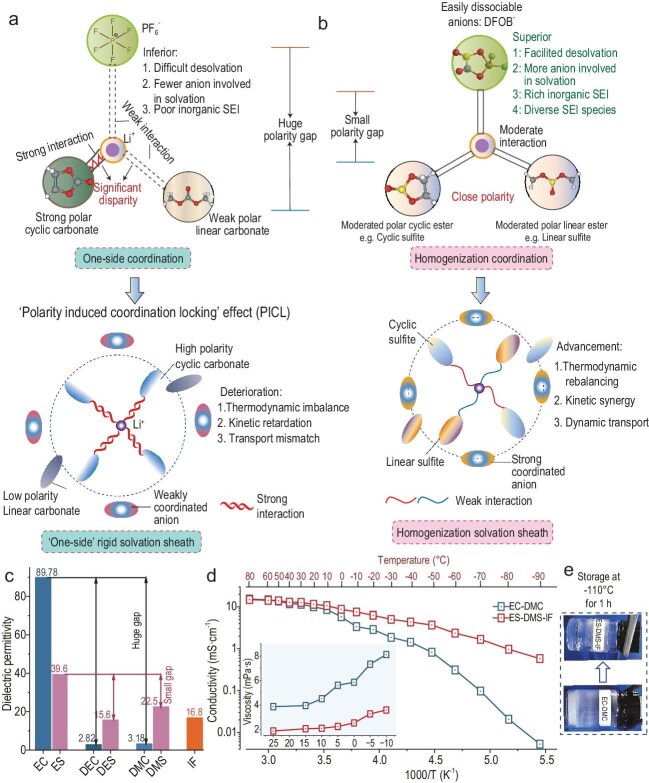 Figure 1
Peer Reviews
No public reviews on file for this paper yet. If you reviewed it on a platform where reviews are public (OpenReview, ICLR, NeurIPS, ICML), you can paste yours below so the community can read it here.
Videos
No videos yet. Explain this paper in a talk, walkthrough, or lecture? Add one.
Taxonomy
TopicsAdvanced Battery Technologies Research · Advanced Battery Materials and Technologies · Advancements in Battery Materials
The severe capacity loss of lithium-ion batteries at temperatures below −30°C remains a major obstacle for their use in polar, aerospace and deep-sea scenarios. This persistent failure stems largely from a catastrophic drop in ionic conductivity and sluggish desolvation kinetics [1,2]. In a recent study published in National Science Review, Chen et al. identify the ‘polarity-induced coordination locking’ (PICL) as the primary failure mechanism in traditional ethylene carbonate (EC)/dimethyl carbonate (DMC) systems [3]. In such mixtures, the imbalanced dielectric contrast in these mixtures creates a segregated environment where high-polarity solvents dominate the inner solvation sheath, leading to a rigid barrier to desolvation. While various strategies such as weakly solvating electrolytes [4] or localized high-concentration designs [5] have attempted to address the cryogenic issue, a critical thermodynamic bottleneck, solvation structure heterogeneity, has largely overlooked, which distorts Li⁺ coordination and interfacial dynamics (Fig. 1a). In contrast to prior approaches that operate within the confines of inherent solvent heterogeneity, the ‘polarity-gradient engineering’ (PGE) strategy represents a paradigm shift by aiming to eliminate this thermodynamic disparity at its source through atomic-scale electronic structure modulation.
To address the PICL issue, Chen et al. introduce a PGE paradigm that systematically compresses dielectric disparity via atomic-scale sulfur substitution in carbonate frameworks (Fig. 1b). By replacing carbon with sulfur in cyclic/linear esters, the team reduces ∆ε from 86.6 (EC/DMC) to 17.1 [ethylene sulfite (ES)/dimethyl sulfite (DMS)] (Fig. 1c), thereby balancing Li⁺ coordination among solvents and anions. This homogenized solvation structure enables three synergistic advances: (i) a 45%–56% reduction in desolvation energy barriers (34.97 vs. 79.1 kJ mol^−1^ in carbonates); (ii) formation of an inorganic-rich interphase (LiF/B–O/Li_x_S > 84%) promoted; and (iii) exceptional ionic conductivity (1 mS cm^−1^ at −80°C) (Fig. 1d) with liquid stability down to −110°C (Fig. 1e). This balanced coordination environment actively recruits anions into the primary solvation shell, lowering their reduction potential and thereby steering interfacial decomposition predominantly toward the formation of an inorganic-rich (LiF/B–O/Li_x_S) solid electrolyte interphase (SEI).
The new recipe of a specific electrolyte [1 M lithium difluoro(oxalato)borate (LiDFOB) in ES/DMS/isobutyl formate (IF) (2:4.5:3.5, v/v)] demonstrates remarkable cryogenic performance. In practical 7.5 Ah LiCoO_2_/Li pouch cells, this polyethylene glycol (PEG) electrolyte achieves 81% capacity retention over 400 cycles at −20°C and delivers 73.3% of room-temperature capacity at −60°C. Furthermore, the system demonstrates superior safety, with significantly delayed thermal runaway under abused conditions. While a significant milestone, its commercial viability will need critical techno-economic analysis. Key future work includes developing scalable synthesis routes for battery-grade organic sulfites and LiDFOB, aiming to narrow the cost gap with mature LiPF_6_/carbonate supply chains. Additionally, adapting this strategy to graphite anodes without causing structural degradation will remain a critical goal for the battery community.
In summary, Chen et al. provide a molecular blueprint for decoupling the trade-off between ion mobility and desolvation kinetics in cryogenic batteries. Their work establishes a universal ‘polarity gradient—solvation homogeneity—interfacial kinetics’ framework, offering transformative insights for extreme-condition energy storage.
The reference list from the paper itself. Each links out to its DOI / PubMed record.
- 1Xu J, Zhang J, Pollard TP et al. Nature 2023; 614: 694–700.10.1038/s 41586-022-05627-836755091 · doi ↗ · pubmed ↗
- 2Chen Y, He Q, Zhao Y et al. Nat Commun 2023; 14: 8326.10.1038/s 41467-023-43163-938097577 PMC 10721867 · doi ↗ · pubmed ↗
- 3Chen Y, Wang A, Zhao Y et al. Natl Sci Rev 2026; 13: nwaf 543.10.1093/nsr/nwaf 54341675644 PMC 12887302 · doi ↗ · pubmed ↗
- 4Yang Y, Fang Z, Yin Y et al. Angew Chem Int Ed 2022; 61: e 202208345.10.1002/anie.20220834535833711 · doi ↗ · pubmed ↗
- 5Fan X, Ji X, Chen L et al. Nat Energy 2019; 4: 882–90.10.1038/s 41560-019-0474-3 · doi ↗