6,7-Dihalo-Benzothiadiazines as Potent and Selective AMPA Receptor Modulators for Cognitive Enhancement and Neuroprotection
Yinlong Li, Hongjie Yuan, Steven H. Liang

TL;DR
Scientists developed a new compound that enhances brain function and protects neurons by modulating AMPA receptors.
Contribution
A new benzothiadiazine compound (BPAM363) with improved cognitive-enhancing and neuroprotective effects was identified.
Findings
Compound 14o (BPAM363) shows robust cognitive-enhancing effects in vivo.
BPAM363 has strong neuroprotective properties and improved pharmacological characteristics.
Structure–activity relationship optimization led to better AMPA receptor modulation.
Abstract
α-Amino-3-hydroxy-5-methyl-4-isoxazolepropionic acid (AMPA) receptors are tetrameric ionotropic glutamate receptors that mediate fast excitatory synaptic transmission in the brain and represent important therapeutic targets for neurological disorders. Positive allosteric modulators (PAMs) of AMPA receptors enhance rapid excitatory signaling by increasing receptor’s sensitivity to glutamate and have been widely explored as agents to improve cognitive function in central nervous system (CNS) diseases. Structural modification of 3,4-dihydro-2H-1,2,4-benzothiadiazine 1,1-dioxides (BTDs) analogs is a key strategy to develop potent AMPAR PAMs. A recent study reported a new pharmacomodulation strategy on the benzene ring of BTDs through systematic structure–activity relationship (SAR) optimization. This work led to the identification of compound 14o (BPAM363), which exhibits improved…
Genes, proteins, chemicals, diseases, species, mutations and cell lines named across the full text — each resolved to its canonical identifier and authoritative record.
Click any figure to enlarge with its caption.
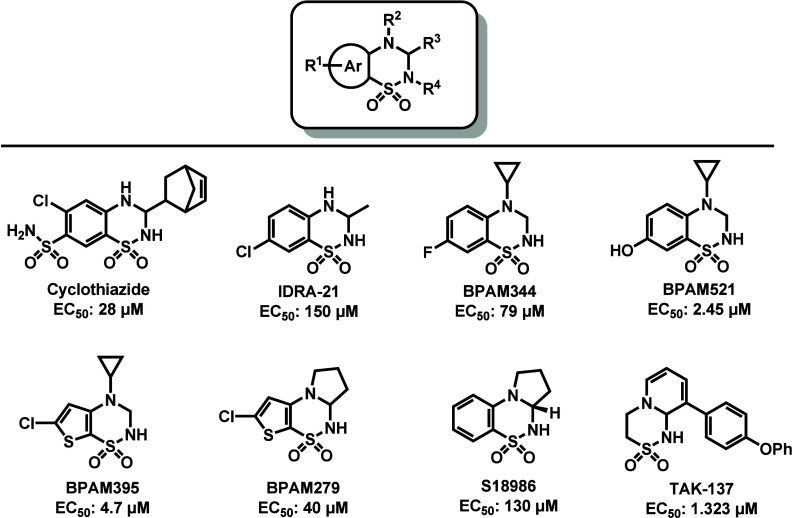 Figure 1
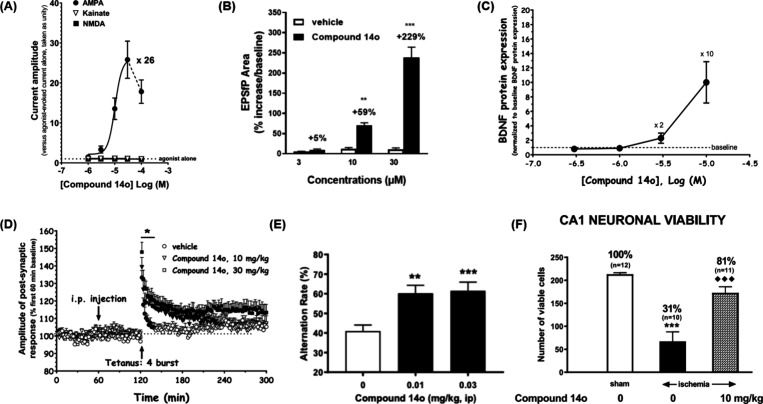 Figure 2
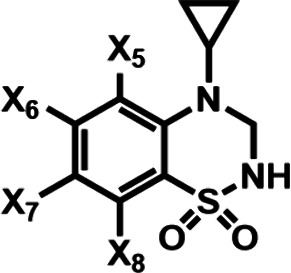 Figure 3
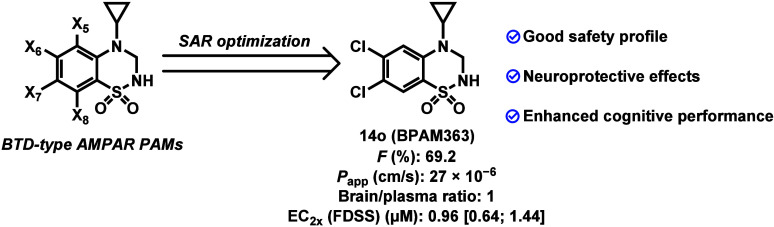 Figure 4
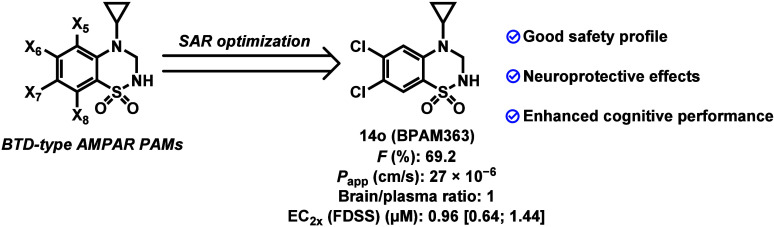 Figure 5
- —National Institute on Aging10.13039/100000049
- —National Institute on Aging10.13039/100000049
- —School of Medicine, Emory University10.13039/100007623
Peer Reviews
No public reviews on file for this paper yet. If you reviewed it on a platform where reviews are public (OpenReview, ICLR, NeurIPS, ICML), you can paste yours below so the community can read it here.
Videos
No videos yet. Explain this paper in a talk, walkthrough, or lecture? Add one.
Taxonomy
TopicsNeuroscience and Neuropharmacology Research · Nicotinic Acetylcholine Receptors Study · Phosphodiesterase function and regulation
Ionotropic glutamate receptors (iGluRs) are a major class of ligand-gated ion channels that mediate excitatory neurotransmission in the central nervous system (CNS). ?−? ? iGluRs play key roles in synaptic plasticity, learning, and memory, and are categorized into three subfamilies based on pharmacology and sequence homology: α-amino-3-hydroxy-5-methyl-4-isoxazolepropionic acid (AMPA) receptors, N-methyl-d-aspartate (NMDA) receptors, and kainate receptors. ?,? Among these, AMPA receptors (AMPARs) mediate the majority of rapid excitatory signaling and are crucial for regulating synaptic strength and neuronal communication. ?,? AMPARs are tetrameric assemblies composed of combinations of four subunits (GluA1, GluA2, GluA3, and GluA4), with each contributing to unique channel gating, ion permeability, and trafficking. ?,? The endogenous agonist l-glutamate binds to the orthosteric site to trigger membrane depolarization and fast excitatory synaptic transmission.? In contrast, allosteric modulators of AMPARs, including negative allosteric modulators (NAMs) and positive allosteric modulators (PAMs) modulate receptor ionic currents by targeting binding sites distinct from the glutamate orthosteric site. ?−? ? Specifically, AMPAR PAMs have been shown to facilitate long-term potentiation, and have demonstrated promise as therapeutic agents for cognitive and neurodegenerative disorders in both preclinical and clinical studies. ?,? Over the past decades, benzothiadiazine derivatives have emerged as one of the most widely investigated classes of AMPAR PAMs, and these modulators have substantially contributed to elucidating the regulatory mechanisms of AMPARs. ?−? ? 1,2,4-Benzothiadiazine 1,1-dioxides (BTDs) feature a heterocyclic core containing a sulfonyl group and two nitrogen atoms that mediate hydrogen-bonding and polar interactions within the AMPAR allosteric site. Subtle pharmacomodulations of the core scaffold or peripheral substituents can markedly influence their potency and subtype selectivity. ?,? As illustrated in Figure, structure-based optimization of alkyl substituents, halogenated and aromatic groups, has led to the identification of multiple sulfonamide-based AMPAR PAMs, including cyclothiazide,? IDRA-21,? BPAM344,? BPAM521,? BPAM395,? BPAM279,? S18986,? and TAK-137.? Although these compounds display micromolar-range potency and favorable pharmacological profiles, further structure–activity relationship (SAR) optimization of BTDs is needed to improve potency and maximize their translational potential.
Building on previous studies, Lesenfants et al. reported a systematic SAR investigation of BTD derivatives by modifying substituents on the benzene ring and varying the N-alkyl groups and evaluated their effects on cognitive enhancement and neuroprotective efficacy.? They first investigated monohalo-substituted BTD derivatives on the benzene ring, and their potency was assessed using an in vitro fluorescence assay (FDSS) on primary cultures from rat embryonic cortex. The results showed that the activity was significantly influenced by halogen position (7 > 8 > 6 or 5) and type (F > Cl > Br). Next, they examined di(fluoro/chloro)-substituted BTDs and found that halogenation at the 6,7-, 6,8-, or 7,8-positions produced potent modulators with EC_2x _ values below 1 μM, exemplified by compounds 14f, 14h, 14j, 14l, and 14o (Table). Notably, the halogen at the 8-position in 7,8-dihalo derivatives (14j, 14l) had little effect on activity, while a chlorine at the 7-position was preferred over fluorine. Considering that compound 14o (BPAM363) exhibited the best safety profile at very high oral doses (100 mg/kg) in mice, it was selected for further in vitro and in vivo studies.
Compound 14o exhibited a concentration-dependent potentiation of AMPA receptor-mediated currents in rat cortex mRNA-injected oocytes, reaching a maximal enhancement of approximately 26-fold relative to AMPA alone. In addition, compound 14o displayed high selectivity for AMPA receptors, as no significant effect on NMDA- or kainate-induced currents was observed (FigureA). In hippocampal slices from Wistar rats, compound 14o enhanced excitatory postsynaptic responses in the CA1 region in a concentration-dependent manner following Schaffer collateral stimulation, with significant increases in the area of the evoked postsynaptic response observed at concentrations of 10 and 30 μM. (FigureB). In primary cortical neuronal cultures, compound 14o dose-dependently elevated the expression of brain-derived neurotrophic factor (BDNF), a key neurotrophin involved in synaptic plasticity (0.3–10 μM) (FigureC). To assess the cognitive effects, long-term potentiation (LTP) was evaluated in the dentate gyrus of the hippocampus in anesthetized Wistar rats. Compared with the vehicle-treated control, compound 14o significantly enhanced both induction and maintenance of synaptic potentiation (FigureD). To evaluate effects of compound 14o on working memory, a spontaneous alternation task in a T-maze was performed. Administration of compound 14o at low doses (0.01 and 0.03 mg/kg, i.p.) significantly improved spontaneous alternation performance compared with vehicle-treated mice, consistent with enhanced working memory function (FigureE). Neuroprotective effects of compound 14o were confirmed in a rat model of delayed hippocampal neuronal cell death. Treatment with compound 14o (10 mg/kg, i.p.) significantly delayed hippocampal neuronal loss observed 7 days after transient global ischemia. Notably, compound 14o preserved the viability of over 80% of hippocampal neurons, compared with only 31% viable cells in ischemic rats receiving vehicle treatment. This neuroprotective efficacy is higher than other known AMPA receptor PAMs, such as S18986 (FigureF). Collectively, these results highlight the therapeutic potential of compound 14o as a promising neuroprotective candidate with the ability to delay neuronal degeneration and enhance cognitive function.
Future
Outlook
Benzothiadiazine derivatives have emerged as one of the most extensively studied classes of AMPAR PAMs. The medicinal chemistry team at the University of Liège conducted comprehensive SAR studies and have identified several potent candidates characterized by favorable safety profiles, high oral bioavailability, and effective CNS penetration. Although these advances have accelerated the translational potential of AMPAR PAMs, their clinical implementation remains a considerable challenge, highlighting the need for further structural optimization and exploration of alternative scaffolds to improve potency and selectivity while minimizing the risk of adverse effects. Importantly, emerging technologies such as positron emission tomography (PET) imaging targeting AMPA receptors can greatly facilitate the development of AMPAR PAMs by enabling in vivo target engagement and pharmacokinetic–pharmacodynamic (PK/PD) assessments. ?,? For example, the development of a ^18^F-labeled analog of BPAM344 ([^18^F]AMPA-2109) demonstrates the feasibility of this approach, which shows good blood–brain barrier (BBB) permeability in rodents and nonhuman primates.? These imaging tools provide critical insights and foundation for the rational design of the next generation of AMPAR-selective modulators and their successful transition into clinical application.
The reference list from the paper itself. Each links out to its DOI / PubMed record.
- 1Madden D. R.The structure and function of glutamate receptor ion channels Nat. Rev. Neurosci.2002329110110.1038/nrn 72511836517 · doi ↗ · pubmed ↗
- 2Niciu M. J.Kelmendi B.Sanacora G.Overview of glutamatergic neurotransmission in the nervous system Pharmacol., Biochem. Behav.2012100465666410.1016/j.pbb.2011.08.00821889952 PMC 3253893 · doi ↗ · pubmed ↗
- 3Reiner A.Levitz J.Glutamatergic Signaling in the Central Nervous System: Ionotropic and Metabotropic Receptors in Concert Neuron 20189861080109810.1016/j.neuron.2018.05.01829953871 PMC 6484838 · doi ↗ · pubmed ↗
- 4Kew J. N. C.Kemp J. A.Ionotropic and metabotropic glutamate receptor structure and pharmacology Psychopharmacology 2005179142910.1007/s 00213-005-2200-z 15731895 · doi ↗ · pubmed ↗
- 5Hansen K. B.Wollmuth L. P.Bowie D.Furukawa H.Menniti F. S.Sobolevsky A. I.Swanson G. T.Swanger S. A.Greger I. H.Nakagawa T.Mc Bain C. J.Jayaraman V.Low C.-M.Dell’Acqua M. L.Diamond J. S.Camp C. R.Perszyk R. E.Yuan H.Traynelis S. F.Structure, Function, and Pharmacology of Glutamate Receptor Ion Channels Pharmacol. Rev.20217341469165810.1124/pharmrev.120.000131 · doi ↗
- 6Derkach V. A.Oh M. C.Guire E. S.Soderling T. R.Regulatory mechanisms of AMPA receptors in synaptic plasticity Nat. Rev. Neurosci.20078210111310.1038/nrn 205517237803 · doi ↗ · pubmed ↗
- 7Carroll R. C.Beattie E. C.von Zastrow M.Malenka R. C.Role of ampa receptor endocytosis in synaptic plasticity Nat. Rev. Neurosci.20012531532410.1038/3507250011331915 · doi ↗ · pubmed ↗
- 8Nicoll R. A.Tomita S.Bredt D. S.Auxiliary Subunits Assist AMPA-Type Glutamate Receptors Science 200631157651253125610.1126/science.112333916513974 · doi ↗ · pubmed ↗