Advances in MICA genotyping: characterization of 406 novel alleles and their frequencies in multiple populations
Viviane Albrecht, Christin Paech, Kathrin Putke, Gerhard Schöfl, Jürgen Sauter, Alexander H. Schmidt, Vinzenz Lange, Anja Klussmeier

TL;DR
This study characterizes 406 new MICA alleles and updates their frequencies in various populations, improving genotyping accuracy.
Contribution
The study fully characterizes 406 novel MICA alleles and reduces the fraction of unknown sequences in MICA genotyping.
Findings
MICA*008, MICA*002, and MICA*009 are the most common alleles in German populations.
The cumulative frequency of novel alleles dropped from 0.3% to 0.03% after database expansion.
Some novel alleles are specific to certain populations, like MICA*258 in South African Black or Colored populations.
Abstract
In 2020, we reported MICA allele frequencies from a cohort of over one million German individuals. This study identified MICA*008 (42%), MICA*002 (12%), and MICA*009 (9%) as the most common MICA alleles at protein resolution. Additionally, we discovered novel alleles with a cumulative frequency of 0.3%. To reduce this fraction of unnamed sequences, we aimed to fully characterize the most frequent novel alleles using both long- and short-read sequencing. As a result, we submitted 603 sequences to the IPD-IMGT/HLA Database: 406 novel alleles and 197 sequence extensions and confirmations. Among the novel alleles, 199 encoded for distinct novel MICA proteins. Following the inclusion of these sequences into the IPD-IMGT/HLA Database, we genotyped 93,814 individuals from an independent cohort. In the German subset (n=48,618), our previous findings on MICA allele frequencies were confirmed. As…
Genes, proteins, chemicals, diseases, species, mutations and cell lines named across the full text — each resolved to its canonical identifier and authoritative record.
Click any figure to enlarge with its caption.
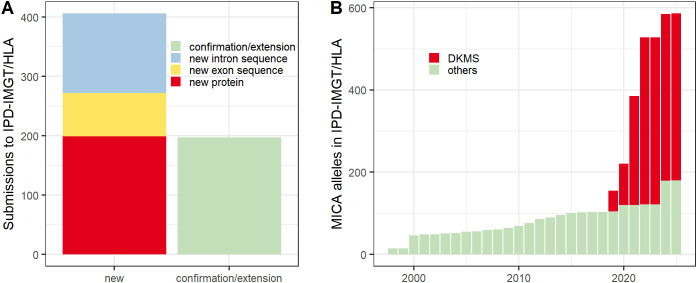 Figure 1
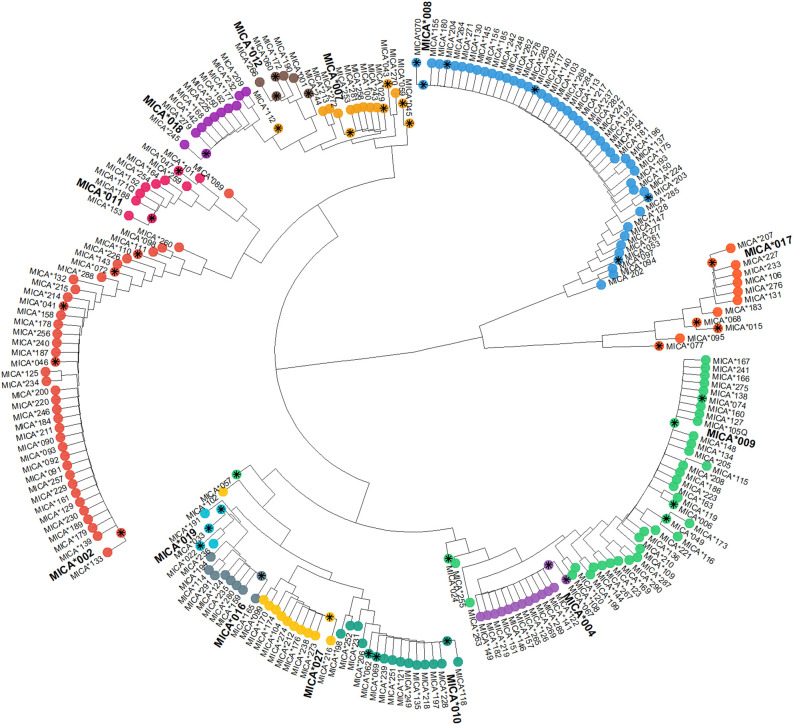 Figure 2
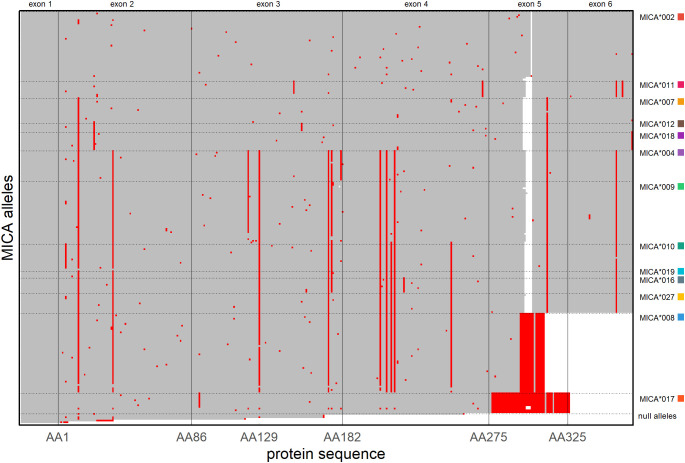 Figure 3
| Allele group | Alleles |
|---|---|
|
| |
|
|
|
| MICA Allele | Novel | frequency DE_Germany n=48618 | frequency PL_Poland n=11776 | PL/DE | frequency UK_British/Irish n=2090 | UK/DE | frequency ZA_White n=1989 | ZAW/DE | frequency ZA_Black n=4085 | ZAB/DE | frequency CL_Non-Indigenous n=4937 | CL/DE | frequency DE_Turkey n=1823 | Turkey/DE |
|---|---|---|---|---|---|---|---|---|---|---|---|---|---|---|
| MICA*008 | N | 0.43643 | 0.39556 | 0.91 | 0.50505 | 1.16 | 0.43489 | 1.00 | 0.27694 | 0.63 | 0.19437 | 0.45 | 0.21419 | 0.49 |
| MICA*002# | N | 0.11496 | 0.13317 | 1.16 | 0.08822 | 0.77 | 0.12418 | 1.08 | 0.22484 | 1.96 | 0.31115 | 2.71 | 0.14243 | 1.24 |
| MICA*009# | N | 0.08733 | 0.09382 | 1.07 | 0.06250 | 0.72 | 0.07692 | 0.88 | 0.04536 | 0.52 | 0.08630 | 0.99 | 0.19687 | 2.25 |
| MICA*010# | N | 0.07777 | 0.05242 | 0.67 | 0.06370 | 0.82 | 0.07567 | 0.97 | 0.00049 | 0.01 | 0.06604 | 0.85 | 0.02337 | 0.30 |
| MICA*004 | N | 0.06501 | 0.07199 | 1.11 | 0.07644 | 1.18 | 0.07466 | 1.15 | 0.24470 | 3.76 | 0.10432 | 1.60 | 0.08111 | 1.25 |
| MICA*007 | N | 0.04845 | 0.06378 | 1.32 | 0.04736 | 0.98 | 0.03796 | 0.78 | 0.00221 | 0.05 | 0.01570 | 0.32 | 0.02475 | 0.51 |
| MICA*018 | N | 0.03602 | 0.05950 | 1.65 | 0.02188 | 0.61 | 0.03042 | 0.84 | 0.02869 | 0.80 | 0.02330 | 0.65 | 0.07204 | 2.00 |
| MICA*017 | N | 0.03321 | 0.03390 | 1.02 | 0.03413 | 1.03 | 0.03142 | 0.95 | 0.00025 | 0.01 | 0.01854 | 0.56 | 0.01320 | 0.40 |
| MICA*012 | N | 0.02145 | 0.02338 | 1.09 | 0.02380 | 1.11 | 0.01961 | 0.91 | 0.01839 | 0.86 | 0.01276 | 0.59 | 0.04482 | 2.09 |
| MICA*016 | N | 0.01886 | 0.02238 | 1.19 | 0.00697 | 0.37 | 0.02187 | 1.16 | 0.00196 | 0.10 | 0.02188 | 1.16 | 0.09926 | 5.26 |
| MICA*011 | N | 0.01846 | 0.01115 | 0.60 | 0.02788 | 1.51 | 0.03117 | 1.69 | 0.01618 | 0.88 | 0.04487 | 2.43 | 0.02255 | 1.22 |
| MICA*027# | N | 0.01577 | 0.01856 | 1.18 | 0.00913 | 0.58 | 0.01232 | 0.78 | 0.00037 | 0.02 | 0.04659 | 2.96 | 0.02035 | 1.29 |
| MICA*019 | N | 0.00838 | 0.00578 | 0.69 | 0.01875 | 2.24 | 0.00804 | 0.96 | 0.05431 | 6.48 | 0.01509 | 1.80 | 0.00605 | 0.72 |
| MICA*001 | N | 0.00778 | 0.00352 | 0.45 | 0.00889 | 1.14 | 0.00930 | 1.20 | 0.01349 | 1.73 | 0.02036 | 2.62 | 0.00055 | 0.07 |
| MICA*006 | N | 0.00425 | 0.00436 | 1.03 | 0.00120 | 0.28 | 0.00302 | 0.71 | 0.00000 | 0.00 | 0.00162 | 0.38 | 0.02942 | 6.92 |
| MICA*015 | N | 0.00079 | 0.00063 | 0.80 | 0.00072 | 0.91 | 0.00251 | 3.19 | 0.04634 | 58.75 | 0.00436 | 5.52 | 0.00137 | 1.74 |
| MICA*029 | N | 0.00069 | 0.00042 | 0.61 | 0.00000 | 0.00 | 0.00025 | 0.37 | 0.00025 | 0.36 | 0.00051 | 0.74 | 0.00110 | 1.60 |
| MICA*068 | N | 0.00054 | 0.00063 | 1.16 | 0.00048 | 0.89 | 0.00000 | 0.00 | 0.00907 | 16.71 | 0.00334 | 6.16 | 0.00027 | 0.51 |
| MICA*047# | N | 0.00031 | 0.00063 | 2.05 | 0.00024 | 0.78 | 0.00025 | 0.82 | 0.00000 | 0.00 | 0.00091 | 2.97 | 0.00082 | 2.68 |
| MICA*072 | N | 0.00031 | 0.00025 | 0.82 | 0.00024 | 0.78 | 0.00000 | 0.00 | 0.00000 | 0.00 | 0.00000 | 0.00 | 0.00000 | 0.00 |
| MICA*045 | N | 0.00028 | 0.00008 | 0.30 | 0.00024 | 0.87 | 0.00126 | 4.54 | 0.00049 | 1.77 | 0.00051 | 1.83 | 0.00110 | 3.98 |
| NEW | N | 0.00026 | 0.00008 | 0.33 | 0.00024 | 0.94 | 0.00000 | 0.00 | 0.00147 | 5.74 | 0.00030 | 1.19 | 0.00137 | 5.37 |
| MICA*070 | N | 0.00026 | 0.00008 | 0.33 | 0.00024 | 0.94 | 0.00000 | 0.00 | 0.00000 | 0.00 | 0.00000 | 0.00 | 0.00000 | 0.00 |
| MICA*030 | N | 0.00018 | 0.00013 | 0.68 | 0.00000 | 0.00 | 0.00075 | 4.09 | 0.00760 | 41.22 | 0.00041 | 2.20 | 0.00027 | 1.49 |
| MICA*052 | N | 0.00018 | 0.00038 | 2.05 | 0.00024 | 1.30 | 0.00000 | 0.00 | 0.00000 | 0.00 | 0.00314 | 17.03 | 0.00000 | 0.00 |
| MICA*107N | Y | 0.00016 | 0.00126 | 7.67 | 0.00000 | 0.00 | 0.00000 | 0.00 | 0.00000 | 0.00 | 0.00000 | 0.00 | 0.00000 | 0.00 |
| MICA*141 | Y | 0.00014 | 0.00038 | 2.63 | 0.00000 | 0.00 | 0.00000 | 0.00 | 0.00000 | 0.00 | 0.00000 | 0.00 | 0.00027 | 1.92 |
| MICA*089 | Y | 0.00012 | 0.00000 | 0.00 | 0.00000 | 0.00 | 0.00000 | 0.00 | 0.00000 | 0.00 | 0.00000 | 0.00 | 0.00000 | 0.00 |
| MICA*119 | Y | 0.00010 | 0.00004 | 0.41 | 0.00000 | 0.00 | 0.00000 | 0.00 | 0.00000 | 0.00 | 0.00132 | 12.85 | 0.00000 | 0.00 |
| MICA*136 | Y | 0.00009 | 0.00008 | 0.91 | 0.00000 | 0.00 | 0.00025 | 2.73 | 0.00000 | 0.00 | 0.00000 | 0.00 | 0.00055 | 5.96 |
|
|
|
|
|
|
|
|
|
|
|
|
|
|
|
|
|
|
|
|
|
|
|
|
Peer Reviews
No public reviews on file for this paper yet. If you reviewed it on a platform where reviews are public (OpenReview, ICLR, NeurIPS, ICML), you can paste yours below so the community can read it here.
Videos
No videos yet. Explain this paper in a talk, walkthrough, or lecture? Add one.
Taxonomy
TopicsImmune Cell Function and Interaction · Phagocytosis and Immune Regulation · Calcium signaling and nucleotide metabolism
Introduction
1
The MICA (MHC class I polypeptide-related sequence A) gene is located on chromosome 6 within the human major histocompatibility (MHC) complex, between HLA-B and MICB (1). Although structurally similar to the classical human leukocyte antigen (HLA) genes, MICA does not present peptides. Upon stress, various cell types (e.g., epithelial cells, fibroblasts) upregulate expression of MICA, which activates the NKG2D receptor on NK cells and T cell subsets. Consequently, MICA promotes immune cell recognition and immune surveillance (2–4). However, MICA can also be shed from the cellular surface as soluble MICA (sMICA), thereby decreasing NKG2D activation (5, 6).
The MICA gene is encoded by six exons. Exon 1 encodes the leader peptide, exons 2–4 the extracellular domain, exon 5 the transmembrane domain and exon 6 the cytoplasmatic tail (1, 7). Like classical HLA genes, MICA is polymorphic. Prior to this work, the IPD-IMGT/HLA Database described 107 MICA alleles (among them 84 distinct MICA proteins), of which only 15 (14%) were described in full length from 5’ to 3’ UTR (release 3.35, January 2019).
MICA alleles can be grouped based on polymorphisms that influence function. One major group consists of MICA008*-like alleles. MICA008*, the most frequent allele in many populations, has a frameshift mutation in exon 5, which leads to the loss of the transmembrane domain. Nevertheless, it is still attached to the cell surface via a GPI-anchor (8). After exosomal release, it has been reported to downregulate the NKG2D response more efficiently than the transmembrane-bound alleles, which are shed as sMICA by proteolytic cleavage (9, 10). In general, both types of sMICA decrease MICA cell surface expression and thereby NKG2D activation. This has been associated with inferior outcome in tumor patients and may represent a cancer immune evasion principle (5, 6). Another important polymorphism is the methionine/valine (Met/Val) dimorphism at position 129 of the mature MICA protein (rs1051792; MICA-129), which stratifies MICA alleles into high-affinity (Met) and low-affinity (Val) binders to NKG2D (11, 12). MICA-129 has been linked to susceptibility or protection in various autoimmune diseases, cancers, and viral infections (13, 14). In hematopoietic cell transplantation (HCT) and kidney transplantation, MICA allele matching or MICA-129 matching has been associated with a favorable outcome for the patient, e.g., a decrease in acute graft-versus host disease (GVHD) (15–20). Despite this data, current guidelines for HCT do not yet recommend MICA-informed donor selection (21, 22). Nonetheless, due to strong linkage disequilibrium between MICA and HLA-B, over 90% of 10/10 HLA-matched donor-recipient pairs are also matched at the MICA locus (17, 23).
To enable broader studies of MICA informed donor selection in unrelated allogenic HCT, we started to genotype potential stem cell donors for MICA upon registration in 2017. In 2020, we published MICA allele frequencies for the German population based on over one million samples. The five most frequent alleles were MICA008* (42%), MICA002* (12%), MICA009#* (9%), MICA010#* (8%) and MICA004* (7%) (24). In that study, we identified novel MICA alleles with a cumulative allele frequency of 0.3%. As expected for a gene that had not yet been broadly genotyped, this value was about tenfold higher than the rate observed for classical HLA genes (e.g., 0.02% for HLA class I genes and 0.04% HLA class II genes (based on sequencing of exon 2 and 3 only); unpublished data). These unnamed alleles complicate genotyping and cannot be clinically reported, thereby limiting their utility in donor selection when MICA matching is relevant. To address this situation and simplify future MICA genotyping, we aimed to characterize the most frequent novel MICA alleles and submit them to the IPD-IMGT/HLA Database.
Methods
2
Samples
2.1
Volunteers from Germany, Poland, UK, USA, Chile, India and South Africa continuously provide samples (buccal swabs) to DKMS for their registration as potential stem cell donors. Between 2017 and 2021, approximately 3.6 million samples were genotyped for MICA (Germany 56%; Poland 18%; UK 15%; US 8%; Chile 2%; India 1%; South Africa 0% (donor center not yet active)). This cohort was used to identify and characterize novel alleles. Another 93,814 samples were genotyped for MICA from 2023 to 2024 and used for MICA population frequency analyses (Germany 65%; Poland 13%; South Africa 8%, Chile 7%; UK 4%; US 3%; India 0.2%). As part of the registration process, the donors are asked to self-assign their ethnic background. All subjects gave written informed consent in accordance with the Declaration of Helsinki. The described genotyping is within the scope of the consent forms signed at recruitment.
High-throughput genotyping
2.2
Samples for the registration of potential stem cell donors are genotyped in an high-throughput workflow that targets HLA-A, -B, -C, -E, -DPB1, -DQB1, -DRB1, -DPA1, -DQA1, -DRB3/4/5, MICA and MICB (MICA/B), KIR, blood groups ABO and Rh, and CCR5 as described before (24–30). A detailed description of the workflow with a focus on MICA genotyping can be found in Klussmeier et al. (24). In brief, MICA exons 2, 3, 4, 5 are amplified by PCR (complete coverage of exons 2 and 3, partial coverage of exons 4 and 5). After pooling the PCR products with the HLA loci of the same donor, an indexing PCR is performed. Before 2019, the PCR products of up to 3,840 donors were pooled, cleaned up and sequenced using HiSeq Rapid SBS Kits V2 (500 cycles) on HiSeq2500 instruments (Illumina, San Diego, USA). After 2019, up to 7520 potential stem cell donors were sequenced using NovaSeq6000 SP Kits (500 cycles) on a NovaSeq6000 instrument (Illumina, San Diego, USA). Genotyping of high-throughput sequencing data was performed by neXtype (24, 25). Since not all bases of MICA are covered by our workflow, some genotyping results are ambiguous. Here, we report them by a representative allele, which is marked with a hash symbol (#) (Table 1). Previously, we described haplotypes with MICA duplications and MICA deletions (31). While neXtype correctly genotypes MICA duplications and reports three MICA alleles in such samples, it reports a homozygous instead of a hemizygous result for samples with MICA deletions. Nevertheless, since MICA deletions are rare (e.g., 0.3% in Europe, 2.5% in Chile), we accepted that this might minimally influence allele frequency calculations.
Novel allele characterization and submission
2.3
Samples with novel MICA alleles were subjected to two independent long-range PCRs (12 kB) that amplify the complete MICA gene from 5’ to 3’UTR. The following primers were used: CTGCTTGAGCCGCTGAGAGG (forward), GATCCAGGCAGGGAATTGAATCCC and GAGATCCAGGCAGGGAATTCAATTCC (reverse). In detail, 4 μL genomic DNA was combined with 0.08 μM primer mix, 1x Advantage Genomic LA Buffer, 1.25 U Advantage Genomic LA Polymerase Mix (Takara Bio, Mountain View, California), and dNTPs (0.4 mM each) in a 25 μL reaction volume. PCR conditions: 94 °C 1 minute, 35 cycles: 98 °C 10 seconds/65 °C 12 minutes, 72 °C 10 minutes. PCR success was checked by agarose gel electrophoresis. The product of one PCR reaction was used for Illumina shotgun sequencing as described before (32–34). In brief, fragmentation and adapter ligation was performed according to “NEBNext Ultra II DNA Library Prep Kit for Illumina” protocol (New England Biolabs, Ipswich, Massachusetts). After purification with 0.7x SPRIselect beads (Beckman Coulter, Brea, California), custom barcodes were attached by a 7-cycle-indexing PCR. Finally, 48 samples were pooled and subsequently purified using 0.7x SPRIselect beads. After qPCR library quantification, four pools (up to 192 samples) were sequenced on a MiSeq instrument using a MiSeq Reagent Kit v2 (500 cycles) according to the manufacturer’s instructions (Illumina, San Diego, California). The product of the second PCR reaction was used for SMRT sequencing (Pacific Biosciences, Menlo Park, California) as described before (32). PCR products of the prior long-range PCR were barcoded by an additional 10-cycle PCR reaction with indexing primers (0.2 μM). 192 samples were then pooled and library preparation was carried out according to the manufacturer’s instructions. Libraries were size selected with the BluePippin system using a 0.75% cartridge (Sage Science, Beverly, Massachusetts) and sequenced on a Sequel instrument using Sequel Sequencing Kit 3.0, SMRT Cell 1 M v3 and a 10 hour movie (Pacific Biosciences, Menlo Park, California).
Sequencing reads were analyzed using NGSengine (GenDx, Utrecht, The Netherlands) and dual redundant reference sequencing (DR2S) as described before (35, 36). The versions of the IPD-IMGT/HLA Database used in this analysis ranged from release 3.35 (2019) to release 3.48 (2022), with each sample batch analyzed using the most current version available at the time (refer to the analysis date of individual sequences in Supplementary Data). Samples with low sequencing quality and not fully conserved consensus sequences were discarded from analysis. Finally, all approved sequences were submitted to the IPD-IMGT/HLA Database using TypeLoader2 (37, 38). In general, all novel sequences were submitted. In addition, we submitted sequence extensions for alleles so far only partially described in the IPD-IMGT/HLA Database. Often, either was true for both alleles of a sequenced sample. If two identical sequences from different samples were available, the second sequence was submitted as confirmation.
In general, samples that failed in PCR and/or analysis were not repeated. We know from experience that this is usually caused by insufficient DNA quality, especially DNA fragmentation, and will not improve by repetition. To deal with this issue, three to five samples with the same targeted novel variation were selected for sequencing if enough samples were available.
Alignment
2.4
MICA protein sequences were obtained from the IPD-IMGT/HLA Database (release 3.60) and aligned using CLC Genomics Workbench (version 24.0) (Qiagen Digital Insights, Aarhus, Denmark). Only sequences with complete amino acid coverage were included. A custom R script was used to compare every amino acid in the alignment to the corresponding amino acid of the reference allele MICA*002. Finally, alleles were sorted manually to generate clusters that visually highlight the similarity of alleles to the most frequent ones.
Phylogenetic tree
2.5
A distance matrix was calculated from the alignment using hamming distance and a neighbor-joining tree with midpoint rooting was built using the R package ape version 5.8.1 (39). Sequences without complete amino acid coverage and null alleles were excluded. Visualization was performed using the R package ggtree version 3.14.0 (40). For improved visualization, the branch lengths of the tree were square rooted before plotting the tree.
Frequency calculations
2.6
MICA population frequencies were calculated using samples that were genotyped in the high-throughput workflow with IPD-IMGT/HLA Database release 3.50 or higher. At this time (January 2023), all our submitted novel exon variations were officially named by the IPD-IMGT/HLA Database and consequently used for genotyping by neXtype. As part of the registration process as potential stem cell donors, the donors are asked to self-assign their ethnic background. These data were used for calculating MICA population frequencies. Since selectable ethnicities varied between the different DKMS donor center questionnaires, data were only grouped within one donor center (e.g., samples indicated as DE_Turkey were collected in Germany but the donor self-assigned to a Turkish ethnic background). Populations with more than 1,000 genotyped samples were selected for calculating MICA frequencies (DE_Germany, PL_Poland, ZA_Black, CL_Non-Indigenous, UK_British/Irish, ZA_White, DE_Turkey). Due to lacking sequence information outside of exons 2-5, MICA population frequencies were only calculated at protein resolution (first field). For samples with phasing ambiguities, the probability of each possible result was calculated based on the allele frequencies of unambiguously typed samples in the respective population. According to these probabilities, counts were added to the different alleles. Ambiguities that cannot be resolved by our workflow are listed in Table 1.
Results
3
MICA sequencing and submission
3.1
In 2017, we added MICA genotyping to our high-throughput stem cell donor workflow. At that time, 107 MICA alleles were listed in the IPD-IMGT/HLA Database, of which 92 (86%) were only partially described (release 3.35, January 2019). Because partial allele entries in the database can complicate genotyping, our initial goal was to extend the sequences of frequently observed partial MICA alleles in the IPD-IMGT/HLA Database. Hence, we selected 299 samples with partial sequence coverage and sequenced MICA in full-length. Thereby, each targeted allele was covered by multiple samples. After sequence analysis, we could successfully extend the sequences of 35 distinct, previously only partially described, MICA alleles. Overall, this first batch resulted in 209 sequence submissions to the IPD-IMGT/HLA Database, among them 22 alleles coding for novel MICA proteins, 9 synonymous exon variations, 70 intron variations and 108 confirmations/sequence extensions (Supplementary Data). These alleles were incorporated in the IPD-IMGT/HLA Database releases between January and October 2020. By release 3.42, the number of MICA alleles had increased to 224, of which 159 were described in full-length (71%) (Figure 1).
Submission to the IPD-IMGT/HLA Database. (A) Number of MICA sequences submitted to the IPD-IMGT/HLA Database. (B) Number of MICA alleles in the IPD-IMGT/HLA Database over time.
By 2020, we had genotyped approximately 3.6 million samples, of which 11,091 contained a novel sequence (0.3%) in exons 2, 3, 4, or 5. However, some of these novel sequences were observed repeatedly, e.g. the most frequent novel sequences were identified in 1,273 and 763 samples (these sequences were later named MICA141* and MICA119*, respectively). Overall, we identified 1,103 distinct novel sequences of which 145 were detected more than ten times. In contrast, 559 variations were observed only once and are presumably very rare alleles.
For optimal use of our resources, we focused the second batch of novel MICA allele characterization on the 145 most frequent variants. A total of 474 samples were selected to cover each variation with multiple samples. Lower-frequency variations were added only to fill plates. As expected from prior experience of long-range PCRs on buccal swab derived DNA, approximately 33% of samples failed (25% in PCR, 8% in analysis) (34), likely due to DNA fragmentation. However, reasons for PCR failure were not further investigated for individual samples. Following analysis, this second batch of MICA novel allele characterization led to 394 sequence submissions to the IPD-IMGT/HLA Database, among them 177 alleles coding for novel proteins, 64 synonymous exon variations, 64 intron variations and 89 confirmations/sequence extensions. These include 139 (96%) of the targeted 145 frequent variations.
Combining both batches, we submitted 603 sequences to the IPD-IMGT/HLA Database: 199 novel proteins, 73 synonymous exon variations, 134 intron variations, and 197 confirmations/sequence extensions (Figure 1A). These sequences now represent approximately two-thirds of all MICA alleles listed in the IPD-IMGT/HLA Database (release 3.60, April 2025) (Figure 1B).
Novel MICA proteins
3.2
Among the characterized and submitted MICA alleles were 199 coding for novel MICA proteins. A detailed overview of all base variations in comparison to the closest known allele at the time of sequence submission is provided in Supplementary Data.
At first-field (protein) resolution, MICA008*, MICA002* and MICA009* have been identified as the most common alleles in the German population (24). Consequently, it is not surprising that more than half of the submitted novel alleles are variations of these alleles (Figures 2, 3). Nevertheless, we identified variations of all other frequent MICA alleles. Specifically, most of the previously undescribed amino acid variations appear to be randomly distributed within the regions covered by our high throughput genotyping workflow (amino acids 1–181 and 204–319 of the mature protein) (Figure 3).
Phylogenetic tree. All MICA amino acid sequences with available full-length coverage (IPD-IMGT/HLA release 3.60) are displayed as neighbor-joining tree with midpoint rooting. The 13 most frequent MICA alleles in Germany are highlighted in large and bold font. Colored tips depict groups of similar alleles. Asterisks in the tip of the alleles indicate that the allele was either previously present in the IPD-IMGT/HLA Database or has been submitted by another laboratory. All alleles without the asterisk resulted from the present work. Null alleles are not shown.
Alignment of MICA proteins. All 230 MICA full-length protein sequences (IPD-IMGT/HLA Database release 3.60) were aligned. Amino acids identical to the reference allele MICA002 are depicted in grey, differing amino acids are depicted in red, deletions in white. MICA proteins were grouped by recurrent variations (dashed horizontal lines) with the most frequent member of a group given on the right (colored squares correspond to colors used in Figure 2). Exon boundaries are indicated by vertical lines. Amino acids are numbered by the mature MICA protein with amino acid 1 (AA1) being encoded by the first codon of exon 2. The Met/Val dimorphism is located at position AA129. A larger version of the figure with individual allele annotations is added as Supplementary Figure 1.*
The most extensively studied amino acid variation in MICA is the Met/Val dimorphism at position 129. Among the common alleles, MICA002*, MICA007*, MICA011*, MICA012*, MICA017*, and MICA018* encode a methionine at this position, while MICA004*, MICA008*, MICA009*, MICA010*, MICA016*, MICA019*, and MICA027* encode valine (Figure 3). Notably, two of our novel alleles are exceptions regarding this amino acid. While MICA147* and MICA202* are otherwise very similar to the valine-encoding MICA008* (Figure 2), they encode methionine at position 129.
Additionally, we report five new MICA null alleles. Frameshift mutations in MICA096N* and MICA107N* are present in exon 2, while those of MICA195N*, MICA222N*, and MICA286N* are located in exon 3 (Figure 3; Supplementary Data). These mutations are predicted to result in non-functional proteins.
MICA alleles in different populations
3.3
In 2020, we published MICA allele frequencies for the German population based on over one million samples, identifying novel alleles at a cumulative allele frequency of 0.3% (24). After characterization of the most frequent novel alleles, our next objective was to analyze the allele frequencies of the previously novel alleles across different populations.
Our independent new cohort consisted of 93,814 samples genotyped for MICA between 2023 and 2024 using our high-throughput workflow. Within this cohort, we identified seven populations with over 1000 samples each: DE_Germany (n=48,618), PL_Poland (n=11,776), CL_Non-Indigenous (n=4,937), ZA_Black (n=4,085), UK_British/Irish (n=2,090), ZA_White (n=1,989) and DE_Turkey (n=1,823). These samples were used to calculate allele frequencies at protein resolution (first field).
Our largest population, DE_Germany, confirmed the results from our previous study (Table 2) (24). The most frequent MICA allele was MICA008* (44%), followed by MICA002#* (11%), MICA009#* (9%), MICA010#* (8%), and MICA004* (7%). Among the previously novel MICA alleles, the most frequent alleles in the German population were MICA107N* (0.02%), MICA141*, MICA089*, MICA119* and MICA136* (all 0.01%) (Table 2; Supplementary Data).
In the Polish population, allele frequencies were largely similar to the German population. The British/Irish population showed the highest MICA008* frequency (51%) among all studied populations (Table 2; Supplementary Data).
Interestingly, the South African White population exhibited MICA allele frequencies closely resembling those of the other European populations. This contrasts with the South African Black population. Even though MICA008* remained the most frequent MICA allele, its frequency was only 28% (43% in ZA_White). MICA004* had a notably higher frequency (24%) in the South African Black population than in any other studied population, followed by MICA002#* (22%), MICA019* (5% vs. 0.8% in ZA_White), and MICA015* (5% vs. 0.3% in ZA_White). Conversely, other MICA alleles were underrepresented in the South African Black population: MICA010#* (0.05% vs. 8% in ZA_White), MICA007* (0.2% vs. 4% in ZA_White), and MICA017* (0.03% vs. 3% in ZA_White) (Table 2).
In the non-indigenous Chilean population, MICA002#* (31%) was the most frequent MICA allele, followed by MICA008* (19%) and MICA004* (10%). In the Turkish population residing in Germany, MICA008* (21%) was followed by MICA009#* (20%) and MICA002#* (14%). Notably, MICA016* had a frequency of 10% in this group, compared to only 2% in the German population.
Some novel alleles appeared to be population-specific. MICA258* (n=26) and MICA008:28* (n=45) were almost exclusively detected in individuals from South Africa that self-assigned as Black or Colored. Only one individual with MICA008:28* self-assigned an Indian ethnic background. MICA244* was exclusively identified in individuals of the ZA_White population (n=8) and all individuals with MICA004:02* self-assigned a Polish or Russian ethnic background (n=6).
As expected, the characterization and submission of the novel alleles substantially reduced the cumulative frequency of novel alleles from 0.3% to 0.03% in the German population. However, less sequenced populations such as ZA_Black and DE_Turkey still reported higher cumulative novel allele frequencies (0.1%). This was likely due to the underrepresentation of these populations in the workflow and therefore lower prioritization for novel allele characterization.
Overall, in this independent cohort of 93,814 samples, we reidentified 120 of the 199 submitted novel MICA proteins. The remaining 79 were not detected again and are presumed to be rare.
Potential linkage of novel MICA alleles to HLA-B
3.4
It is well known that MICA is in strong linkage disequilibrium to HLA-B (23). However, due to the absence of phased genotype data, we are unable to determine HLA-B linkage information for every novel MICA allele. For alleles identified in multiple samples, though, we could infer the most likely linkage. For example, MICA107N* was identified 57 times in the cohort that was used for MICA frequency calculations, and all samples were positive for an HLA-B14:02:01G* allele, as well. Consequently, based on this co-occurrence, we conclude that MICA107N* and HLA-B14:02:01G* share a haplotype. Similarly, Table 3 lists every novel MICA allele that was detected in at least 10 samples, of which all were reported with the given HLA-B allele.
Discussion
4
Recent research indicates potential future applications for MICA genotyping. On one hand, MICA informed donor selection has been associated with favorable outcomes in both HSC transplantation and solid organ transplantation (15–20). Similar to HLA, this would require MICA genotyping of patients and their (potential) donors. On the other hand, the regulatory pathways of the NKG2D receptor and its ligands have been proposed as promising targets for cancer immunotherapy (5). Innovative therapeutic approaches aim to increase the MICA/B density on the cell surface by enhancing MICA/B expression and/or inhibition of MICA/B shedding (41–43). For some of these potential future therapies, prior patient MICA genotyping might be necessary, e.g., to exclude variations in an antibody binding site.
A prerequisite for genotyping is an extensive and well maintained reference database, namely, the IPD-IMGT/HLA Database, which includes all HLA and related genes within the MHC complex (44). However, when we started MICA genotyping in 2017, the available data for MICA was still limited in comparison to the classical HLA genes (e.g., 107 described MICA alleles, 14% in full-length; release 3.35, January 2019). Consequently, we identified approximately ten times more novel MICA alleles (0.3%) than novel HLA alleles (0.02-0.04%) in the German population at that time (24). This not only complicates unambiguous reporting of genotyping results but also increases the workload during sequence data analysis.
After the characterization and submission of 603 MICA sequences to the IPD-IMGT/HLA Database, we were able to reduce the proportion of novel MICA alleles encountered during genotyping in samples from the German population to 0.03%. However, the fraction remains higher in South African Black and Turkish populations (0.1%) (Table 2). The reason for this is that we prioritized characterization of novel sequences according to their overall frequencies observed in our laboratory, which predominantly processes samples from Germany and Poland. Consequently, it can be assumed that additional, still-undescribed MICA alleles occur at higher frequencies in populations that were underrepresented in this study.
Among the characterized novel alleles are 199 distinct novel MICA proteins. Interestingly, all are similar to well-known MICA proteins, with unique amino acid variations randomly distributed across exons 2-5 (Figure 3). Due to the limitations of our high-throughput workflow that was used for variant identification, variations in exons 1 and 6 and small parts of exons 4 and 5 are severely underrepresented. Consequently, this limitation also applies to the current IPD-IMGT/HLA Database (release 3.60) where our novel alleles account for two thirds of all described alleles (Figure 1B).
In general, frequent MICA alleles have been functionally grouped by their mode of cell membrane attachment or by their binding affinity to NKG2D (8–12). Since most of our novel alleles harbor additional unique amino acid variations that have not been previously reported, we can only speculate that they may share functional characteristics with their closest known frequent alleles. It is worth noting that MICB seems to be as diverse as MICA, although only 307 MICB alleles are described in the current IPD-IMGT/HLA Database (release 3.60). In our study from 2020, we identified novel MICB alleles at a rate of 0.4% in the German population, but these have not yet been systematically characterized and submitted (24).
In this study, we confirmed MICA allele frequencies for the German population using an independent cohort of 48,618 samples (24). Additionally, we provide allele frequencies for 71 of our novel alleles (Table 2; Supplementary Data), with MICA107N* being the most frequent (0.02%). The MICA allele frequencies observed in other European populations (Polish and British/Irish), as well as the South African White population, were comparable to those found in the German population. In contrast, larger differences were observed in the South African Black, the non-indigenous Chilean and the Turkish population residing in Germany.
While some alleles are common across all populations (e.g., MICA008*, MICA002#), others vary significantly. For example, MICA010# has an allele frequency of 8% in the German population, 2% in the Turkish population with German residency and 0.05% in the South African Black population. Other studies reported 13% MICA010* frequency in the Finnish population (45), and 17%-20% in South Korean and Chinese populations (46, 47). Another example is MICA015*, which has a frequency of 0.8% in the German population, 4.5% in the South African Black population, and was not detected in the Finnish or Asian studies (45–47). The novel allele MICA258* was identified exclusively in the South African Black population, with a calculated allele frequency of 0.1%. Even though MICA-informed donor selection is not mandatory for HCT today and donor registries focus on the availability of an optimal HLA-matched donor for every patient, the characterization of such population-specific alleles presents an important step to population equity in donor registries (48). In conclusion, we report the identification, characterization and submission of 406 distinct novel MICA alleles and 197 sequence confirmations/extensions, along with MICA frequencies across several populations. These novel alleles have already been incorporated into the IPD-IMGT/HLA Database, thereby significantly broadening the reference for MICA genotyping.
The reference list from the paper itself. Each links out to its DOI / PubMed record.
- 1Bahram S Bresnahan M Geraghty DE Spies T . A second lineage of mammalian major histocompatibility complex class I genes. Proc Natl Acad Sci. (1994) 91:6259–63. doi: 10.1073/pnas.91.14.6259, PMID: 8022771 PMC 44180 · doi ↗ · pubmed ↗
- 2Bauer S Groh V Wu J Steinle A Phillips JH Lanier LL . Activation of NK cells and T cells by NKG 2D, a receptor for stress-inducible MICA. Science. (1999) 285:727–9. doi: 10.1126/science.285.5428.727, PMID: 10426993 · doi ↗ · pubmed ↗
- 3Glienke J Sobanov Y Brostjan C Steffens C Nguyen C Lehrach H . The genomic organization of NKG 2C, E, F, and D receptor genes in the human natural killer gene complex. Immunogenetics. (1998) 48:163–73. doi: 10.1007/s 002510050420, PMID: 9683661 · doi ↗ · pubmed ↗
- 4Risti M Bicalho M da G . MICA and NKG 2D: is there an impact on kidney transplant outcome? Front Immunol. (2017) 8:179. doi: 10.3389/fimmu.2017.00179, PMID: 28289413 PMC 5326783 · doi ↗ · pubmed ↗
- 5Schmiedel D Mandelboim O . NKG 2D ligands-critical targets for cancer immune escape and therapy. Front Immunol. (2018) 9:2040. doi: 10.3389/fimmu.2018.02040, PMID: 30254634 PMC 6141707 · doi ↗ · pubmed ↗
- 6Zhao Y Chen N Yu Y Zhou L Niu C Liu Y . Prognostic value of MICA/B in cancers: a systematic review and meta-analysis. Oncotarget. (2017) 8:96384–95. doi: 10.18632/oncotarget.21466, PMID: 29221214 PMC 5707108 · doi ↗ · pubmed ↗
- 7Li P Morris DL Willcox BE Steinle A Spies T Strong RK . Complex structure of the activating immunoreceptor NKG 2D and its MHC class I–like ligand MICA. Nat Immunol. (2001) 2:443–51. doi: 10.1038/87757, PMID: 11323699 · doi ↗ · pubmed ↗
- 8Ashiru O López-Cobo S Fernández-Messina L Pontes-Quero S Pandolfi R Reyburn HT . A GPI anchor explains the unique biological features of the common NKG 2D-ligand allele MICA*008. Biochem J. (2013) 454:295–302. doi: 10.1042/BJ 20130194, PMID: 23772752 · doi ↗ · pubmed ↗