Reduced Left Ventricular Ejection Fraction as a Marker of Vulnerability to Healthcare-Associated Infections in Coronary Care Unit Patients: A Single-Centre Cohort Study
Daniela-Mirela Vîrtosu, Angela Dragomir, Simina Crișan, Silvia Luca, Oana Pătru, Ruxandra-Maria Băghină, Mihai-Andrei Lazăr, Alina-Ramona Cozlac, Stela Iurciuc, Constantin-Tudor Luca

TL;DR
Patients with reduced heart function in coronary care units are more likely to get hospital infections, mainly due to longer stays and more invasive devices.
Contribution
Identifies reduced left ventricular ejection fraction as a marker for infection vulnerability in CCU patients.
Findings
Reduced LVEF was associated with higher HAI incidence (3.82% vs. 1.10%).
Patients with reduced LVEF had greater exposure to invasive devices (OR 2.06).
Urinary tract infections were the main driver of increased HAI in this group.
Abstract
Background/Objectives: Healthcare-associated infections (HAIs) remain an important cause of morbidity in coronary care units (CCUs). Although left ventricular ejection fraction (LVEF) is central to cardiovascular risk stratification, its relationship with infection susceptibility in CCU patients is poorly defined. We explored the association between LVEF and HAI incidence in a real-world CCU population. Methods: We performed a retrospective cohort study including 870 consecutive adult patients admitted to a tertiary CCU. Patients were stratified by LVEF into reduced (<40%) and preserved or mildly reduced (≥40%) groups. HAIs were defined using Centers for Disease Control and Prevention/National Healthcare Safety Network (CDC/NHSN) criteria and required microbiological confirmation. Demographic data, comorbidities, exposure to invasive devices, colonization status and clinical outcomes…
Genes, proteins, chemicals, diseases, species, mutations and cell lines named across the full text — each resolved to its canonical identifier and authoritative record.
Click any figure to enlarge with its caption.
 Figure 1
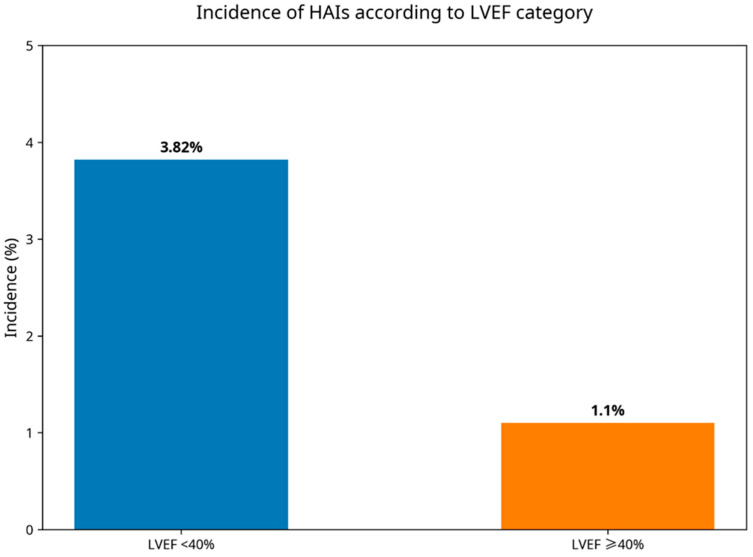 Figure 2
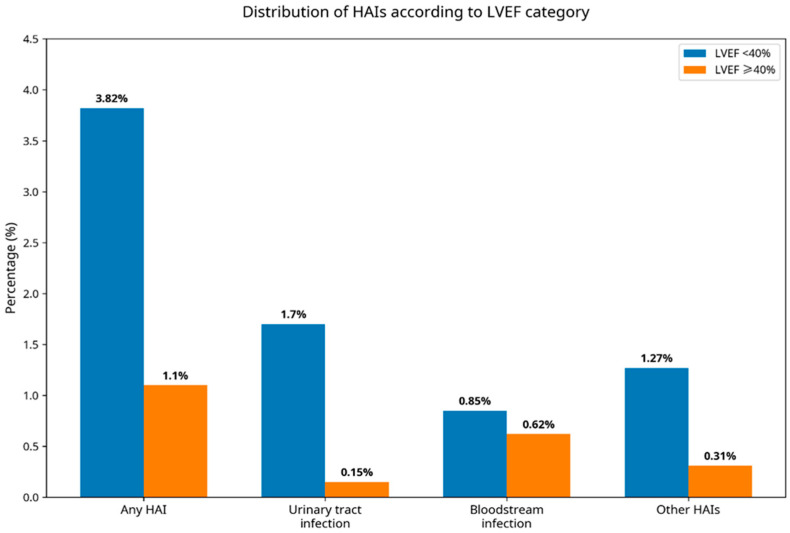 Figure 3
 Figure 4
Peer Reviews
No public reviews on file for this paper yet. If you reviewed it on a platform where reviews are public (OpenReview, ICLR, NeurIPS, ICML), you can paste yours below so the community can read it here.
Videos
No videos yet. Explain this paper in a talk, walkthrough, or lecture? Add one.
Taxonomy
TopicsUrinary Tract Infections Management · Nosocomial Infections in ICU · Surgical site infection prevention