Patient-Level Modeling of Ménière’s Disease vs. Vestibular Migraine: Performance of Speech Discrimination and Caloric-vHIT Dissociation
Nicolás Pérez-Fernández, Lorea Arbizu

TL;DR
This study shows that speech discrimination scores alone can effectively distinguish Ménière’s disease from vestibular migraine, better than other vestibular tests.
Contribution
The study demonstrates that speech discrimination scores alone outperform vestibular test patterns in differentiating Ménière’s disease from vestibular migraine at the patient level.
Findings
Bilateral speech discrimination scores achieved an AUC of 0.866 for distinguishing MD from VM.
Caloric–vHIT dissociation (CalHiT-A) was more common in MD but did not improve diagnostic performance when added to SDS.
SDS-only models showed better calibration and decision benefit compared to models including CalHiT-A.
Abstract
Background: Differentiating Ménière’s disease (MD) from vestibular migraine (VM) remains difficult because current diagnostic frameworks are predominantly clinical and incorporate pure-tone thresholds, risking incorporation bias. We asked whether speech discrimination scores (SDS) alone can separate MD from VM at the patient level and whether adding a prespecified vestibular marker, the caloric–vHIT dissociation, pattern A (abnormal calorics with normal horizontal vHIT), improves performance. Methods: In a retrospective cohort (2015–2018) including definite MD (n = 60) and definite VM (n = 40) by Bárány/ICHD criteria, we trained patient-level logistic regression models with 5-fold out-of-fold validation and in-fold preprocessing. To avoid incorporation bias, PTA was excluded from all models. Predefined feature sets were as follows: (1) SDS-only (bilateral SDS), (2) CalHiT-A-only…
Genes, proteins, chemicals, diseases, species, mutations and cell lines named across the full text — each resolved to its canonical identifier and authoritative record.
Click any figure to enlarge with its caption.
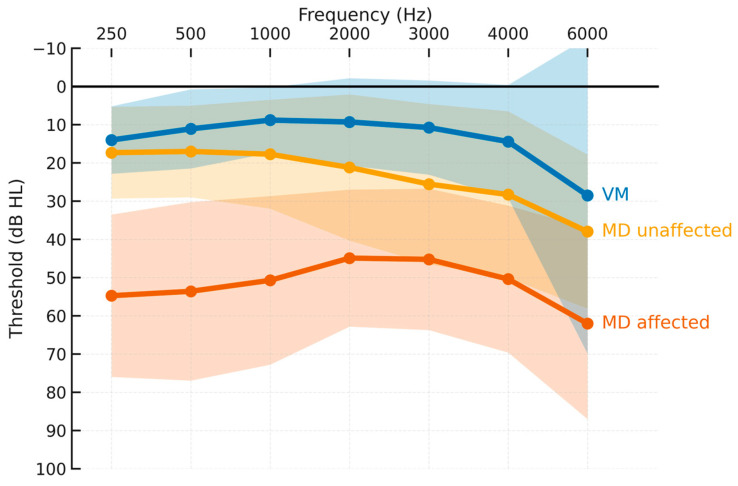 Figure 1
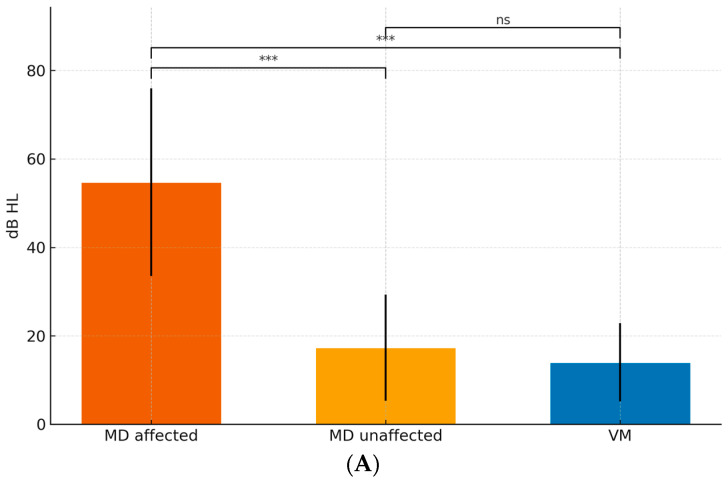 Figure 2
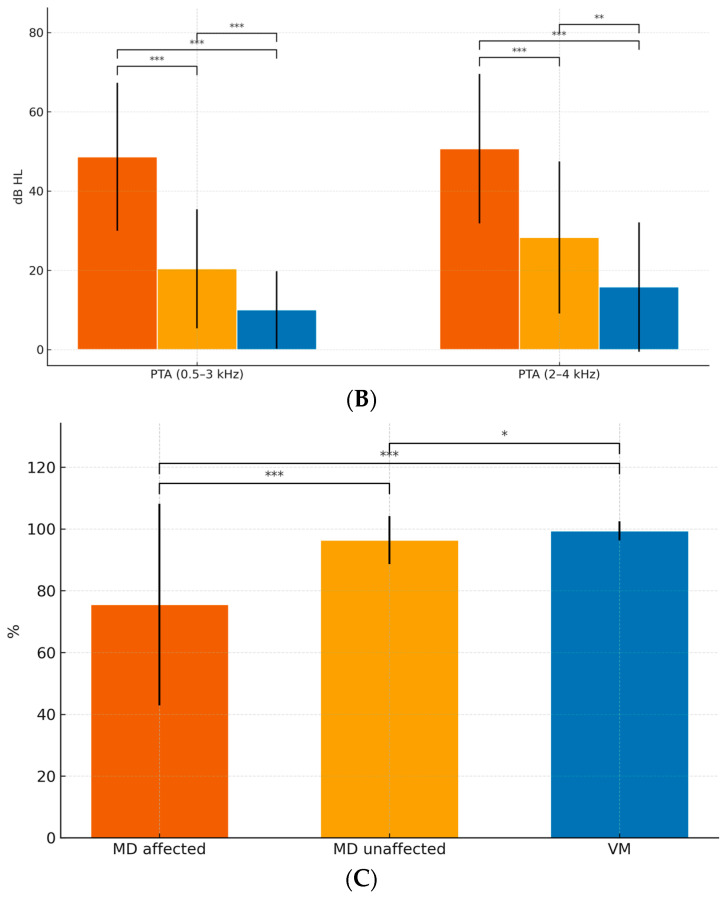 Figure 3
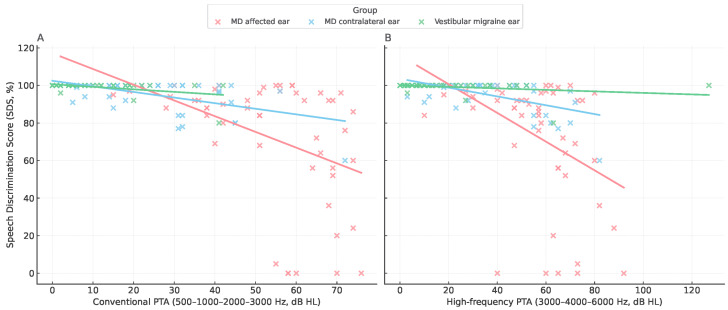 Figure 4
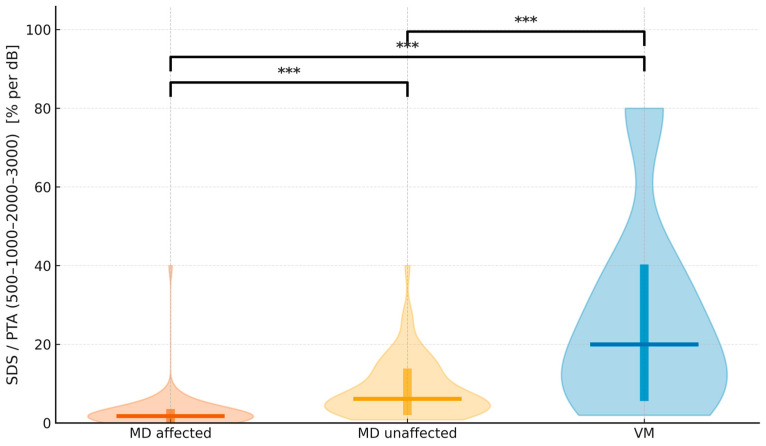 Figure 5
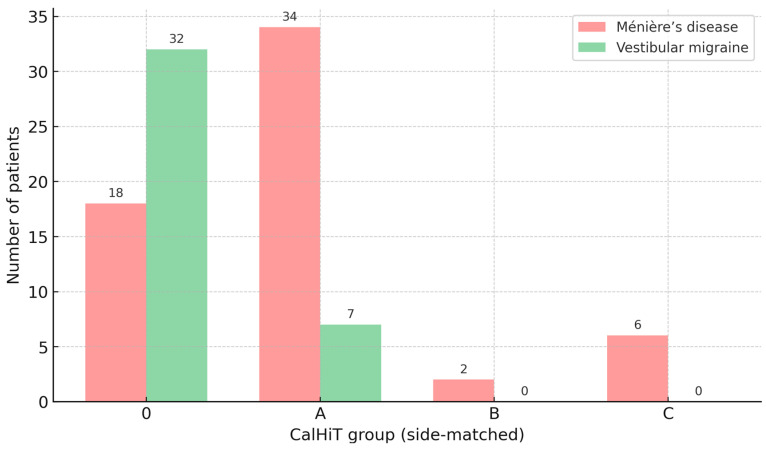 Figure 6
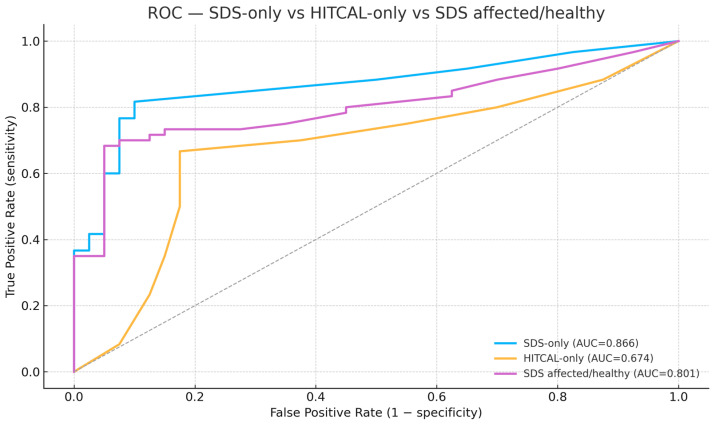 Figure 7
Peer Reviews
No public reviews on file for this paper yet. If you reviewed it on a platform where reviews are public (OpenReview, ICLR, NeurIPS, ICML), you can paste yours below so the community can read it here.
Videos
No videos yet. Explain this paper in a talk, walkthrough, or lecture? Add one.
Taxonomy
TopicsVestibular and auditory disorders · Hearing, Cochlea, Tinnitus, Genetics · Ear Surgery and Otitis Media