Revisiting the Sarcopenic Index in Older Adults with Reduced Kidney Function: Association with EWGSOP2-Defined Probable Sarcopenia
Diana Moldovan, Ina Kacso, Cosmina Bondor, Lucreția Avram, Dana Crişan, Ariana Condor, Crina Rusu, Alina Potra, Dacian Tirinescu, Maria Ticala, Yuriy Maslyennikov, Valer Donca

TL;DR
This study examines the relationship between a sarcopenic index and sarcopenia in older adults with reduced kidney function, finding that age and BMI are stronger indicators than the index.
Contribution
The study evaluates the sarcopenic index's validity in diagnosing sarcopenia in older adults with impaired kidney function using the EWGSOP2 framework.
Findings
The sarcopenic index was not independently associated with sarcopenia stages.
Age was the strongest independent correlate of probable sarcopenia.
BMI was independently associated with confirmed sarcopenia.
Abstract
Background: Sarcopenia is highly prevalent in older adults and in individuals with impaired kidney function, where it is associated with adverse clinical outcomes. A creatinine–cystatin C–based sarcopenic index has been proposed as a surrogate marker of muscle status; however, its association with sarcopenia as defined by the EWGSOP2 framework, particularly in the context of renal dysfunction, remains uncertain. Methods: Older adults were classified according to EWGSOP2 criteria into probable, confirmed, and severe sarcopenia. Associations between the sarcopenic index and sarcopenia phenotypes were examined using group comparisons and multivariable logistic regression analyses in the overall cohort and in a subgroup of participants with an estimated glomerular filtration rate (eGFR) < 60 mL/min/1.73 m2. Results: The sarcopenic index was not independently associated with probable,…
Genes, proteins, chemicals, diseases, species, mutations and cell lines named across the full text — each resolved to its canonical identifier and authoritative record.
Click any figure to enlarge with its caption.
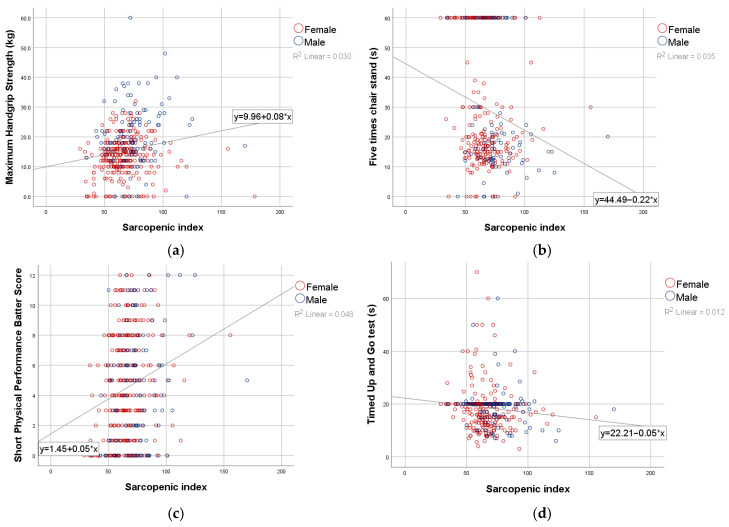 Figure 1
Peer Reviews
No public reviews on file for this paper yet. If you reviewed it on a platform where reviews are public (OpenReview, ICLR, NeurIPS, ICML), you can paste yours below so the community can read it here.
Videos
No videos yet. Explain this paper in a talk, walkthrough, or lecture? Add one.
Taxonomy
TopicsNutrition and Health in Aging · Body Composition Measurement Techniques · Dialysis and Renal Disease Management