Spinal Cord Stimulation for Non-Reconstructable Chronic Limb-Threatening Ischemia: A Real-World, Multidisciplinary, Single-Center Experience
Naoufel Ouerchefani, Edward Goldberg, Pascal Desgranges

TL;DR
Spinal cord stimulation improves pain and mobility in patients with severe leg ischemia, potentially reducing the need for amputation.
Contribution
A real-world, single-center study demonstrating long-term benefits of spinal cord stimulation for chronic limb-threatening ischemia.
Findings
SCS significantly reduced claudication pain intensity and increased walking distance in CLTI patients.
Skin lesions stabilized in 63% of patients, and limb survival rates were 90% and 70% at 12 months for stages IIb/III and IV, respectively.
Amputation risk was associated with Fontaine Stage, smoking, hypertension, and prior minor amputation.
Abstract
Background/Objectives: Chronic limb-threatening ischemia (CLTI) is a severe form of peripheral artery disease characterized by ischemic rest pain or ulcer necrosis. In Europe, spinal cord stimulation (SCS) can be offered to CLTI patients with chronic pain to improve mobility and prolong limb preservation. We evaluated the long-term, real-world outcomes of SCS therapy in patients with CLTI. Methods: In this observational study, medical chart review data from consecutive CLTI patients treated with SCS were analyzed. Results: Fifty-three patients (56.6% Fontaine Stage III, 39.6% Fontaine Stage IV, 3.8% Fontaine Stage IIb) had a single-stage SCS implant procedure between 2013 and 2022. Two years after SCS therapy activation, claudication pain intensity had significantly improved; the overall numerical rating scale pain score decreased from 9.4 ± 0.9 at baseline to 3.7 ± 3.2 (p < 0.0001). In…
Genes, proteins, chemicals, diseases, species, mutations and cell lines named across the full text — each resolved to its canonical identifier and authoritative record.
Click any figure to enlarge with its caption.
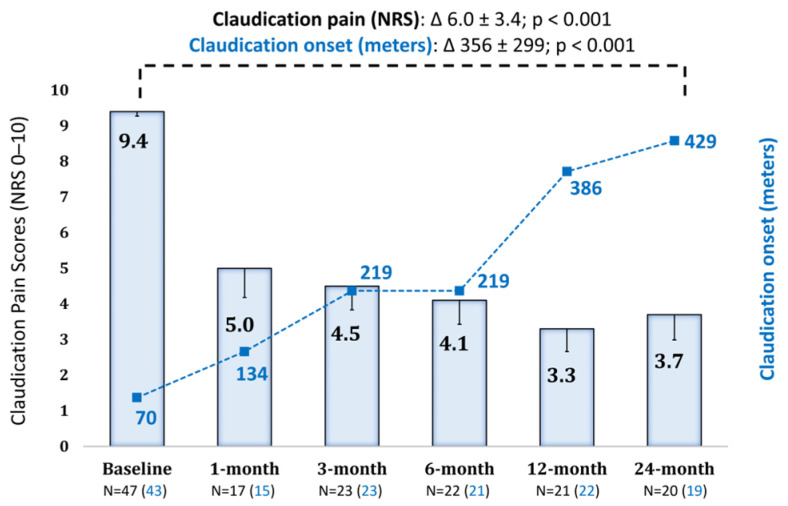 Figure 1
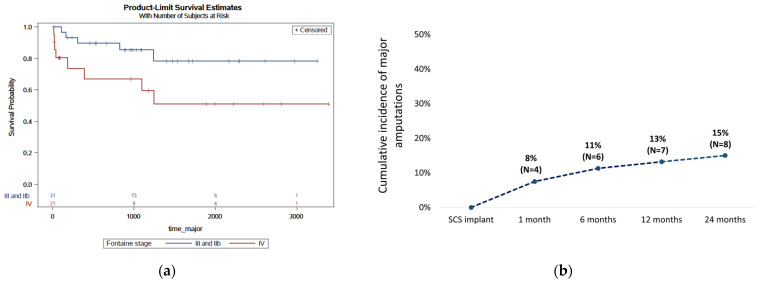 Figure 2
Peer Reviews
No public reviews on file for this paper yet. If you reviewed it on a platform where reviews are public (OpenReview, ICLR, NeurIPS, ICML), you can paste yours below so the community can read it here.
Videos
No videos yet. Explain this paper in a talk, walkthrough, or lecture? Add one.
Taxonomy
TopicsPain Management and Treatment · Myofascial pain diagnosis and treatment · Peripheral Artery Disease Management