Comparing Changes in FEV1 and Impulse Oscillometry Parameters Following Methacholine Challenge Testing: Physiological Correlates, Clinical Markers, and Pulmonary Symptoms
Thomas Ringbaek, Lars Frølund, Jann Mortensen, Charlotte S. Ulrik, Laura H. Thomsen, Henrik H. El Ali

TL;DR
This study compares two methods for measuring airway responsiveness to methacholine and finds that impulse oscillometry detects more cases than traditional spirometry.
Contribution
The study demonstrates that impulse oscillometry identifies a larger and partly distinct group of methacholine-responsive individuals compared to FEV1-based testing.
Findings
Impulse oscillometry (IOS) identified 70.6% of participants as hyperresponsive, compared to 37.5% using FEV1–PD20 criteria.
IOS responses showed larger stepwise differences in symptom categories compared to FEV1 declines.
A 20% decline in FEV1 corresponded to a 74% increase in R5, while a 40% increase in R5 corresponded to only a 7.6% FEV1 decline.
Abstract
Background: Spirometry-based methacholine challenge testing using the provocative dose causing a 20% decline in forced expiratory volume in 1 s (FEV1, PD20) is a reference method for assessing airway hyperresponsiveness. Impulse oscillometry (IOS), performed during tidal breathing, may capture airway mechanical changes not fully reflected by spirometry. We compared FEV1- and IOS-based methacholine responsiveness in a large, real-world adult cohort and examined associations with clinical markers and symptoms. Methods: We analyzed 794 consecutively referred adults undergoing standardized methacholine challenge testing with concurrent spirometry and IOS. IOS positivity was defined as a ≥40% increase in resistance at 5 Hz (ΔR5 ≥ 40%). Agreement between FEV1–PD20 positivity (PD20 ≤ 1440 µg) and IOS positivity was evaluated using cross-classification and Cohen’s κ. Associations between…
Genes, proteins, chemicals, diseases, species, mutations and cell lines named across the full text — each resolved to its canonical identifier and authoritative record.
Click any figure to enlarge with its caption.
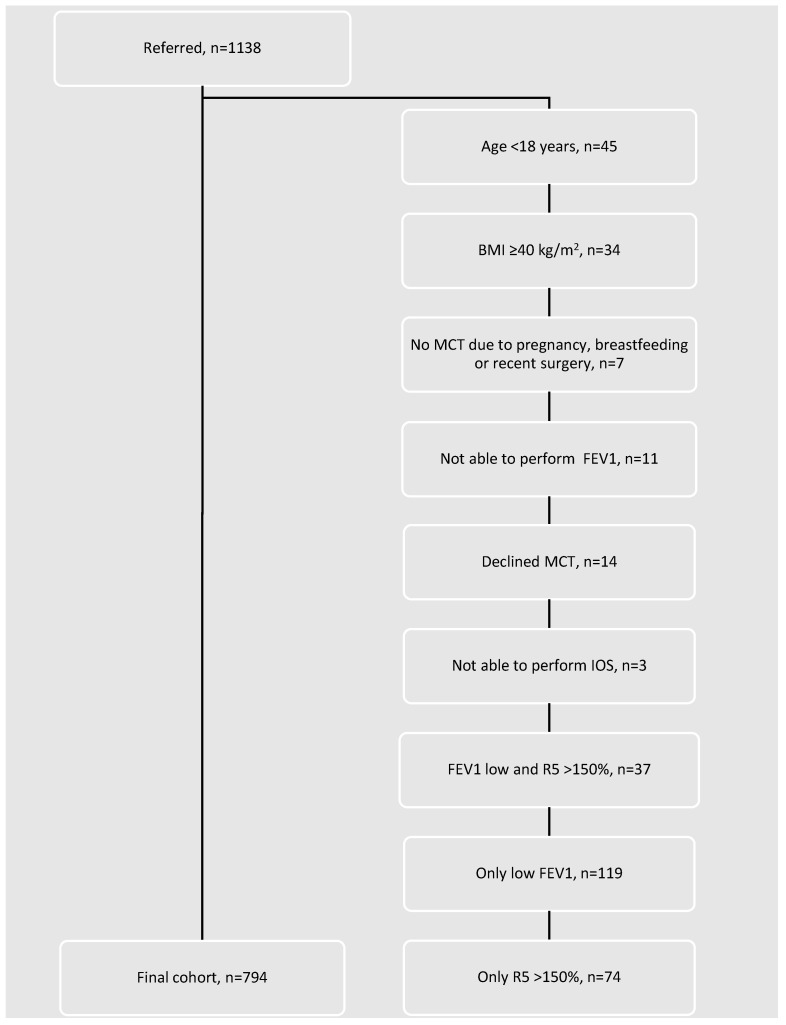 Figure 1
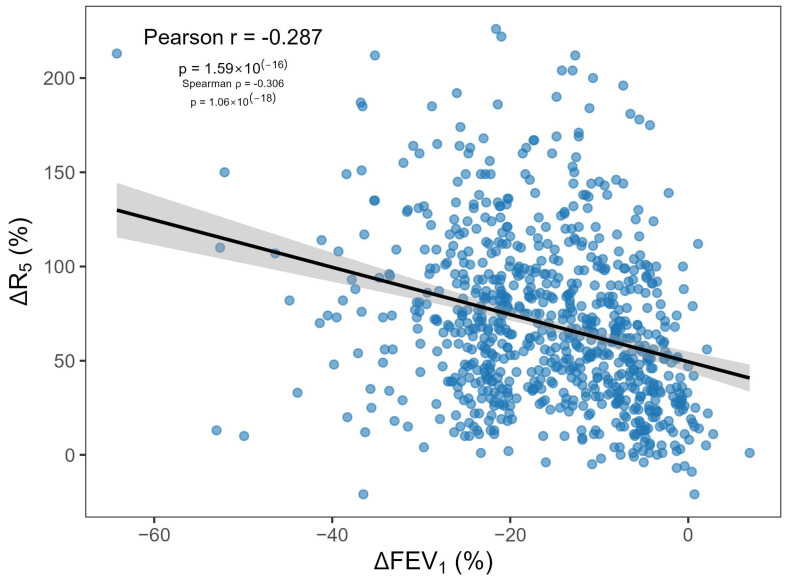 Figure 2
 Figure 3
Peer Reviews
No public reviews on file for this paper yet. If you reviewed it on a platform where reviews are public (OpenReview, ICLR, NeurIPS, ICML), you can paste yours below so the community can read it here.
Videos
No videos yet. Explain this paper in a talk, walkthrough, or lecture? Add one.
Taxonomy
TopicsChronic Obstructive Pulmonary Disease (COPD) Research · Asthma and respiratory diseases · Respiratory and Cough-Related Research