Fetal Urinary Cystatin C, NGAL and Beta-2-Microglobulin as Predictors of Postnatal Renal Function Impairment and Death in Fetuses with Lower Urinary Tract Obstruction
Małgorzata Stańczyk, Krzysztof Badura, Ayaana Ibshaan, Katarzyna Fortecka-Piestrzeniewicz, Iwona Maroszyńska, Tomasz Talar, Dariusz Olejniczak, Michał Podgórski, Jolanta Romak, Zuzanna Gaj, Krzysztof Szaflik, Piotr Kaczmarek, Marcin Tkaczyk

TL;DR
This study shows that fetal urine markers like Cystatin C, NGAL, and Beta-2-Microglobulin can predict kidney problems and death in babies with urinary tract blockages before birth.
Contribution
The study introduces fetal urinary biomarkers as potential predictors of postnatal renal dysfunction and mortality in fetuses with lower urinary tract obstruction.
Findings
Cystatin C corrected for creatinine was the strongest predictor of decreased kidney function 30 days after birth.
NGAL and Beta-2-Microglobulin also showed significant predictive value for postnatal outcomes.
The biomarkers could help guide prenatal decisions and improve counseling for affected families.
Abstract
Background/Objectives: Fetal lower urinary tract obstruction (LUTO) is a rare congenital anomaly that often leads to pulmonary hypoplasia and kidney dysfunction, which contribute to increased mortality. Prenatal estimation of the severity of LUTO is challenging due to the lack of specific diagnostic tools, which may guide clinical decisions. The aim of this analysis was to assess the role of fetal urinary concentrations of neutrophil gelatinase-associated lipocalin (NGAL), β2-microglobulin (B2M) and Cystatin C (CysC) in the prediction of unfavorable outcomes, such as postnatal renal dysfunction and death, among LUTO patients. Methods: A total of 38 women carrying fetuses with suspected LUTO (based on ultrasound features) were included in the study. Fetal urine was collected from the bladder of the fetus under ultrasound guidance, and measurements of NGAL, CysC and B2M were performed…
Genes, proteins, chemicals, diseases, species, mutations and cell lines named across the full text — each resolved to its canonical identifier and authoritative record.
Click any figure to enlarge with its caption.
 Figure 1
 Figure 2
 Figure 3
 Figure 4
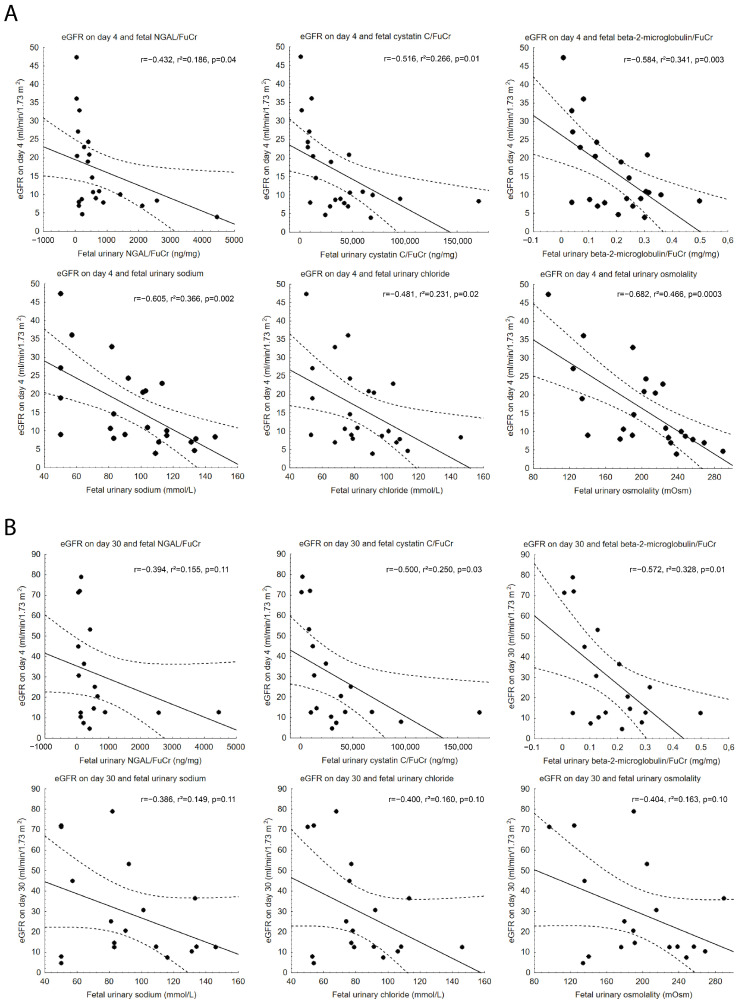 Figure 5
Peer Reviews
No public reviews on file for this paper yet. If you reviewed it on a platform where reviews are public (OpenReview, ICLR, NeurIPS, ICML), you can paste yours below so the community can read it here.
Videos
No videos yet. Explain this paper in a talk, walkthrough, or lecture? Add one.
Taxonomy
TopicsPediatric Urology and Nephrology Studies · Acute Kidney Injury Research · Renal and related cancers