A Cross-Sectional Analysis of Musculoskeletal and Functional Outcomes in Patients with Pituitary Disorders: Frailty and Sarcopenia
Kader Ugur, Mustafa Gur, Mithat Mızrak, Hasan Eryesil, Abdulvahap Hohluoglu, Hakan Artas, Kenan Bozbay, Burak Oz, Ahmet Karatas, Elif Emre, Mustafa Ata Aydin, İlknur Zeynep Acartürk, İbrahim Akdeniz, Suleyman Serdar Koca, Suleyman Aydın, Do-Youn Lee

TL;DR
This study found that patients with pituitary disorders like acromegaly and hypopituitarism have higher rates of frailty and sarcopenia compared to healthy individuals.
Contribution
The study provides new evidence on the link between pituitary disorders and musculoskeletal decline, emphasizing sarcopenia in hypopituitarism.
Findings
Hypopituitarism and acromegaly patients showed significantly higher frailty scores than healthy controls.
Hypopituitarism patients had lower muscle strength and skeletal muscle index compared to both acromegaly and control groups.
Sarcopenia was most prevalent in hypopituitarism patients, with 54% affected compared to 9% in acromegaly and 50% in controls.
Abstract
Background/Objectives: The purpose of this study was to compare the prevalence of sarcopenia and frailty in patients with acromegaly and hypopituitarism to healthy controls. Methods: This descriptive, comparative study included 32 patients with acromegaly, 24 patients with hypopituitarism, and 28 healthy volunteers who had undergone abdominal computed tomography (CT) within a month of their presentation at the endocrinology outpatient clinic between October 2023 and October 2024. The Tilburg Frailty Indicator was used to measure frailty. Sarcopenia was assessed using a dynamometer to measure handgrip strength and a CT-derived skeletal muscle index (SMI) at the L3 spinal level to measure muscle mass. Results: Both the hypopituitarism (7.5 ± 2.8) and acromegaly (7 ± 2.7) groups had substantially greater frailty ratings than the controls (4.8 ± 2.9) (p = 0.015). Frailty prevalence was 43%…
Genes, proteins, chemicals, diseases, species, mutations and cell lines named across the full text — each resolved to its canonical identifier and authoritative record.
Click any figure to enlarge with its caption.
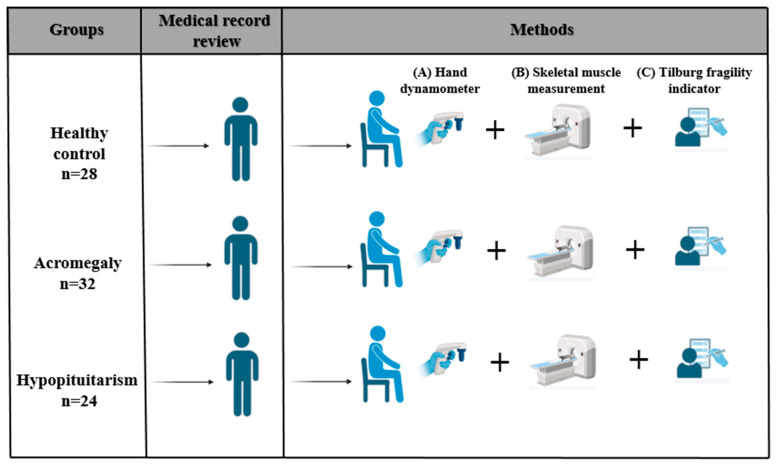 Figure 1
Peer Reviews
No public reviews on file for this paper yet. If you reviewed it on a platform where reviews are public (OpenReview, ICLR, NeurIPS, ICML), you can paste yours below so the community can read it here.
Videos
No videos yet. Explain this paper in a talk, walkthrough, or lecture? Add one.
Taxonomy
TopicsPituitary Gland Disorders and Treatments · Nutrition and Health in Aging · Growth Hormone and Insulin-like Growth Factors