Impact of Lipoprotein(a) on Residual Cardiovascular Risk After an Acute Coronary Syndrome
Nelsa González-Aguado, Rafael Franco-Hita, Jose Ignacio Larrubia-Valle, Fernando Puyol-Ruiz, Ainhoa Robles-Mezcua, José Manuel García-Pinilla, María Jiménez-Salva, Alberto Piserra-López, Francisco Javier Pavon-Moron, Alejandro Pérez-Cabeza, Pierre Sabouret, Francesco Costa

TL;DR
This paper reviews how lipoprotein(a) contributes to ongoing heart disease risk after a heart attack, despite existing treatments.
Contribution
The paper synthesizes current evidence on Lp(a)'s role in residual cardiovascular risk after acute coronary syndrome.
Findings
Lp(a) is a significant contributor to residual cardiovascular risk after acute coronary syndrome.
Current therapies targeting Lp(a) are limited, but RNA-based treatments show promise in reducing Lp(a) levels.
Ongoing clinical trials are evaluating whether Lp(a) reduction translates to improved clinical outcomes.
Abstract
Reducing residual cardiovascular risk following acute coronary syndrome (ACS) remains a major unmet clinical need. Despite substantial advances in lipid-lowering therapies, the risk of recurrent major adverse cardiovascular events (MACEs) after ACS remains high, with an estimated incidence of approximately 33.4% at 5 years. Residual cardiovascular risk is driven by multiple mechanisms, including persistent inflammation, a prothrombotic status, metabolic disturbances, and the presence of atherogenic lipoproteins beyond low-density lipoprotein cholesterol (LDL-C). Lipoprotein(a) (Lp(a)) is a pro-inflammatory, prothrombotic, and pro-atherosclerotic lipoprotein that appears to play a major role in residual risk after ACS or ischemic stroke. Elevated Lp(a) is a well-established independent and causal risk factor for atherosclerotic cardiovascular disease (ASCVD). Nevertheless, evidence…
Genes, proteins, chemicals, diseases, species, mutations and cell lines named across the full text — each resolved to its canonical identifier and authoritative record.
Click any figure to enlarge with its caption.
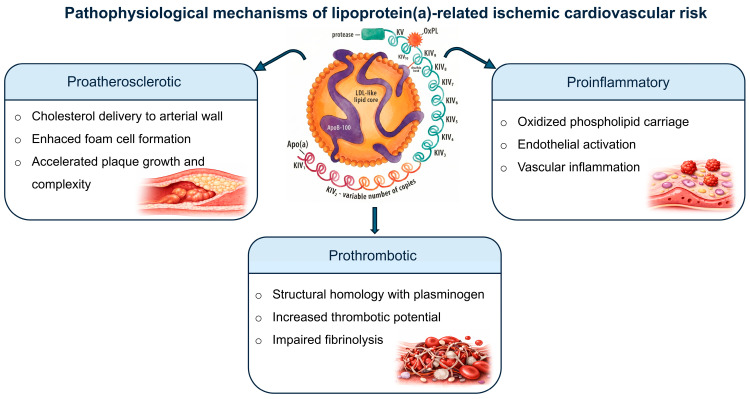 Figure 1
 Figure 2
Peer Reviews
No public reviews on file for this paper yet. If you reviewed it on a platform where reviews are public (OpenReview, ICLR, NeurIPS, ICML), you can paste yours below so the community can read it here.
Videos
No videos yet. Explain this paper in a talk, walkthrough, or lecture? Add one.
Taxonomy
TopicsLipoproteins and Cardiovascular Health · Atherosclerosis and Cardiovascular Diseases · Adipokines, Inflammation, and Metabolic Diseases