Medical Management of Well-Differentiated Pancreatic Neuroendocrine Tumors: From Conventional Therapies to Emerging Strategies
Min Je Sung, Namyoung Park

TL;DR
This paper reviews treatment options for pancreatic neuroendocrine tumors, focusing on how to choose therapies based on tumor characteristics and patient needs.
Contribution
The paper provides a practical framework for individualized treatment selection and sequencing for Grade 1–2 pancreatic neuroendocrine tumors.
Findings
Long-acting somatostatin analogues are effective for low-volume, SSTR-positive, and indolent tumors.
Peptide receptor radionuclide therapy with 177Lu-DOTATATE is beneficial for SSTR-positive tumors with progressive disease.
Combination chemotherapy like CAPTEM is recommended for higher tumor burdens or aggressive tumor biology.
Abstract
Grade 1–2 pancreatic neuroendocrine tumors exhibit considerable biological and clinical diversity, which translates into a broad range of available therapeutic approaches. Given the absence of a universally accepted treatment sequence, treatment selection requires a practical framework based on tumor biology and clinical presentation. Clinical management should be individualized by integrating the histologic grade, disease extent, symptom burden, and somatostatin receptor (SSTR) expression. For patients with low-volume, SSTR-positive, and clinically indolent disease (Ki-67 < 10%), long-acting somatostatin analogues, including octreotide and lanreotide, are commonly used as initial therapies to control hormonal symptoms and delay tumor progression. In patients with radiologic progression requiring systemic disease control, targeted agents such as everolimus and sunitinib represent…
Genes, proteins, chemicals, diseases, species, mutations and cell lines named across the full text — each resolved to its canonical identifier and authoritative record.
Click any figure to enlarge with its caption.
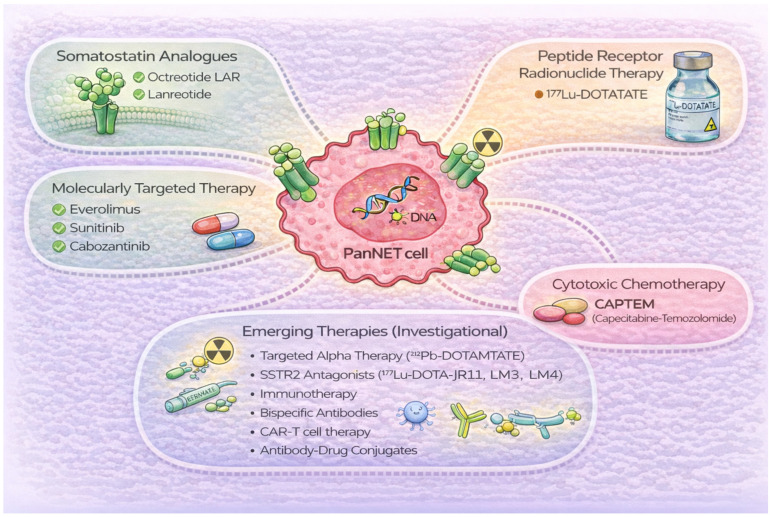 Figure 1
Peer Reviews
No public reviews on file for this paper yet. If you reviewed it on a platform where reviews are public (OpenReview, ICLR, NeurIPS, ICML), you can paste yours below so the community can read it here.
Videos
No videos yet. Explain this paper in a talk, walkthrough, or lecture? Add one.
Taxonomy
TopicsNeuroendocrine Tumor Research Advances · Lung Cancer Research Studies · Pancreatic and Hepatic Oncology Research