Exploratory Evaluation of the Predictive Value of Serum Neurofilament Light Chain for Autonomic Neuropathy in Hereditary Transthyretin Amyloidosis
Milou Berends, Anne Floor Brunger, Hendrea S. A. Tingen, Johan Bijzet, Charlotte E. Teunissen, Paul A. van der Zwaag, Reinold O. B. Gans, Bouke P. C. Hazenberg, Fiete Lange, Gea Drost, Walter Noordzij, Hans L. A. Nienhuis, Riemer H. J. A. Slart

TL;DR
This study explores whether a blood marker called sNfL can predict autonomic neuropathy in a type of amyloidosis disease, but finds limited evidence.
Contribution
The study is the first to explore the predictive value of sNfL for autonomic neuropathy in hereditary transthyretin amyloidosis.
Findings
Individuals with autonomic neuropathy had significantly higher median sNfL levels.
Multivariable analysis showed peripheral neuropathy, not autonomic neuropathy, predicted sNfL status.
Receiver operating characteristic analysis suggested potential but had wide confidence intervals.
Abstract
Background/Objectives: Serum neurofilament light chain (sNfL) is a biomarker for peripheral neuropathy as sNfL correlates with polyneuropathy severity in hereditary transthyretin (ATTRv) amyloidosis. It is unclear whether sNfL also correlates with autonomic neuropathy (ANP). In this exploratory study, we aimed to evaluate the value of sNfL as marker for ANP in patients with ATTRv amyloidosis. Methods: sNfL was measured retrospectively in 10 pathogenic transthyretin gene variant (TTRv) carriers and 28 patients with ATTRv amyloidosis. All 38 individuals underwent a comprehensive evaluation for ANP. Results: Individuals with ANP had a higher median sNfL level compared to those without ANP (p < 0.001). In univariable logistic regression analysis, age-adjusted sNfL status (normal versus abnormal for age) was associated with sex, ANP, and peripheral neuropathy. In multivariable logistic…
Genes, proteins, chemicals, diseases, species, mutations and cell lines named across the full text — each resolved to its canonical identifier and authoritative record.
Click any figure to enlarge with its caption.
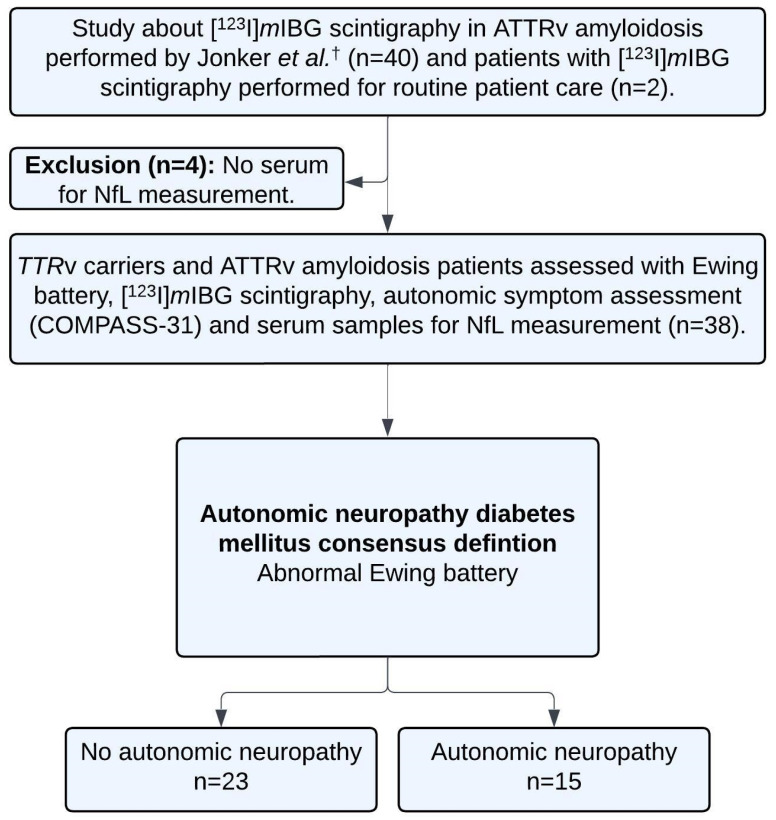 Figure 1
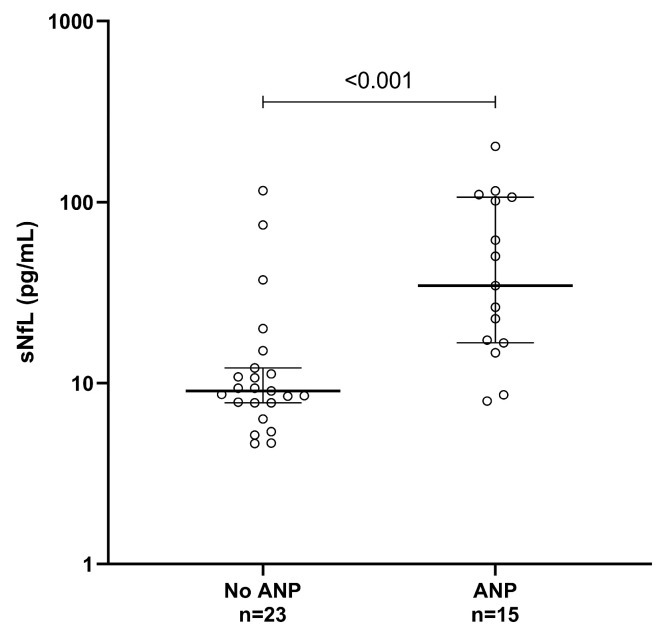 Figure 2
Peer Reviews
No public reviews on file for this paper yet. If you reviewed it on a platform where reviews are public (OpenReview, ICLR, NeurIPS, ICML), you can paste yours below so the community can read it here.
Videos
No videos yet. Explain this paper in a talk, walkthrough, or lecture? Add one.
Taxonomy
TopicsAmyloidosis: Diagnosis, Treatment, Outcomes · Alzheimer's disease research and treatments · Skin and Cellular Biology Research