Analysis of Different Post-Operative Hyperamylasemia Criteria for Defining Post-Pancreatectomy Acute Pancreatitis After Distal Pancreatectomy—A Retrospective Single-Center Study
Lukas Heinrich Poelsler, Ruben Bellotti, Daniel Pably, Dagmar Morell-Hofert, Eva Maier, Benno Cardini, Rupert Oberhuber, Thomas Resch, Florian Ponholzer, Felix J. Krendl, Christian Margreiter, Stefan Schneeberger, Dietmar Öfner, Manuel Maglione

TL;DR
This study compares two criteria for diagnosing post-pancreatectomy acute pancreatitis and finds that one is more clinically relevant.
Contribution
The study evaluates the clinical relevance of different hyperamylasemia criteria for diagnosing post-pancreatectomy acute pancreatitis.
Findings
Using a 48-hour hyperamylasemia criterion, PPAP occurred in 5.8% of patients, versus 13.0% with a shorter criterion.
PPAP was strongly associated with clinically relevant pancreatic fistulas and major complications.
The 48-hour criterion better captured clinically significant outcomes compared to the shorter criterion.
Abstract
Background/Objectives: The International Study Group for Pancreatic Surgery has recently defined post-pancreatectomy acute pancreatitis (PPAP), stating that sustained postoperative hyperamylasemia (POH) for at least 48 h is a pivotal criterion. However, the clinical relevance of POH and PPAP following distal pancreatectomy remains uncertain. This study compares two PPAP definitions differing in POH criteria. Methods: We retrospectively analyzed all patients who consecutively underwent distal pancreatectomy at our institution (2010–2023). PPAP diagnosis required clinical symptoms, characteristic CT findings, and either sustained POH ≥ 48 h (standard group) or transient POH less than 48 h (modified group). Outcomes were compared between definitions. Results: Among 207 patients included, in the standard group, PPAP was diagnosed in 12 (5.8%), and in the modified group in 27 (13.0%)…
Genes, proteins, chemicals, diseases, species, mutations and cell lines named across the full text — each resolved to its canonical identifier and authoritative record.
Click any figure to enlarge with its caption.
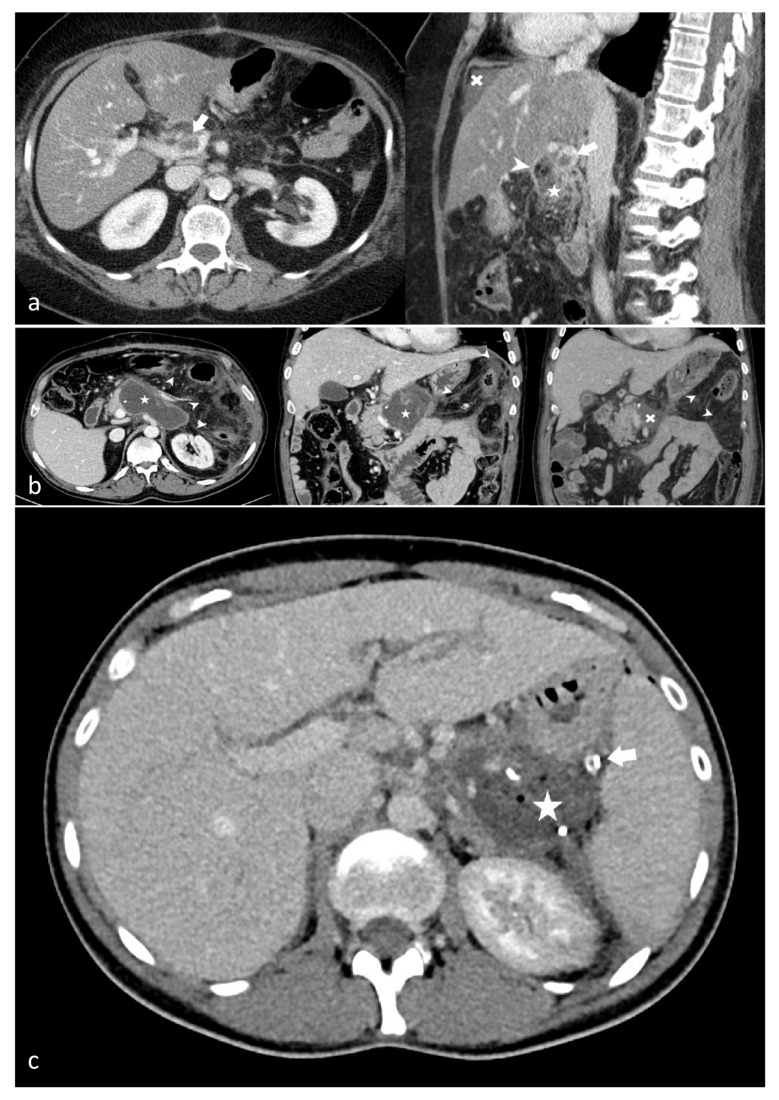 Figure 1
Peer Reviews
No public reviews on file for this paper yet. If you reviewed it on a platform where reviews are public (OpenReview, ICLR, NeurIPS, ICML), you can paste yours below so the community can read it here.
Videos
No videos yet. Explain this paper in a talk, walkthrough, or lecture? Add one.
Taxonomy
TopicsPancreatic and Hepatic Oncology Research · Pancreatitis Pathology and Treatment · Neuroendocrine Tumor Research Advances