Systemic Integrative Mechanisms and Intervention Strategies in Exercise-Induced Skeletal Muscle Damage: Evidence from Animal, Clinical, and Multi-Omics Studies
Tianhang Peng, Zike Zhang, Ju Wei, Ni Ding, Wanyuan Liang, Xiuqi Tang

TL;DR
This paper explores how exercise-induced muscle damage involves complex interactions between mechanical stress, metabolism, and immunity, and how these systems can lead to injury or recovery.
Contribution
The study introduces a systems biology framework for understanding exercise-induced muscle damage and evaluates interventions based on multi-omics and clinical evidence.
Findings
EIMD involves feedback loops between mechanical, metabolic, oxidative, and immune processes.
Molecular tipping points like ROS accumulation and iron-dependent lipid peroxidation determine injury outcomes.
Satellite cells integrate metabolic history and epigenetic memory, affecting muscle adaptability and disease risk.
Abstract
Exercise-induced muscle damage (EIMD) has classically been attributed to localized mechanical disruption following eccentric contractions. Emerging evidence, however, indicates that EIMD represents a systems-level failure of stress integration within skeletal muscle rather than a purely mechanical lesion. Mechanical loading initiates disturbances in intracellular Ca2+ homeostasis, which interact with metabolic stress, redox imbalance, and immune activation to form self-reinforcing feedback loops. When compensatory capacity is exceeded, transient injury may shift toward maladaptive remodeling marked by mitochondrial dysfunction, ferroptosis, chronic inflammation, and impaired regeneration. Recent studies identify reactive oxygen species accumulation, iron-dependent lipid peroxidation, dysregulated energy sensing, and aberrant immune polarization as key molecular tipping points governing…
Genes, proteins, chemicals, diseases, species, mutations and cell lines named across the full text — each resolved to its canonical identifier and authoritative record.
Click any figure to enlarge with its caption.
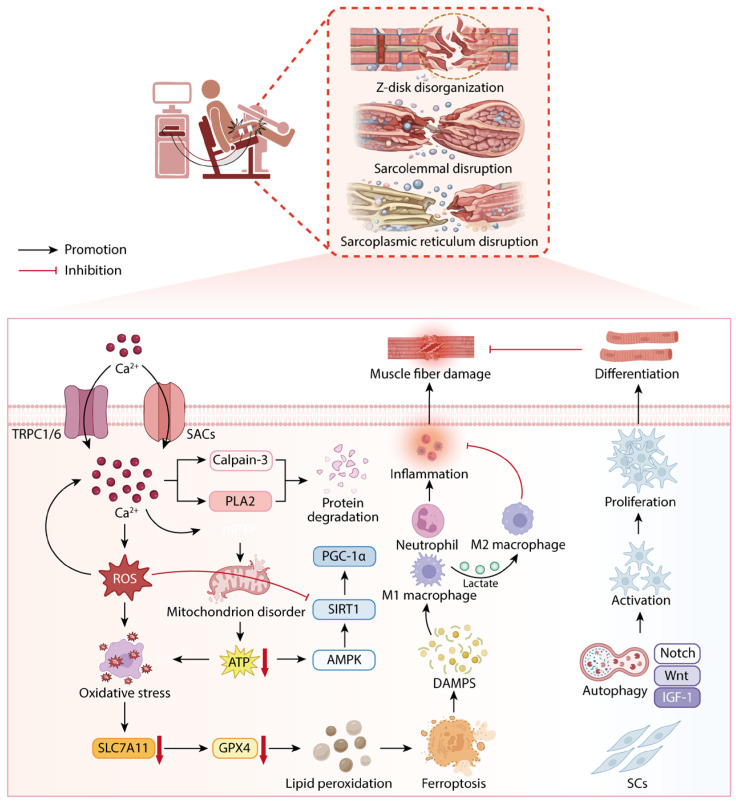 Figure 1
 Figure 2
 Figure 3
Peer Reviews
No public reviews on file for this paper yet. If you reviewed it on a platform where reviews are public (OpenReview, ICLR, NeurIPS, ICML), you can paste yours below so the community can read it here.
Videos
No videos yet. Explain this paper in a talk, walkthrough, or lecture? Add one.
Taxonomy
TopicsExercise and Physiological Responses · Muscle Physiology and Disorders · Ferroptosis and cancer prognosis