Comparison of Mini-Percutaneous Nephrolithotomy and Flexible Ureteroscopy for Treating 1–2 cm Single Stones in Solitary Kidney: Outcomes and Renal Function Impact
Yuehan Yang, Zhongwei Jiang, Xike Mao, Lvwen Zhang, Zongyao Hao

TL;DR
This study compares two kidney stone treatments in patients with one kidney, finding that flexible ureteroscopy offers similar stone removal with better safety and kidney function preservation.
Contribution
The study provides a comparative analysis of mPCNL and f-URS in solitary kidney patients with 1–2 cm stones, focusing on renal function outcomes.
Findings
f-URS showed comparable stone-free rates to mPCNL but with less blood loss and shorter hospital stays.
f-URS resulted in greater improvements in serum creatinine and eGFR at one month.
All transfusion-related complications occurred in the mPCNL group.
Abstract
Objective: The optimal surgical approach for 1.0–2.0 cm renal stones in solitary kidney patients remains controversial. This retrospective study compared mini-percutaneous nephrolithotomy (mPCNL) and flexible ureteroscopy (f-URS) outcomes in this vulnerable population. Methods: Between June 2018 and April 2024, 50 patients with solitary kidneys and 1.0–2.0 cm renal stones underwent either mPCNL (n = 26) or f-URS (n = 24). Outcomes included 3-month stone-free rate (SFR), complications (Clavien–Dindo classification), and renal function (serum creatinine, eGFR by CKD-EPI equation) at the baseline, 72 h, and 1 month. Results: Stone-free rates were comparable (mPCNL 96.2% vs. f-URS 91.7%, p = 0.157). The f-URS group demonstrated significantly less hemoglobin decline (2.2 ± 0.9 vs. 5.7 ± 2.4 g/dL, p < 0.001) and shorter hospitalization (4.1 ± 1.1 vs. 7.8 ± 1.6 days, p < 0.001). All Grade II…
Genes, proteins, chemicals, diseases, species, mutations and cell lines named across the full text — each resolved to its canonical identifier and authoritative record.
Click any figure to enlarge with its caption.
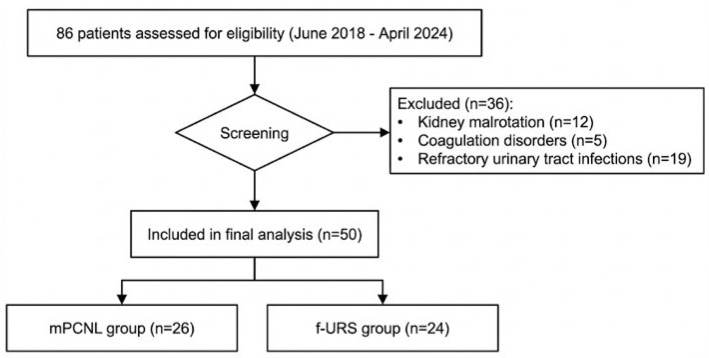 Figure 1
Peer Reviews
No public reviews on file for this paper yet. If you reviewed it on a platform where reviews are public (OpenReview, ICLR, NeurIPS, ICML), you can paste yours below so the community can read it here.
Videos
No videos yet. Explain this paper in a talk, walkthrough, or lecture? Add one.
Taxonomy
TopicsKidney Stones and Urolithiasis Treatments · Dialysis and Renal Disease Management · Acute Kidney Injury Research