FSH Receptor Asn680Ser Polymorphism Modulates Intrafollicular Nitric Oxide Bioavailability and Ovarian Responsiveness During IVF
Charalampos Voros, Diamantis Athanasiou, Despoina Mavrogianni, Ntilay Soyhan, Georgia Panagou, Maria Sakellariou, Georgios Papadimas, Fotios Chatzinikolaou, Eleni Sivylla Bikouvaraki, Georgios Daskalakis, Kalliopi Pappa

TL;DR
This study shows that a genetic variation in the FSH receptor affects ovarian response during IVF, possibly through changes in nitric oxide levels in follicles.
Contribution
The study links the FSHR Asn680Ser polymorphism to ovarian responsiveness and intrafollicular nitric oxide bioavailability during IVF.
Findings
Ser/Ser homozygotes had higher oocyte counts and better fertilization outcomes than Asn allele carriers.
Ser/Ser individuals showed elevated intrafollicular NO2-NO3 concentrations, though not statistically significant.
The polymorphism is associated with differing ovarian responsiveness during IVF.
Abstract
In vitro fertilisation (IVF) has significant hurdles due to individual differences in ovarian response during controlled ovarian stimulation. The Asn680Ser polymorphism of the follicle-stimulating hormone receptor (FSHR) is linked to varying ovarian sensitivity to FSH. However, its relationship with intrafollicular redox signalling remains unclear. Nitric oxide (NO) is a crucial compound that functions inside follicles and participates in angiogenesis, steroidogenesis, and oocyte competence. This prospective observational research classified women undergoing IVF into Asn allele carriers (Asn/Asn and Asn/Ser) and Ser/Ser homozygotes, according to the FSHR Asn680Ser polymorphism. The groups were assessed according to follicular fluid nitric oxide metabolites (NO2-NO3), fertilisation results, ovarian response indicators, and hormonal profiles. No substantial variation was seen between…
Genes, proteins, chemicals, diseases, species, mutations and cell lines named across the full text — each resolved to its canonical identifier and authoritative record.
Click any figure to enlarge with its caption.
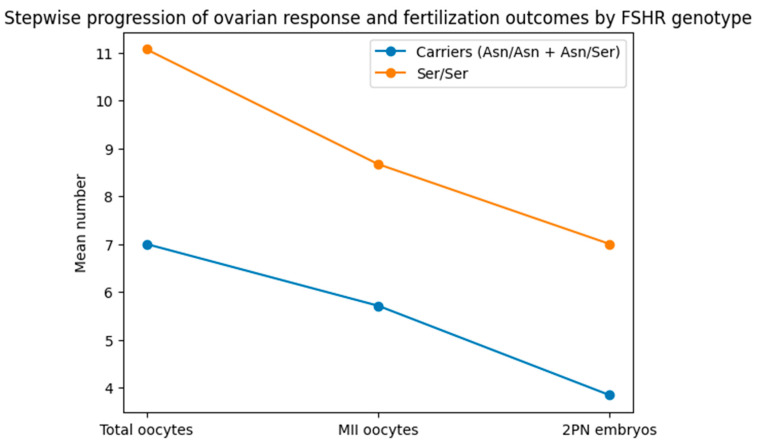 Figure 1
Peer Reviews
No public reviews on file for this paper yet. If you reviewed it on a platform where reviews are public (OpenReview, ICLR, NeurIPS, ICML), you can paste yours below so the community can read it here.
Videos
No videos yet. Explain this paper in a talk, walkthrough, or lecture? Add one.
Taxonomy
TopicsReproductive Biology and Fertility · Ovarian function and disorders · Reproductive Physiology in Livestock