Serum Cocaine- and Amphetamine-Regulated Transcript (CART) Levels in Graves’ Disease: Associations with Metabolic Status, Autoimmunity, and Thyroid Ultrasound Heterogeneity
Betül Çiğdem Yortanlı, Ümmügülsüm Can, İslam Köse, Semiha Durmaz, Mehmet Yortanlı, Oğuzhan Aksu

TL;DR
This study explores serum levels of a neuropeptide called CART in patients with Graves’ disease and finds associations with metabolic and autoimmune factors, but not with thyroid hormone levels.
Contribution
The study identifies novel associations between serum CART levels and thyroid ultrasound heterogeneity, metabolic status, and autoimmunity in Graves’ disease.
Findings
Serum CART levels were not significantly different between Graves’ disease patients and healthy controls.
CART levels correlated with body mass index and insulin resistance but inversely with autoantibody levels in Graves’ disease patients.
CART levels varied with thyroid ultrasound heterogeneity, suggesting a role in reflecting metabolic and autoimmune heterogeneity.
Abstract
Graves’ disease (GD) is an autoimmune disorder characterized by hyperthyroidism and a hypermetabolic state involving complex endocrine, metabolic, and immune interactions. Cocaine- and amphetamine-regulated transcript (CART) is a neuropeptide involved in energy balance, neuroendocrine signaling, and neuroimmune modulation; however, its circulating levels and clinical relevance in GD remain unclear. In this single-center prospective study, serum CART levels were evaluated in 44 patients with GD and 44 age- and sex-matched healthy controls. Associations with thyroid function, autoimmune markers, metabolic parameters, and thyroid ultrasound heterogeneity were analyzed. Serum CART concentrations were measured using an enzyme-linked immunosorbent assay, and clinical, biochemical, and ultrasonographic data were recorded. Serum CART levels did not differ significantly between GD patients and…
Genes, proteins, chemicals, diseases, species, mutations and cell lines named across the full text — each resolved to its canonical identifier and authoritative record.
Click any figure to enlarge with its caption.
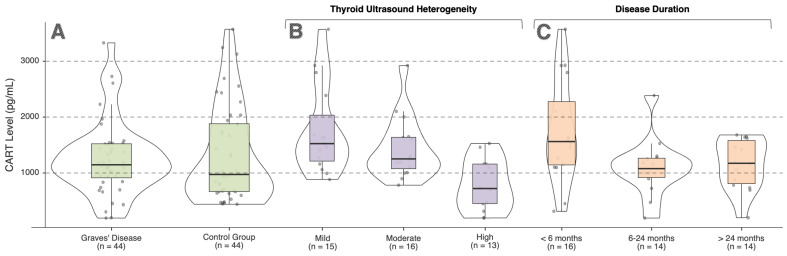 Figure 1
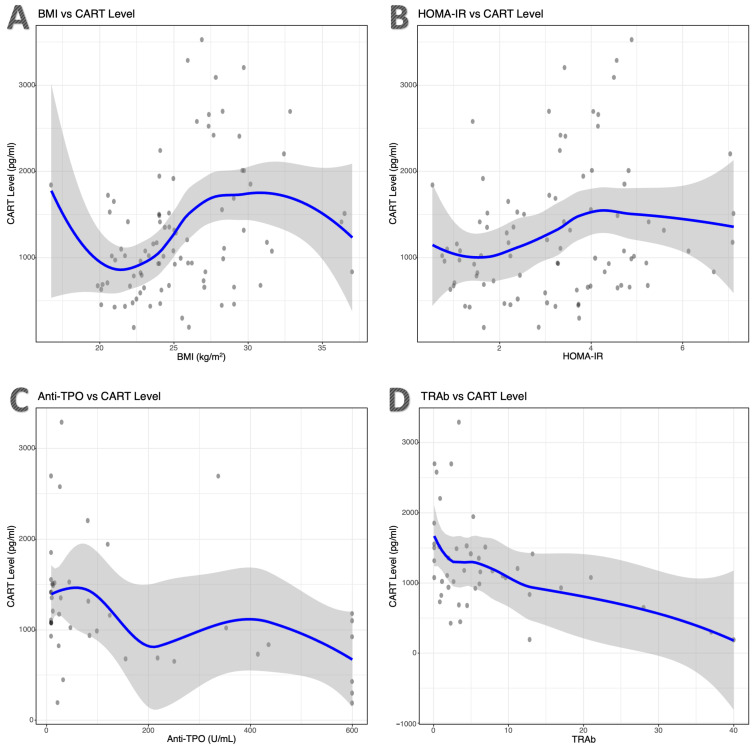 Figure 2
Peer Reviews
No public reviews on file for this paper yet. If you reviewed it on a platform where reviews are public (OpenReview, ICLR, NeurIPS, ICML), you can paste yours below so the community can read it here.
Videos
No videos yet. Explain this paper in a talk, walkthrough, or lecture? Add one.
Taxonomy
TopicsRegulation of Appetite and Obesity · Diabetes and associated disorders · Growth Hormone and Insulin-like Growth Factors