Isocyanides Versus Nitriles: Divergent Hydrogen Bonding Behavior Driven by the Balance Between Dispersive and Electrostatic Forces
Alexander Kanzow, Martin A. Suhm, Margarethe Bödecker

TL;DR
The paper shows how isocyanides and nitriles form different hydrogen bonds with water or alcohol, influenced by electrostatic and dispersive forces.
Contribution
First characterization of isocyanides as hydrogen-bond acceptors using jet-cooled infrared spectroscopy.
Findings
t-BuNC forms classical σ-type hydrogen bonds with H2O, while t-BuCN prefers dispersion-stabilized π-type arrangements.
Replacing H2O with t-BuOH enhances dispersion interactions, shifting both complexes toward π-type binding.
Hydrogen bonding preferences are governed by the balance between electrostatic and dispersive forces.
Abstract
Isocyanides as hydrogen‐bond acceptors are characterized using jet‐cooled Fourier transform infrared spectroscopy for the first time. The hydrogen‐bonded structures of tert‐butyl isocyanide (t‐BuNC) and its constitutional isomer pivalonitrile (t‐BuCN) with a single H2O or tert‐butyl alcohol (t‐BuOH) molecule are analyzed. The most stable monohydrate structures differ markedly: t‐BuNC adopts a classical σ‐type hydrogen bond, whereas t‐BuCN favors a dispersion‐stabilized orthogonal π‐type arrangement. Substitution of H2O with the more polarizable t‐BuOH enhances dispersion interaction between the molecules and drives both complexes toward π‐type binding motifs. These findings highlight the balance between dispersive and electrostatic interactions in governing noncovalent binding preferences. While isocyanides favor σ‐type hydrogen bonding, as illustrated by t‐BuNC···H2O (top), nitriles…
Genes, proteins, chemicals, diseases, species, mutations and cell lines named across the full text — each resolved to its canonical identifier and authoritative record.
Click any figure to enlarge with its caption.
 Figure 1
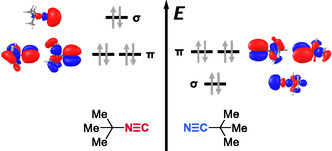 Figure 2
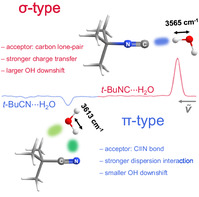 Figure 3
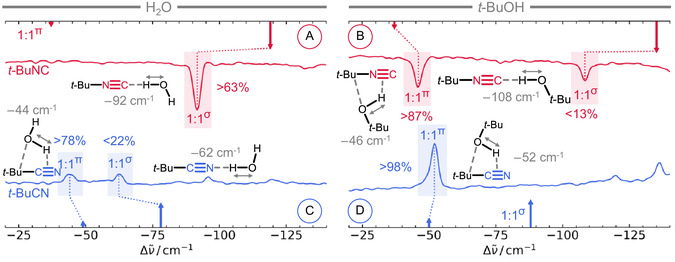 Figure 4
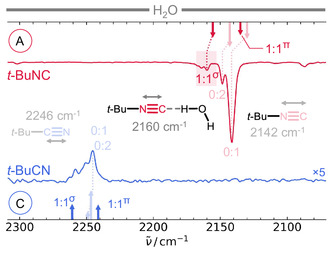 Figure 5
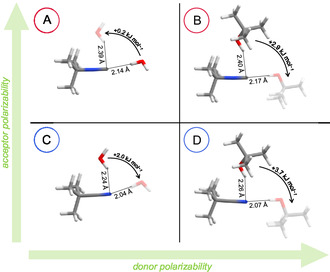 Figure 6
Peer Reviews
No public reviews on file for this paper yet. If you reviewed it on a platform where reviews are public (OpenReview, ICLR, NeurIPS, ICML), you can paste yours below so the community can read it here.
Videos
No videos yet. Explain this paper in a talk, walkthrough, or lecture? Add one.
Taxonomy
TopicsCrystallography and molecular interactions · Synthesis and Properties of Aromatic Compounds · Luminescence and Fluorescent Materials