Highly radiative emission of room temperature–localized excitons enabled by charge-neutralized 0D quantum wells in 2D semiconductors
Taeyoung Moon, Hyeongwoo Lee, Jihae Lee, Dong Kyo Oh, Soo Ho Choi, Yeonjeong Koo, Christopher E. Stevens, Hyunje Cho, Deep Jariwala, Je-Hyung Kim, Moon-Ho Jo, Joshua R. Hendrickson, Ki Kang Kim, Junsuk Rho, Yung Doug Suh, Kyoung-Duck Park

TL;DR
Researchers developed a method to enable efficient light emission from localized excitons at room temperature using charge-neutralized quantum wells in 2D semiconductors.
Contribution
The novel approach involves using a charge-neutralized 0D quantum well to achieve high quantum yield in room-temperature exciton emission.
Findings
A drift-diffusion model confirmed ~98% exciton confinement efficiency.
Tip-induced pressure controls exciton dynamics and quantum yield reversibly.
Nanohole funneling enables bright localized exciton emission at the nanoscale.
Abstract
Nondiffusing localized excitons (XL) in two-dimensional semiconductors present a robust platform for mediating light-matter interactions, with potential applications in both photovoltaics and light-emitting devices. However, at room temperature, high thermal energy hinders XL formation, while excess charges diminish the quantum yield (QY) through nonradiative decay. Here, we present high-QY XL emission in ambient conditions by removing excess charges and inducing efficient exciton funneling into a Au nanohole. Specifically, by evaporating an H2O barrier between the n-type MoS2 and the Au substrate, we induce a grounding effect on electrons. Dominantly populating excitons are then funneled and bound to the nanohole through the strain-induced zero-dimensional quantum well effect. We confirm the exciton confinement efficiency of ~98% using a drift-diffusion model, enabling bright XL…
Genes, proteins, chemicals, diseases, species, mutations and cell lines named across the full text — each resolved to its canonical identifier and authoritative record.
Click any figure to enlarge with its caption.
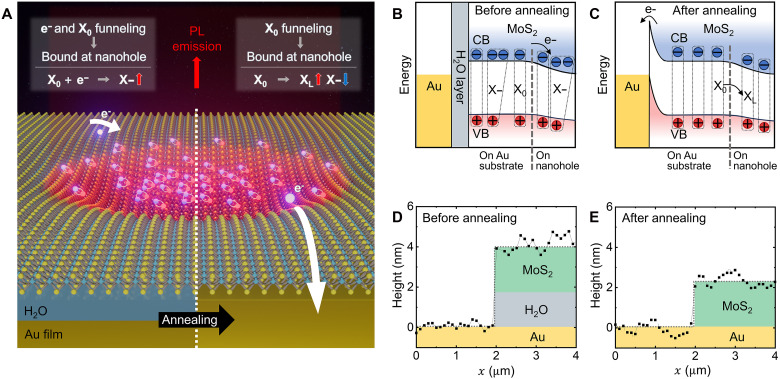 Figure 1
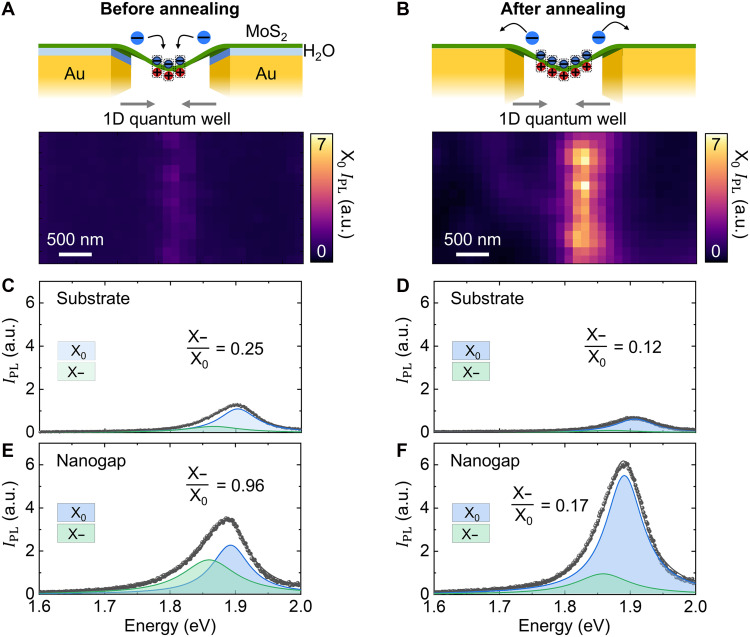 Figure 2
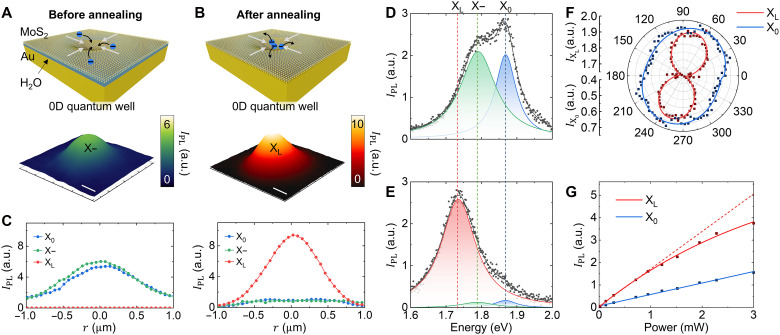 Figure 3
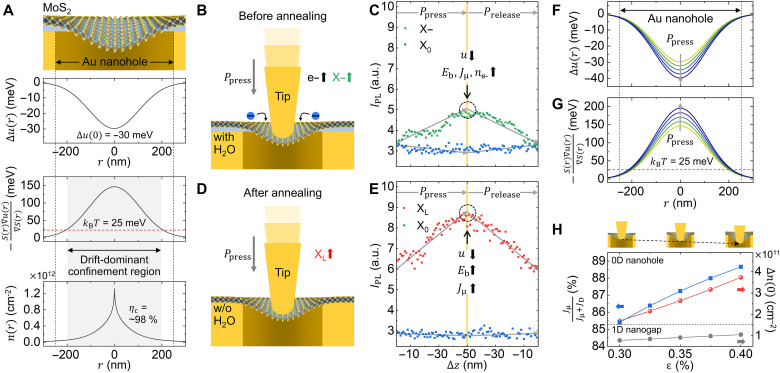 Figure 4
Peer Reviews
No public reviews on file for this paper yet. If you reviewed it on a platform where reviews are public (OpenReview, ICLR, NeurIPS, ICML), you can paste yours below so the community can read it here.
Videos
No videos yet. Explain this paper in a talk, walkthrough, or lecture? Add one.
Taxonomy
TopicsStrong Light-Matter Interactions · 2D Materials and Applications · Semiconductor Quantum Structures and Devices