Factors Influencing Clinical and Radiological Response in Perianal Disease: Results from a Real-World Cohort Treated with Anti-TNF Therapy
Clara Amiama Roig, Cristina Suárez-Ferrer, José Luis Rueda García, Laura García Ramírez, María Sánchez Azofra, Eduardo Martín-Arranz, Joaquín Poza Cordón, Jesús Noci, Carmen Amor Costa, Irene González Díaz, María Dolores Martín-Arranz

TL;DR
This study examines how patients with perianal Crohn's disease respond to anti-TNF therapy over time and identifies early response as a predictor of long-term success.
Contribution
The study provides real-world data on anti-TNF therapy outcomes for perianal Crohn's disease and identifies early clinical response as a predictor of long-term success.
Findings
84.6% of patients achieved a clinical response at week 24, with 90.7% maintaining it at week 52.
Absence of ANCA was an independent predictor of clinical response at week 52.
Early clinical response (week 24) was strongly associated with long-term outcomes.
Abstract
Background: Perianal Crohn’s disease (PD) remains a major therapeutic challenge, with heterogeneous responses to anti-TNF therapy and limited real-world data on predictors of long-term outcomes. This study aimed to evaluate clinical and radiological response to anti-TNF therapy initiated exclusively for PD and to identify factors associated with treatment response. Methods: A retrospective study was conducted in a cohort of 65 patients with PD treated with anti-TNF. The primary endpoint was clinical response assessed at weeks 24, 52, and 60 months. It was defined as a ≥50% reduction in drainage, and remission as complete absence of drainage. Radiological response was assessed by magnetic resonance imaging at the same time points whenever feasible. Multivariate logistic regression analyses were performed to identify independent predictors of response. Results: At week 24, 84.6% of…
Genes, proteins, chemicals, diseases, species, mutations and cell lines named across the full text — each resolved to its canonical identifier and authoritative record.
Click any figure to enlarge with its caption.
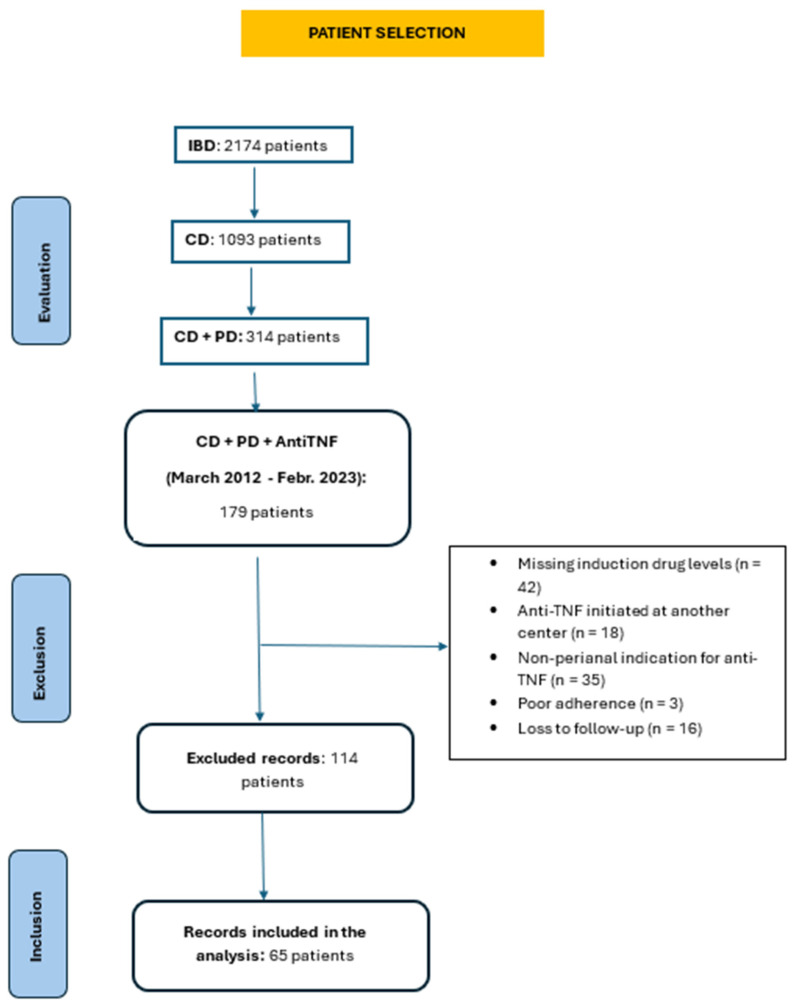 Figure 1
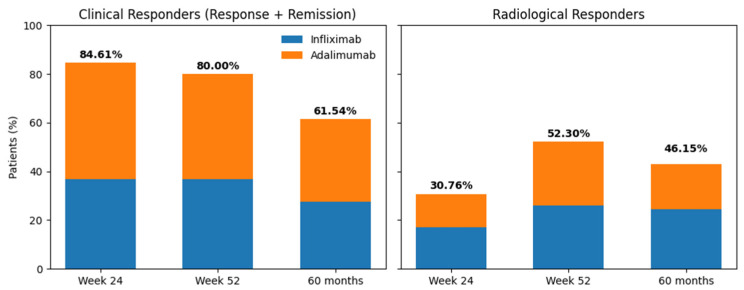 Figure 2
 Figure 3
Peer Reviews
No public reviews on file for this paper yet. If you reviewed it on a platform where reviews are public (OpenReview, ICLR, NeurIPS, ICML), you can paste yours below so the community can read it here.
Videos
No videos yet. Explain this paper in a talk, walkthrough, or lecture? Add one.
Taxonomy
TopicsAnorectal Disease Treatments and Outcomes · Inflammatory Bowel Disease · Hidradenitis Suppurativa and Treatments