Repetitive Transcranial Magnetic Stimulation for Spasticity in Stroke and Other Neuromotor Disorders: A Systematic Review of Randomized Clinical Trials
Michele Iacona, Rosario Ferlito, Rita Bella, Mariagiovanna Cantone, Raffaele Ferri, Francesco Fisicaro, Salvatore Giunta, Pietro Marano, Maria P. Mogavero, Vito Pavone, Manuela Pennisi, Gianluca Testa, Davide N. Tringali, Giuseppe Lanza

TL;DR
This review examines whether repetitive transcranial magnetic stimulation (rTMS) can safely and effectively reduce spasticity in stroke and other neuromotor disorders.
Contribution
The study provides a systematic review of RCTs evaluating rTMS for spasticity, comparing outcomes across neuromotor conditions.
Findings
rTMS significantly reduced spasticity compared to control interventions in most studies.
Benefits of rTMS generally lasted up to 12 weeks.
rTMS was found to be safe with no serious adverse events reported.
Abstract
Background: Spasticity is a common and disabling feature of several neuromotor disorders. Repetitive transcranial magnetic stimulation (rTMS) has been proposed as a non-invasive approach to modulate corticospinal excitability and reduce spasticity, although its clinical effectiveness remains debated. This systematic review evaluated the efficacy and safety of rTMS in reducing spasticity in stroke and other neuromotor conditions. Methods: A systematic search of PubMed, Scopus, and Cochrane Library was conducted up to June 2025 in accordance with PRISMA 2020 guidelines. Eligible studies were randomized controlled trials (RCTs) comparing rTMS with sham stimulation or conventional therapy and assessing spasticity using validated scales, primarily the Modified Ashworth Scale. Included populations comprised patients with stroke, spinal cord injury, multiple sclerosis, cerebral palsy, and…
Genes, proteins, chemicals, diseases, species, mutations and cell lines named across the full text — each resolved to its canonical identifier and authoritative record.
Click any figure to enlarge with its caption.
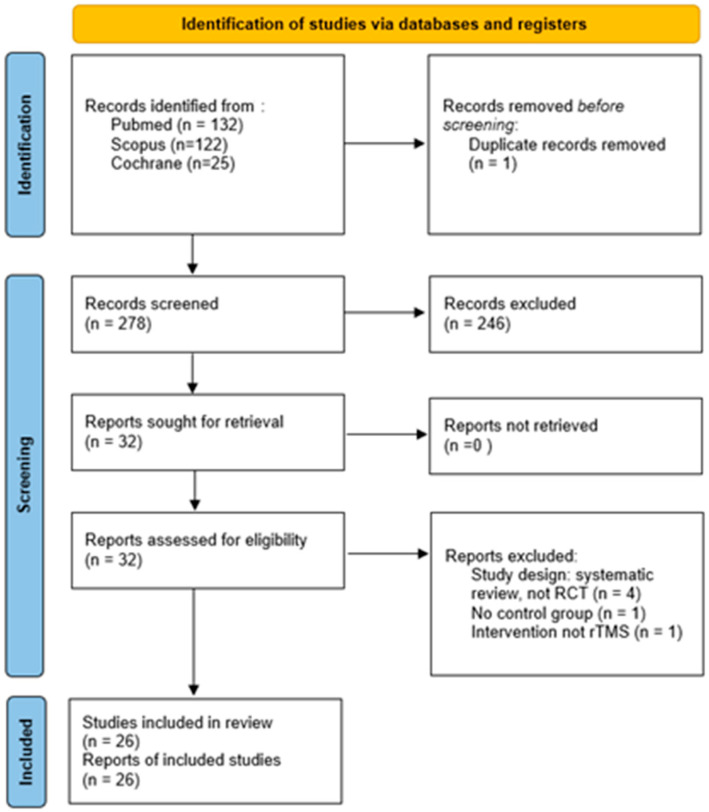 Figure 1
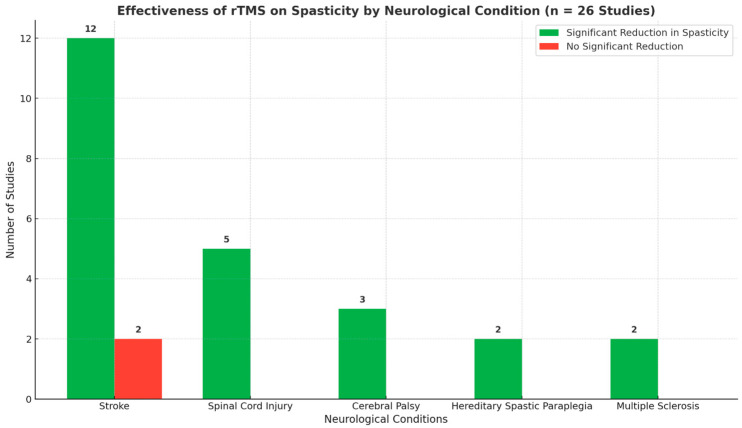 Figure 2
Peer Reviews
No public reviews on file for this paper yet. If you reviewed it on a platform where reviews are public (OpenReview, ICLR, NeurIPS, ICML), you can paste yours below so the community can read it here.
Videos
No videos yet. Explain this paper in a talk, walkthrough, or lecture? Add one.
Taxonomy
TopicsTranscranial Magnetic Stimulation Studies · Stroke Rehabilitation and Recovery · Spatial Neglect and Hemispheric Dysfunction