Galanin Receptors in the Central Nervous System: Exploring Ligand Interactions, Signal Transduction, and Potential Clinical Implications
Anna Owczarek, Kamilla Blecharz-Klin

TL;DR
This paper reviews how galanin receptors in the brain affect signaling pathways and could lead to new treatments for neurological disorders.
Contribution
The paper integrates current knowledge on galanin receptor ligand interactions and signaling to highlight their clinical potential in CNS disorders.
Findings
Galanin receptors (GalR1, GalR2, GalR3) mediate distinct signaling pathways like AC inhibition and calcium signaling.
Targeting galanin receptors shows preclinical promise for treating mood, pain, epilepsy, and neuroprotection.
Endogenous and exogenous ligands help elucidate receptor-specific functions and pharmacological opportunities.
Abstract
Galanin is a highly conserved neuropeptide widely expressed in the central nervous system (CNS), where it regulates neurotransmission, neuroplasticity, and neuroendocrine functions. Its effects are mediated through three G protein-coupled galanin receptor subtypes, GalR1, GalR2, and GalR3, each exhibiting distinct tissue distributions, ligand affinities, and intracellular signaling mechanisms. Endogenous ligands, including galanin, galanin-like peptide (GALP), and spexin, interact with these receptors to trigger receptor-specific pathways, such as adenylyl cyclase (AC) inhibition (GalR1/GalR3) and phospholipase C-mediated calcium signaling (GalR2), enabling modulation of neuronal excitability, neurotransmitter release, and cell survival. Exogenous ligands, including peptide analogs and non-peptide agonists, have further elucidated receptor function and highlighted opportunities for…
Genes, proteins, chemicals, diseases, species, mutations and cell lines named across the full text — each resolved to its canonical identifier and authoritative record.
Click any figure to enlarge with its caption.
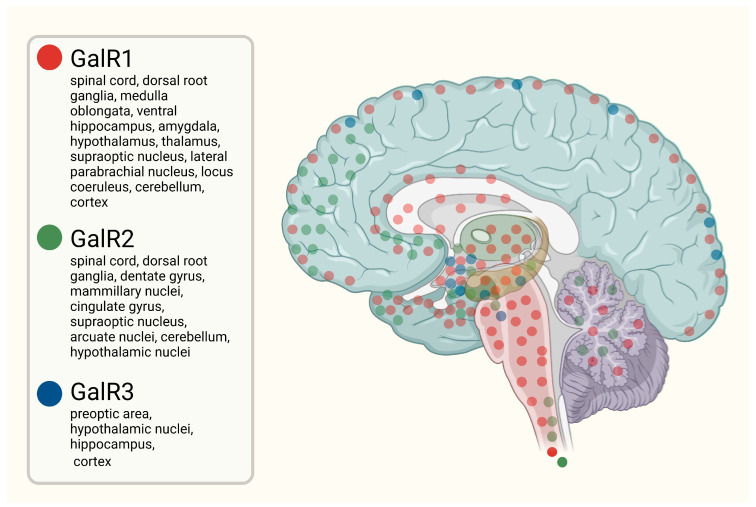 Figure 1
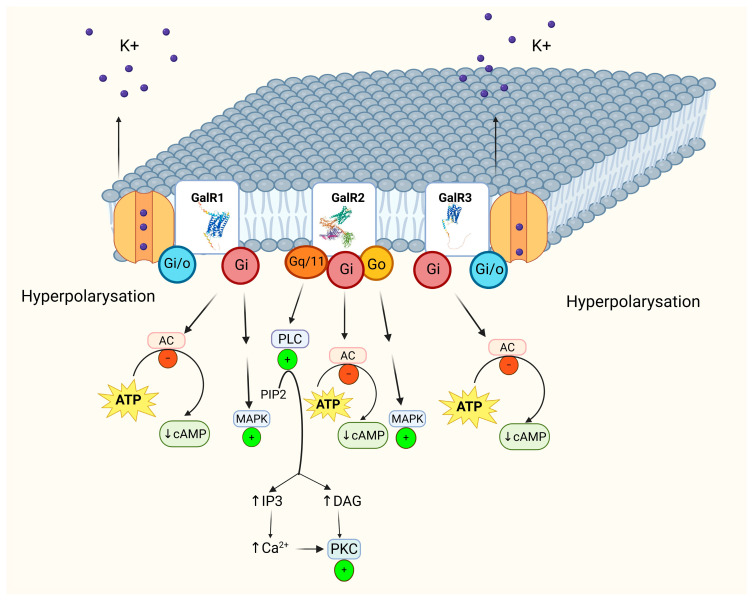 Figure 2
 Figure 3
Peer Reviews
No public reviews on file for this paper yet. If you reviewed it on a platform where reviews are public (OpenReview, ICLR, NeurIPS, ICML), you can paste yours below so the community can read it here.
Videos
No videos yet. Explain this paper in a talk, walkthrough, or lecture? Add one.
Taxonomy
TopicsNeuropeptides and Animal Physiology · Cell Adhesion Molecules Research · Supramolecular Self-Assembly in Materials