Leptin Receptor b (LEPRb) Mutations Disrupt Hypothalamic Control of the Reproductive Axis
Athanasios Zikopoulos, Efthalia Moustakli, Periklis Katopodis, Vasilis Sebastian Paraschos, Anastasios Potiris, Ismini Anagnostaki, Aikaterini Lydia Vogiatzoglou, Konstantinos Zacharis, Theodoros Karampitsakos, Konstantinos Zikopoulos, Sofoklis Stavros

TL;DR
LEPRb mutations disrupt the brain's control of reproduction by impairing leptin signaling, leading to infertility and potential insights into obesity-related reproductive issues.
Contribution
This review highlights the role of LEPRb mutations in reproductive dysfunction and explores emerging therapies like kisspeptin-based treatments.
Findings
LEPRb mutations impair JAK2/STAT3, PI3K, and MAPK pathways, causing central leptin resistance.
Disrupted hypothalamic circuitry upstream of GnRH neurons leads to hypogonadotropic hypogonadism.
Kisspeptin-mediated signaling plays a central role in leptin-dependent reproductive regulation.
Abstract
Adipocytes produce the hormone leptin, a hormone that links energy availability to reproductive function by permitting activation of the hypothalamic–pituitary–gonadal (HPG) axis. Loss-of-function mutations in the long leptin receptor isoform (LEPRb) disrupt intracellular signaling pathways, including the Janus kinase 2 (JAK2)/signal transducer and activator of transcription 3 (STAT3), phosphoinositide 3-kinase (PI3K), and mitogen-activated protein kinase (MAPK) pathways, resulting in central leptin resistance and impaired neuroendocrine control of reproduction. Evidence from human monogenic obesity syndromes, animal models, and neuroendocrine studies indicates that LEPRb mutations disrupt hypothalamic circuitry upstream of gonadotropin-releasing hormone (GnRH) neurons, impairing GnRH pulsatility and leading to hypogonadotropic hypogonadism (HH) and infertility. This review synthesizes…
Genes, proteins, chemicals, diseases, species, mutations and cell lines named across the full text — each resolved to its canonical identifier and authoritative record.
Click any figure to enlarge with its caption.
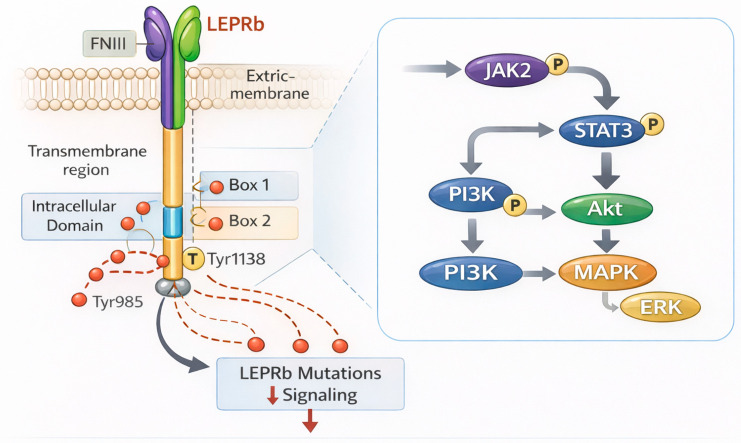 Figure 1
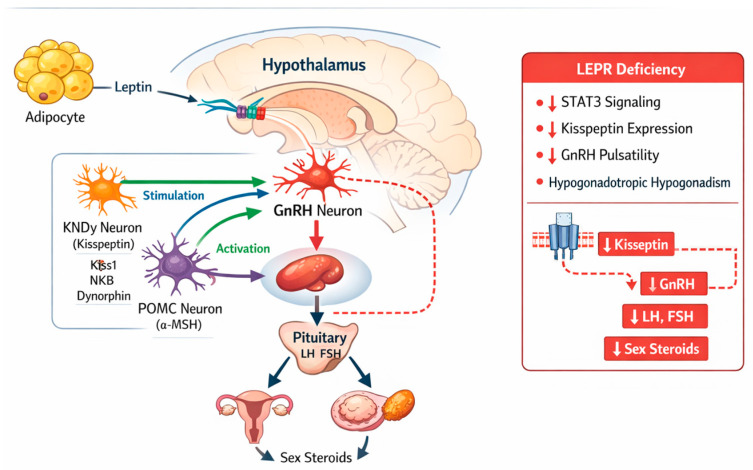 Figure 2
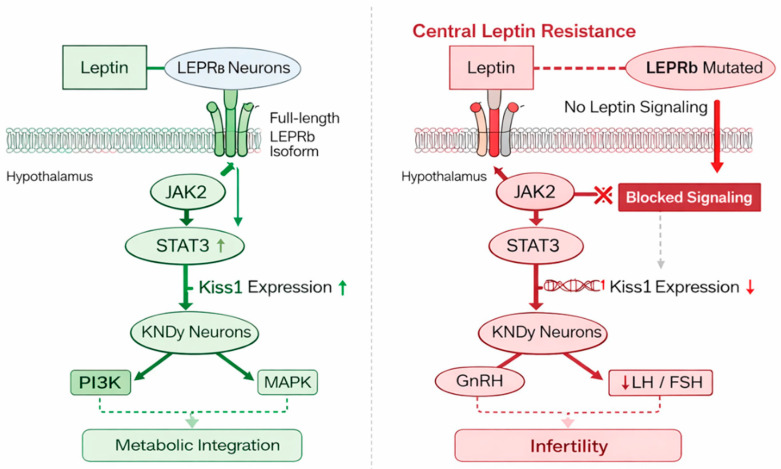 Figure 3
Peer Reviews
No public reviews on file for this paper yet. If you reviewed it on a platform where reviews are public (OpenReview, ICLR, NeurIPS, ICML), you can paste yours below so the community can read it here.
Videos
No videos yet. Explain this paper in a talk, walkthrough, or lecture? Add one.
Taxonomy
TopicsHypothalamic control of reproductive hormones · Regulation of Appetite and Obesity · Neuropeptides and Animal Physiology